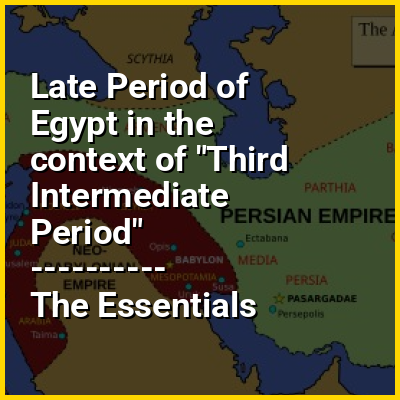
The Late Period of Egypt refers to the last flowering of native Egyptian rulers after the Third Intermediate Period in the 26th Saite Dynasty founded by Psamtik I, but includes the time of Achaemenid rule over Egypt after the conquest by Cambyses II in 525 BC as well. The Late Period existed from 664 BC until 332 BC, following a period of foreign rule by the Nubian 25th Dynasty and beginning with a short period of Neo-Assyrian suzerainty, with Psamtik I initially ruling as their vassal. The period ended with the conquests of the Achaemenid Empire by Alexander the Great and establishment of the Ptolemaic dynasty by his general Ptolemy I Soter, one of the Hellenistic diadochi from Macedon in northern Greece. With the Macedonian Greek conquest in the latter half of the 4th century BC, the age of Hellenistic Egypt began.
>>>PUT SHARE BUTTONS HERE<<<
Late Period of Egypt in the context of Ancient Egyptian
Ancient Egypt was a cradle of civilization concentrated along the lower reaches of the Nile River in Northeast Africa. It emerged from prehistoric Egypt around 3150 BC (according to conventional Egyptian chronology), when Upper and Lower Egypt were amalgamated by Menes, who is believed by the majority of Egyptologists to have been the same person as Narmer. The history of ancient Egypt unfolded as a series of stable kingdoms interspersed by the "Intermediate Periods" of relative instability. These stable kingdoms existed in one of three periods: the Old Kingdom of the Early Bronze Age; the Middle Kingdom of the Middle Bronze Age; or the New Kingdom of the Late Bronze Age.
The pinnacle of ancient Egyptian power was achieved during the New Kingdom, which extended its rule to much of Nubia and a considerable portion of the Levant. After this period, Egypt entered an era of slow decline. Over the course of its history, it was invaded or conquered by a number of foreign civilizations, including the Hyksos, the Kushites, the Assyrians, the Persians, and the Greeks and then the Romans. The end of ancient Egypt is variously defined as occurring with the end of the Late Period during the Wars of Alexander the Great in 332 BC or with the end of the Greek-ruled Ptolemaic Kingdom during the Roman conquest of Egypt in 30 BC. In AD 642, the Arab conquest of Egypt brought an end to the region's millennium-long Greco-Roman period.