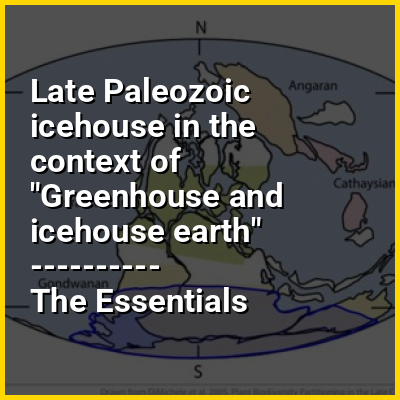
The late Paleozoic icehouse, also known as the Late Paleozoic Ice Age (LPIA) and formerly known as the Karoo ice age, was an ice age that began in the Late Devonian and ended in the Late Permian, occurring from 360 to 255 million years ago (Mya), and large land-based ice sheets were then present on Earth's surface. It was the second major icehouse period of the Phanerozoic, after the Late Ordovician Andean-Saharan glaciation.
>>>PUT SHARE BUTTONS HERE<<<
In this Dossier
Late Paleozoic icehouse in the context of Greenhouse and icehouse Earth
Throughout Earth's climate history (Paleoclimate) its climate has fluctuated between two primary states: greenhouse and icehouse Earth. Both climate states last for millions of years and should not be confused with the much smaller glacial and interglacial periods, which occur as alternating phases within an icehouse period (known as an ice age) and tend to last less than one million years. There are five known icehouse periods in Earth's climate history, namely the Huronian, Cryogenian, Andean-Saharan (also known as Early Paleozoic), Late Paleozoic and Late Cenozoic glaciations.
The main factors involved in changes of the paleoclimate are believed to be the concentration of atmospheric greenhouse gases such as carbon dioxide (CO2) and less importantly methane (CH4), changes in Earth's orbit, long-term changes in the solar constant, and oceanic and orogenic changes from tectonic plate dynamics. Greenhouse and icehouse periods have played key roles in the evolution of life on Earth by directly and indirectly forcing biotic adaptation and turnover at various spatial scales across time.