Languages of the United States in the context of "Demographics of the United States"

Play Trivia Questions online!

or

Skip to study material about Languages of the United States in the context of "Demographics of the United States"


⭐ Core Definition: Languages of the United States

The most commonly used language in the United States is English (specifically American English), which is the national language. While the U.S. Congress has never passed a law to make English the country's official language, a March 2025 executive order declared it to be. In addition, 32 U.S. states out of 50 and all five U.S. territories have laws that recognize English as an official language, with three states and most territories having adopted English plus one or more other official languages. Overall, 430 languages are spoken or signed by the population, of which 177 are indigenous to the U.S. or its territories, and accommodations for non-English-language speakers are sometimes made under various federal, state, and local laws.

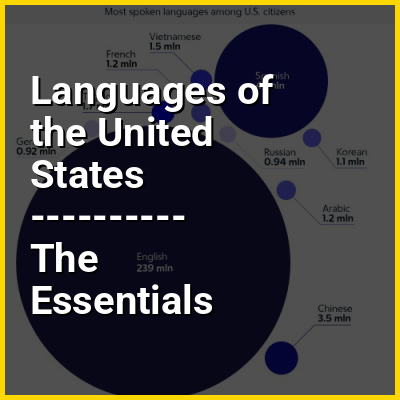
The majority of the U.S. population (77%) speaks only English at home as of 2024, according to the American Community Survey (ACS) of the U.S. Census Bureau. The second most common language by far is Spanish, spoken by 13.9% of the population, followed by Chinese, spoken by around 1% of the population. Other languages spoken by over a million residents are Tagalog, Vietnamese, Arabic, French, Korean, and Russian. Only 8.4% of U.S. residents report that they speak English less than "very well".
↓ Menu

In this Dossier

Languages of the United States in the context of American English

American English, sometimes called United States English or U.S. English, is the set of varieties of the English language native to the United States. English is the most widely spoken language in the U.S. and is an official language in 32 of the 50 U.S. states. It is the de facto common language used in government, education, and commerce in all 50 states, the District of Columbia, and in all territories except Puerto Rico. De jure, there is no official language in the U.S. at the federal level, as there is no federal law designating any language to be official. However, Executive Order 14224 of 2025 declared English to be the official language of the U.S., and English is recognized as such by federal agencies. Since the late 20th century, American English has become the most influential form of English worldwide.

Varieties of American English include many patterns of pronunciation, vocabulary, grammar, and particularly spelling that are unified nationwide but distinct from other forms of English around the world. Any American or Canadian accent perceived as lacking noticeably local, ethnic, or cultural markers is known in linguistics as General American; it covers a fairly uniform accent continuum native to certain regions of the U.S. but especially associated with broadcast mass media and highly educated speech. However, historical and present linguistic evidence does not support the notion of there being one single mainstream American accent. The sound of American English continues to evolve, with some local accents disappearing, but several larger regional accents having emerged in the 20th century.

↑ Return to Menu

Languages of the United States in the context of Cultural policy of the United States

Most cultural policy in the United States is enacted at the local and state level, though federal programs also exist to carry out cultural policy. These promote the culture of the United States, including visual art, performing arts, heritage, language, museums, libraries, and sports.

↑ Return to Menu

Languages of the United States in the context of Culture of the United States

The culture of the United States encompasses various social behaviors, institutions, and norms, including forms of speech, literature, music, visual arts, performing arts, food, sports, religion, law, technology, as well as other customs, beliefs, and forms of knowledge. American culture has been shaped by the history of the United States, its geography, and various internal and external forces and migrations.

America's foundations were initially Western-based, and primarily English-influenced, but also with prominent French, German, Greek, Irish, Italian, Scottish, Welsh, Jewish, Polish, Scandinavian, Spanish and Portuguese regional influences. However, non-Western influences, including African and Indigenous cultures, and more recently, Asian cultures, have firmly established themselves in the fabric of American culture as well. Since the United States was established in 1776, its culture has been influenced by successive waves of immigrants, and the resulting "melting pot" of cultures has been a distinguishing feature of its society. Americans pioneered or made great strides in musical genres such as heavy metal, rhythm and blues, jazz, gospel, country, hip hop, and rock 'n' roll. The "big four sports" are American football, baseball, basketball, and ice hockey. In terms of religion, the majority of Americans are Protestant or Catholic, with a growing irreligious population. American cuisine includes popular tastes such as hot dogs, milkshakes, and barbecue, as well as many other class and regional preferences. The most commonly used language is English; while no law designates it official, a 2025 executive order declares English the official language. Distinct cultural regions include New England, Mid-Atlantic, the South, Midwest, Southwest, Mountain West, and Pacific Northwest.

↑ Return to Menu

Languages of the United States in the context of Chinese language in the United States

Chinese, including Mandarin and Cantonese among other varieties, is the third most-spoken language in the United States, and is mostly spoken within Chinese-American populations and by immigrants or the descendants of immigrants, especially in California and New York. Around 2004, over 2 million Americans spoke varieties of Chinese, with Mandarin becoming increasingly common due to immigration from mainland China and to some extent Taiwan. Within this category, approximately one third of respondents described themselves as speaking Cantonese or Mandarin specifically, with the other two thirds answering "Chinese", despite the lack of mutual intelligibility between different varieties of Chinese. This phenomenon makes it more difficult to readily identify the relative prevalence of any single Chinese language in the United States.

According to data reported on the 2000 US census long-form, 259,750 people spoke "Cantonese", with 58.62% percent residing in California and the next most with 16.19% in New York. The actual number of Cantonese speakers was probably higher. In the 1982–83 school year, 29,908 students in California were reported to be using Cantonese as their primary home language. Approximately 16,000 of these students were identified as limited English proficient (LEP).

↑ Return to Menu

Languages of the United States in the context of Discrimination in the United States

Discrimination comprises "base or the basis of class or category without regard to individual merit, especially to show prejudice on the basis of ethnicity, gender, or a similar social factor". This term is used to highlight the difference in treatment between members of different groups when one group is intentionally singled out and treated worse, or not given the same opportunities. Attitudes toward minorities have been marked by discrimination in the history of the United States. Many forms of discrimination have come to be recognized in American society, particularly on the basis of national origin, race and ethnicity, non-English languages, religion, gender, and sexual orientation.

↑ Return to Menu