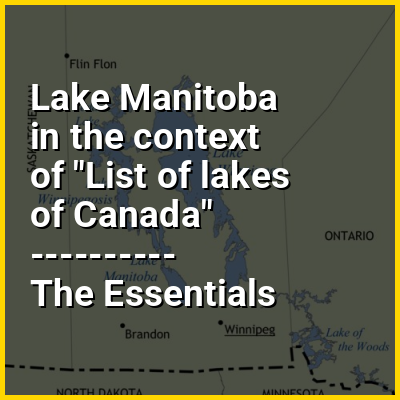
Lake Manitoba (French: Lac Manitoba) is the 14th largest lake in Canada and the 31st largest lake in the world with a total area of 4,624 square kilometres (1,785 sq mi). It is located within the Canadian province of Manitoba about 75 kilometres (47 mi) northwest of the province's capital, Winnipeg, at 50°59′N 98°48′W / 50.983°N 98.800°W.
HINT:
In this Dossier
Lake Manitoba in the context of Lake Agassiz
Lake Agassiz (/ˈæɡəsi/ AG-ə-see) was a large proglacial lake that existed in central North America during the late Pleistocene, fed by meltwater from the retreating Laurentide Ice Sheet at the end of the last glacial period. At its peak, the lake's area was larger than all of the modern Great Lakes combined. It eventually drained into what is now Hudson Bay, leaving behind Lake Winnipeg, Lake Winnipegosis, Lake Manitoba, and Lake of the Woods.
First postulated in 1823 by William H. Keating, it was named by Warren Upham in 1879 after Louis Agassiz, the then recently deceased (1873) founder of glaciology, when Upham recognized that the lake was formed by glacial action.
View the full Wikipedia page for Lake Agassiz