Labia minora in the context of "Female reproductive system"

Play Trivia Questions online!

or

Skip to study material about Labia minora in the context of "Female reproductive system"

Ad spacer

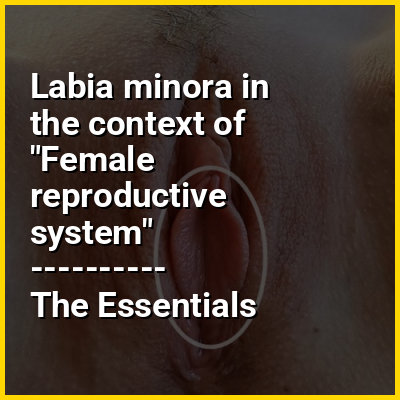
⭐ Core Definition: Labia minora

The labia minora (Latin for 'smaller lips', sg.: labium minus), also known as the inner labia, inner lips, or nymphae, are two flaps of skin that are part of the primate vulva, extending outwards from the inner vaginal and urethral openings to encompass the vestibule. At the glans clitoridis, each labium splits, above forming the clitoral hood, and below the frenulum of the clitoris. At the bottom, the labia meet at the labial commissure. The labia minora vary widely in size, color and shape from individual to individual.

The labia minora are situated between the labia majora and together form the labia. The labia minora are homologous to the penile raphe and ventral penile skin in males.
↓ Menu

>>>PUT SHARE BUTTONS HERE<<<
In this Dossier

Labia minora in the context of Female reproductive tract

The human female reproductive system is made up of the internal and external sex organs that function in the reproduction of new offspring. The reproductive system is immature at birth and develops at puberty to be able to release matured ova from the ovaries, facilitate their fertilization, and create a protective environment for the developing fetus during pregnancy. The female reproductive tract is made of several connected internal sex organs—the vagina, uterus, and fallopian tubes—and is prone to infections. The vagina allows for sexual intercourse and childbirth, and is connected to the uterus at the cervix. The uterus (or womb) accommodates the embryo by developing the uterine lining.

The uterus also produces secretions which help the transit of sperm to the fallopian tubes, where sperm fertilize the ova. During the menstrual cycle, the ovaries release an ovum, which transits through the fallopian tube into the uterus. If an egg cell meets with sperm on its way to the uterus, a single sperm cell can enter and merge with it, creating a zygote. If no fertilization occurs, menstruation is the process by which the uterine lining is shed as blood, mucus, and tissue.

↑ Return to Menu

Labia minora in the context of Vulva

In mammals, the vulva (pl.: vulvas or vulvae) comprises mostly external, visible structures of the female genitalia leading into the interior of the female reproductive tract. For humans, it includes the mons pubis, labia majora, labia minora, clitoris, vestibule, urinary meatus, vaginal introitus, hymen, and openings of the vestibular glands (Bartholin's and Skene's). The folds of the outer and inner labia provide a double layer of protection for the vagina (which leads to the uterus). While the vagina is a separate part of the anatomy, colloquially the term has often been used synonymously with vulva. Pelvic floor muscles support the structures of the vulva. Other muscles of the urogenital triangle also give support.

Blood supply to the vulva comes from the three pudendal arteries. The internal pudendal veins give drainage. Afferent lymph vessels carry lymph away from the vulva to the inguinal lymph nodes. The nerves that supply the vulva are the pudendal nerve, perineal nerve, ilioinguinal nerve and their branches. Blood and nerve supply to the vulva contribute to the stages of sexual arousal that are helpful in the reproduction process.

↑ Return to Menu

Labia minora in the context of Female genital mutilation

Female genital mutilation (FGM) (also known as female genital cutting, female genital mutilation/cutting (FGM/C) and female circumcision) is the cutting or removal of some or all of the vulva for non-medical reasons. FGM prevalence varies worldwide, but is significantly present in some countries of Africa, Asia and Middle East, and within their diasporas. As of 2024, UNICEF estimates that worldwide 230 million girls and women (144 million in Africa, 80 million in Asia, 6 million in Middle East, and 1-2 million in other parts of the world) had been subjected to one or more types of FGM.

Typically carried out by a traditional cutter using a blade, FGM is conducted from days after birth to puberty and beyond. In half of the countries for which national statistics are available, most girls are cut before the age of five. Procedures differ according to the country or ethnic group. They include removal of the clitoral hood (type 1-a) and clitoral glans (1-b); removal of the inner labia (2-a); and removal of the inner and outer labia and closure of the vulva (type 3). In this last procedure, known as infibulation, a small hole is left for the passage of urine and menstrual fluid, the vagina is opened for intercourse and opened further for childbirth. FGM is commonly performed without any form of anesthesia or analgesia and with non-medical equipment such as razor blades.

↑ Return to Menu

Labia minora in the context of Erectile tissue

Erectile tissue is tissue in the body with numerous vascular spaces, or cavernous tissue, that may become engorged with blood. However, tissue that is devoid of or otherwise lacking erectile tissue (such as the labia minora, vestibule, vagina and urethra) may also be described as engorging with blood, often with regard to sexual arousal.

↑ Return to Menu

Labia minora in the context of Vulval vestibule

The vulval vestibule (also known as the vulvar vestibule or vestibule of vagina) is the part of the vulva between the labia minora. At the innermost part are the vaginal introitus and urinary meatus. The Bartholin's and Skene's glands each have two openings to the vestibule on the inside. The outer edge, marked by a coloration difference in the tissues, is called Hart's line, named after David Berry Hart.

The vestibule represents the distal end of the urogenital sinus of the embryo.

↑ Return to Menu

Labia minora in the context of Labia majora

In primates, and specifically in humans, the labia majora (sg.: labium majus), also known as the outer lips or outer labia, are two prominent longitudinal skin folds that extend downward and backward from the mons pubis to the perineum. Together with the labia minora, they form the labia of the vulva.

The labia majora are homologous to the male scrotum.

↑ Return to Menu

Labia minora in the context of Labia

The labia are the major externally visible structures of the vulva. In humans and other primates, there are two pairs of labia: the labia majora (outer lips) are large and thick folds of skin that cover the vulva's other parts, while the labia minora (inner lips) are the folds of skin between the outer labia that surround and protect the urethral and vaginal openings, as well as the glans clitoridis.

In other mammals, the labia majora are not present and the labia minora are instead referred to as the labia vulvae.

↑ Return to Menu