L-Glucose in the context of Aldohexose


L-Glucose in the context of Aldohexose

⭐ Core Definition: L-Glucose

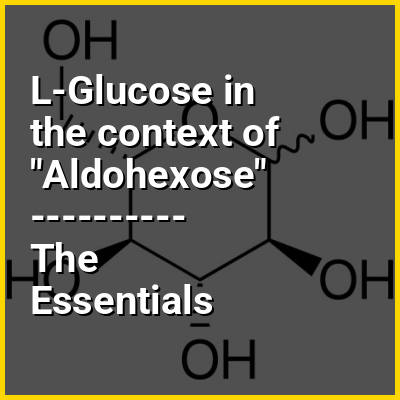
l-Glucose is an organic compound with formula C6H12O6 or O=CH[CH(OH)]5H, specifically one of the aldohexose monosaccharides. As the l-isomer of glucose, it is the enantiomer of the more common d-glucose.

l-Glucose does not occur naturally in living organisms, but can be synthesized in the laboratory. l-Glucose is indistinguishable in taste from d-glucose, but cannot be used by living organisms as a source of energy because it cannot be phosphorylated by hexokinase, the first enzyme in the glycolysis pathway. One of the known exceptions is in Trinickia caryophylli, a plant pathogenic bacterium, which contains the enzyme d-threo-aldose 1-dehydrogenase which is capable of oxidizing l-glucose.
↓ Menu
HINT:

In this Dossier

L-Glucose in the context of Open-chain compound

In chemistry, an open-chain compound (or open chain compound) or acyclic compound (Greek prefix α 'without' and κύκλος 'cycle') is a compound with a linear structure, rather than a cyclic one.An open-chain compound having no side groups is called a straight-chain compound (also spelled as straight chain compound). Many of the simple molecules of organic chemistry, such as the alkanes and alkenes, have both linear and ring isomers, that is, both acyclic and cyclic. For those with 4 or more carbons, the linear forms can have straight-chain or branched-chain isomers. The lowercase prefix n- denotes the straight-chain isomer; for example, n-butane is straight-chain butane, whereas i-butane is isobutane. Cycloalkanes are isomers of alkenes, not of alkanes, because the ring's closure involves a C-C bond. Having no rings (aromatic or otherwise), all open-chain compounds are aliphatic.

Typically in biochemistry, some isomers are more prevalent than others. For example, in living organisms, the open-chain isomer of glucose usually exists only transiently, in small amounts; D-glucose is the usual isomer; and L-glucose is rare.

View the full Wikipedia page for Open-chain compound
↑ Return to Menu

L-Glucose in the context of Haworth projection

In chemistry, a Haworth projection is a common way of writing a structural formula to represent the cyclic structure of monosaccharides with a simple three-dimensional perspective. A Haworth projection approximates the shapes of the actual molecules better for furanoses—which are in reality nearly planar—than for pyranoses that exist in solution in the chair conformation. Organic chemistry and especially biochemistry are the areas of chemistry that use the Haworth projection the most.

The Haworth projection was named after the British chemist Sir Norman Haworth.

View the full Wikipedia page for Haworth projection
↑ Return to Menu