Kwara State in the context of "States of Nigeria"

Play Trivia Questions online!

or

Skip to study material about Kwara State in the context of "States of Nigeria"

Ad spacer

⭐ Core Definition: Kwara State

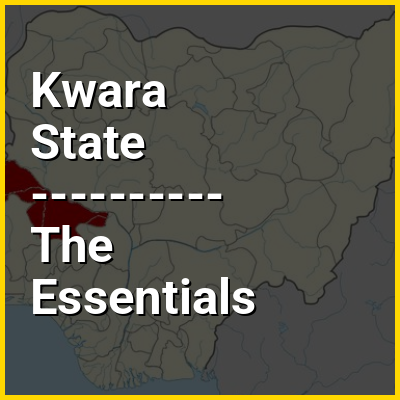
Kwara (Yoruba: Ìpínlẹ̀ Kwárà) is a state in Western Nigeria, bordered to the east by Kogi State, to the north by Niger State, and to the south by Ekiti, Osun, and Oyo states, while its western border makes up part of the international border with Benin. Its capital is the city of Ilorin and the state has 16 local government areas.

Of the 36 states of Nigeria, Kwara is the ninth largest in area but the sixth least populous with an estimated population of about 3.2 million as of 2016. Geographically, Kwara is split between the West Sudanian savanna in the east and the Guinean forest–savanna mosaic ecoregion in the rest of the state. Important geographic features include rivers with the Niger flowing along the northern border into Lake Jeba before continuing as the border while the Awun, Asa, Aluko, and Oyun rivers flow through the interior. In the far northwest of the state is the Borgu section of the Kainji National Park, a large national park that contains populations of grey heron, kob, hippopotamus, African bush elephant, olive baboon, and roan antelope, along with some of the last remaining West African lions on earth. In the far southwest, a small part of the Old Oyo National Park contains crowned eagle, martial eagle, African buffalo, oribi, and patas monkey populations.
↓ Menu

>>>PUT SHARE BUTTONS HERE<<<
In this Dossier

Kwara State in the context of Northern Nigeria

Northern Nigeria (or Arewancin Nijeriya) was an autonomous division within Nigeria, distinctly different from the southern part of the country, with independent customs, foreign relations and security structures. In 1962, it acquired the territory of the British Northern Cameroons, which voted to become a province within Northern Nigeria.

In 1967, Northern Nigeria was divided into the North-Eastern State, North-Western State, Kano State, Kaduna State, Kwara State, and the Benue-Plateau State, each with its own Governor.

↑ Return to Menu

Kwara State in the context of Federal Capital Territory, Nigeria

The Federal Capital Territory (FCT) is a federal territory in central Nigeria. Abuja, the capital city of Nigeria, is located in this territory. The FCT was formed in 1976 from parts of the states of old Kaduna, Kwara, Niger, and Plateau states, with the bulk of land mass carved out of Niger state. The Federal Capital Territory is within the North Central region of the country. Unlike other states of Nigeria, which are headed by elected Governors, it is administered by the Federal Capital Territory Administration, headed by a minister, who is appointed by the president.

↑ Return to Menu

Kwara State in the context of Yoruba religion


The Yorùbá religion (Yoruba: Ìṣẹ̀ṣe [ìʃɛ̀ʃē]), West African Orisa (Òrìṣà [òɾìʃà]), or Isese (Ìṣẹ̀ṣe), comprises the traditional religious and spiritual concepts and practice of the Yoruba people. Its homeland is in present-day Southwestern Nigeria and Southern Benin, which comprises the majority of the states of; Oyo, Ogun, Osun, Ondo, Ekiti, Kwara, Lagos and parts of Kogi in Nigeria, the Departments of; Collines, Oueme, Plateau in Benin, and the adjoining parts of central Togo, commonly known as Yorubaland (Yoruba: Ilẹ̀ Káàárọ̀-Oòjíire). It has become the largest indigenous African tradition / belief system in the world with several million adherents worldwide.

It shares some parallels with the Vodun practised by the neighbouring Fon and Ewe peoples to its west and with the religion of the Edo people to its east. Yorùbá religion is the basis for several religions in the New World, notably Santería, Umbanda, Trinidad Orisha, and Candomblé. Yorùbá religious beliefs are part of Ìtàn (history), the total complex of songs, histories, stories, and other cultural concepts which make up the Yorùbá society.

↑ Return to Menu

Kwara State in the context of Niger State

Niger State is a state in the North Central region of Nigeria, bordered to the east by Kaduna State and the Federal Capital Territory, to the north by Kebbi State and Zamfara State, and to the south by Kogi and Kwara states, while its western border makes up part of the international border with Benin. It is the largest state in the country by area. The state capital is Minna, and the state is divided into 25 local government areas. Other major cities include Bida, Kontagora, and Suleja.

Of the 36 states of Nigeria, Niger is the eleventh most populous with an estimated population of about 6.7 million as of 2020. Geographically, the state is split between the West Sudanian savanna in the east and the Guinean forest–savanna mosaic ecoregion in the rest of the state. The Kainji Lake as well as the Niger and Kaduna rivers are the state's major water bodies, with the River Niger flowing through from Kainji Lake through the western part of the state and forming the border with Kwara State. Niger State is also home to the Kainji, Jebba, and Shiroro Dams, which are major sources of hydroelectric power. Also situated there is Kainji National Park, the largest National Park in Nigeria, which contains Kainji Lake, the Borgu Game Reserve and the Zugurma Game Reserve.

↑ Return to Menu

Kwara State in the context of North Central (Nigeria)

The North Central (often hyphenated to the North-Central) is one of the six geopolitical zones of Nigeria representing the majority of the country's Middle Belt. It comprises six statesBenue, Kogi, Kwara, Nasarawa, Niger, and Plateau — in addition to the Federal Capital Territory.

The North Central stretches across the whole width of the country, from the border with Cameroon to that with Benin. In terms of the environment, the zone is dominated by the Guinean forest–savanna mosaic, with the western portion falling into the West Sudanian savanna ecoregion. Plateau State is also named for the Jos Plateau, which lies in the east-central portion of the zone.

↑ Return to Menu

Kwara State in the context of Law of Nigeria

The Law of Nigeria consists of courts, offences, and various types of laws. Nigeria has its own constitution which was established on 29 May 1999. The Constitution of Nigeria is the supreme law of the country. There are four distinct legal systems in Nigeria, which include English law, Common law, Customary law, and Sharia Law. English law in Nigeria is derived from the colonial Nigeria, while common law is a development from its post-colonial independence.

Customary law is derived from indigenous traditional norms and cultural practices, including the dispute resolution meetings of pre-colonial Yoruba land secret societies and the Èkpè and Okónkò of Igboland and Ibibioland. Sharia Law (also known as Islamic Law) used to be used only in Northern Nigeria, where Islam is the predominant religion. It is also being used in Lagos State, Oyo State, Kwara State, Ogun State, and Osun State by Muslims. The country has a judicial branch, the highest court of which is the Supreme Court of Nigeria.

↑ Return to Menu