Nazi Germany undertook several research programs relating to nuclear technology, including nuclear weapons and nuclear reactors, before and during World War II. These were variously called Uranverein (Uranium Society) or Uranprojekt (Uranium Project). The first effort started in April 1939, just months after the discovery of nuclear fission in Berlin in December 1938, but ended shortly ahead of the September 1939 German invasion of Poland, for which many German physicists were drafted into the Wehrmacht. A second effort under the administrative purview of the Wehrmacht's Heereswaffenamt began on September 1, 1939, the day of the invasion of Poland. The program eventually expanded into three main efforts: Uranmaschine (nuclear reactor) development, uranium and heavy water production, and uranium isotope separation. Eventually, the German military determined that nuclear fission would not contribute significantly to the war, and in January 1942 the Heereswaffenamt turned the program over to the Reich Research Council (Reichsforschungsrat) while continuing to fund the activity.
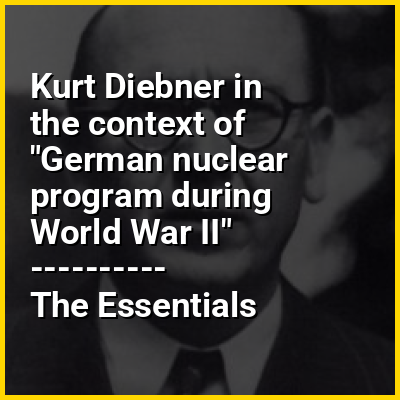
The program was split up among nine major institutes where the directors dominated research and set their own objectives. Subsequently, the number of scientists working on applied nuclear fission began to diminish as many researchers applied their talents to more pressing wartime demands. The most influential people in the Uranverein included Kurt Diebner, Abraham Esau, Walther Gerlach, and Erich Schumann. Schumann was one of the most powerful and influential physicists in Germany. Diebner, throughout the life of the nuclear weapon project, had more control over nuclear fission research than did Walther Bothe, Klaus Clusius, Otto Hahn, Paul Harteck, or Werner Heisenberg. Esau was appointed as Reichsmarschall Hermann Göring's plenipotentiary for nuclear physics research in December 1942, and was succeeded by Walther Gerlach after he resigned in December 1943.