Kula ring in the context of "Marcel Mauss"

Play Trivia Questions online!

or

Skip to study material about Kula ring in the context of "Marcel Mauss"

Ad spacer

⭐ Core Definition: Kula ring

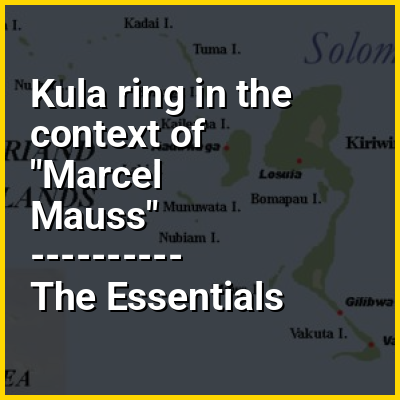
Kula, also known as the Kula exchange or Kula ring, is a ceremonial exchange system conducted in the Milne Bay Province of Papua New Guinea. The Kula ring was made famous by Bronisław Malinowski, considered the father of modern anthropology. He used this test case to argue for the universality of rational decision-making and for the cultural nature of the object of their effort. Malinowski's seminal work on the topic, Argonauts of the Western Pacific (1922), directly confronted the question, "Why would men risk life and limb to travel across huge expanses of dangerous ocean to give away what appear to be worthless trinkets?" Malinowski carefully traced the network of exchanges of bracelets and necklaces across the Trobriand Islands, and established that they were part of a system of exchange (the Kula ring), and that this exchange system was clearly linked to political authority.

Malinowski's study became the subject of debate with the French anthropologist, Marcel Mauss, author of The Gift ("Essai sur le don", 1925). Since then, the Kula ring has been central to the continuing anthropological debate on the nature of gift-giving, and the existence of gift economies.
↓ Menu

>>>PUT SHARE BUTTONS HERE<<<
In this Dossier

Kula ring in the context of Gift economy

A gift economy or gift culture is a system of exchange where valuables are not sold, but rather given without an explicit agreement for immediate or future rewards. Social norms and customs govern giving a gift in a gift culture; although there is some expectation of reciprocity, gifts are not given in an explicit exchange of goods or services for money, or some other good or service. This contrasts with a market economy or bartering, where goods and services are primarily explicitly exchanged for value received.

The nature of gift economies is the subject of a foundational debate in anthropology. Anthropological research into gift economies began with Bronisław Malinowski's description of the Kula ring in the Trobriand Islands during World War I. The Kula trade appeared to be gift-like since Trobrianders would travel great distances over dangerous seas to give what were considered valuable objects without any guarantee of a return. Malinowski's debate with the French anthropologist Marcel Mauss quickly established the complexity of "gift exchange" and introduced a series of technical terms such as reciprocity, inalienable possessions, and presentation to distinguish between the different forms of exchange.

↑ Return to Menu

Kula ring in the context of Milne Bay Province

Milne Bay is a province of Papua New Guinea. Its capital is Alotau. The province covers 14,345 km of land and 252,990 km of sea, within the province there are more than 600 islands, about 160 of which are inhabited. The province has about 276,000 inhabitants, speaking about 48 languages, most of which belong to the Eastern Malayo-Polynesian branch of the Austronesian language family. Economically the province is dependent upon tourism, oil palm, and gold mining on Misima Island; in addition to these larger industries there are many small-scale village projects in cocoa and copra cultivation. The World War II Battle of Milne Bay took place in the province.

Culturally the Milne Bay region is sometimes referred to as the Massim, a term originating from the name of Misima Island. Massim societies are usually characterized by matrilineal descent, elaborate mortuary sequences and complex systems of ritual exchange including the Kula ring. From island group to island group and even between close lying islands, the local culture changes remarkably. What is socially acceptable on one island may not be so on another.

↑ Return to Menu