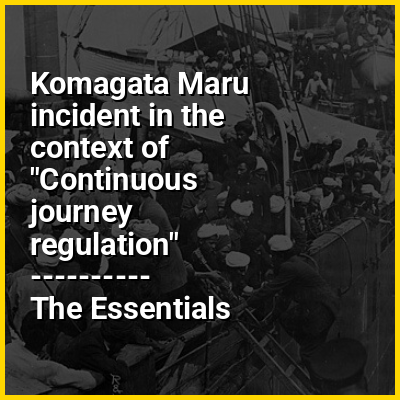
The Komagata Maru incident was an immigration dispute in which passengers aboard the Japanese steamship Komagata Maru were denied entry in Vancouver, British Columbia, Canada, on 23 May 1914. The 376 passengers (340 Sikhs, 24 Muslims and 12 Hindus from Punjab province, British India) were denied entry despite being British subjects under Canada's continuous journey regulation, which barred South Asian migration. Only 24 passengers were allowed to disembark, and the ship was forced to return to India under naval escort on 23 July 1914. Upon reaching Budge Budge, near Calcutta (present-day Kolkata) on 27 September 1914, the Indian Imperial Police attempted to arrest the group leaders, leading to violence in which police open fired and killed 20 passengers while others were arrested or imprisoned. The incident highlighted Canada's racially discriminatory immigration policies in the early twentieth century, later resulting in public apologies issued by government officials, and has been the focus of scholarship, public memorialisation, artistic and literary portrayals,
- ⭐ Core Definition: Komagata Maru incident
- Komagata Maru incident in the context of Immigration to Canada
Komagata Maru incident in the context of Immigration to Canada
According to the 2021 Canadian census, immigrants in Canada number 8.3 million persons and make up approximately 23 percent of Canada's total population. This represents the eighth-largest immigrant population in the world, while the proportion represents one of the highest ratios for industrialized Western countries.
Following Canada's confederation in 1867, immigration played an integral role in helping develop vast tracts of land. During this era, the Canadian Government would sponsor information campaigns and recruiters to encourage settlement in rural areas; however, this would primarily be only towards those of European and religious Christian backgrounds, while others – "Buddhist, Shinto, Sikh, Muslim, and Jewish immigrants in particular" as well as the poor, ill, and disabled – would be less than welcome. Examples of this exclusion include the 1885 Chinese Immigration Act, the 1908 continuous journey regulation and ensuing 1914 Komagata Maru incident, and the 1940s internment of Japanese Canadians. Following 1947, in the post–World War II period, Canadian domestic immigration law and policy went through significant changes, most notably with the Immigration Act, 1976, and the current Immigration and Refugee Protection Act from 2002.
View the full Wikipedia page for Immigration to Canada