Klondike Gold Rush in the context of White Pass Trail


Klondike Gold Rush in the context of White Pass Trail

⭐ Core Definition: Klondike Gold Rush

The Klondike Gold Rush was a migration by an estimated 100,000 prospectors to the Klondike region of Yukon in northwestern Canada, between 1896 and 1899. Gold was discovered there by local miners on August 16, 1896; when news reached Seattle and San Francisco the following year, it triggered a stampede of prospectors. Some became wealthy, but the majority went in vain. It has been immortalized in films, literature, and photographs.

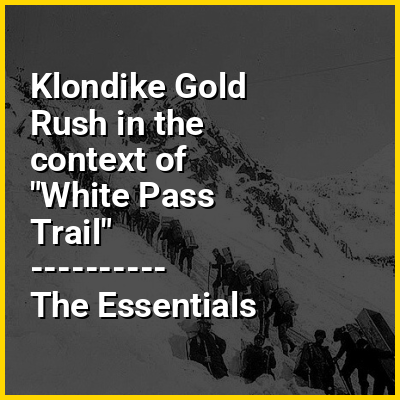
To reach the gold fields, most prospectors took the route through the ports of Dyea and Skagway in southeast Alaska. Here, the "Klondikers" could follow either the Chilkoot or White Pass trail to the Yukon River and sail down to the Klondike. The Canadian authorities required each person to bring a year's supply of food in order to prevent starvation. In all, the Klondikers' equipment weighed close to a ton, which most carried themselves in stages. Performing this task and contending with the mountainous terrain and cold climate meant that most of those who persisted did not arrive until the summer of 1898. Once there, they found few opportunities, and many left disappointed.
↓ Menu
HINT:

In this Dossier

Klondike Gold Rush in the context of Yukon River

The Yukon River is a major watercourse of northwestern North America. From its source in British Columbia, it flows through Canada's territory of Yukon (itself named after the river). The lower half of the river continues westward through the U.S. state of Alaska. The river is 3,190 kilometres (1,980 mi) long and empties into the Bering Sea at the Yukon–Kuskokwim Delta. The average flow is 6,400–7,000 m/s (230,000–250,000 cu ft/s). The total drainage area is 854,700 km (330,000 sq mi), of which 323,800 km (125,000 sq mi) lies in Canada. The total area is more than 25% larger than Texas or Alberta.

The longest river in Alaska and Yukon, it was one of the principal means of transportation during the 1896–1903 Klondike Gold Rush. A portion of the river in Yukon—"The Thirty Mile" section, from Lake Laberge to the Teslin River—is a national heritage river and a unit of Klondike Gold Rush International Historical Park. Paddle-wheel riverboats continued to ply the river until the 1950s, when the Klondike Highway was completed. After the purchase of Alaska by the United States in 1867, the Alaska Commercial Company acquired the assets of the Russian-American Company and constructed several posts at various locations on the Yukon River.

View the full Wikipedia page for Yukon River
↑ Return to Menu

Klondike Gold Rush in the context of Dawson City

Dawson City is a town in the Canadian territory of Yukon. It is inseparably linked to the Klondike Gold Rush (1896–1899). Its population was 1,577 as of the 2021 census, making it the second-largest municipality in Yukon.

View the full Wikipedia page for Dawson City
↑ Return to Menu

Klondike Gold Rush in the context of Yukon Quest

The Yukon Quest, formally the Yukon Quest 1,000-mile International Sled Dog Race, is a sled dog race scheduled every February since 1984 between Fairbanks, Alaska, and Whitehorse, Yukon, switching directions each year. Because of the harsh winter conditions, difficult trail, and the limited support that competitors are allowed, it is considered the "most difficult sled dog race in the world", or even the "toughest race in the world"—"even tougher, more selective and less attention-seeking than the Iditarod Trail Sled Dog Race." The originator envisioned it as "a race so rugged that only purists would participate."

In the competition, first run in 1984, a dog team leader (called a musher) and a team of 6 to 14 dogs race for 10 to 20 days. The course follows the route of the historic 1890s Klondike Gold Rush, mail delivery, and transportation routes between Fairbanks, Dawson City, and Whitehorse. Mushers pack up to 250 pounds (113 kg) of equipment and provisions for themselves and their dogs to survive between checkpoints. Each musher must rely on a single sled for the entire run, versus three in the Iditarod.

View the full Wikipedia page for Yukon Quest
↑ Return to Menu

Klondike Gold Rush in the context of Jack London Square

Jack London Square is a neighborhood on the waterfront of Oakland, California, United States. Named after the author Jack London and owned by the Port of Oakland, it is the home of stores, restaurants, hotels, Amtrak's Jack London Square station, a San Francisco Bay Ferry ferry dock, the historic Heinold's First and Last Chance Saloon, the (re-located) cabin where Jack London lived in the Klondike, and a movie theater. The former presidential yacht USS Potomac is moored at an adjacent slip.

View the full Wikipedia page for Jack London Square
↑ Return to Menu

Klondike Gold Rush in the context of Teslin River

The Teslin River is a river in southern Yukon Territory and northwestern British Columbia, Canada, that flows 632 kilometres (393 mi) from its source south of Teslin Lake to its confluence with the Yukon River.

During the Klondike Gold Rush of 1896–99, the river became a popular route to the Klondike gold fields near Dawson City with the stampeders who had crossed the Coast Mountains by routes such as the Chilkoot Trail or the White Pass trail.

View the full Wikipedia page for Teslin River
↑ Return to Menu

Klondike Gold Rush in the context of Klondike Gold Rush International Historical Park

Klondike Gold Rush National Historical Park is a national historical park operated by the National Park Service that seeks to commemorate the Klondike Gold Rush of the late 1890s. Though the gold fields that were the ultimate goal of the stampeders lay in Yukon, the park comprises staging areas for the trek there and the routes leading in its direction. There are four units, including three in Municipality of Skagway Borough, Alaska and a fourth in the Pioneer Square National Historic District in Seattle, Washington.

A fuller appreciation of the story of the Klondike Gold Rush requires exploration and discovery on both sides of the Canada–United States border. National historic sites in Whitehorse and Dawson City, Yukon, as well as in British Columbia, complete the story. In 1998, Klondike Gold Rush National Historical Park joined with Chilkoot Trail National Historic Site, Dawson Historical Complex National Historic Site, and "The Thirty Mile" stretch of the Yukon River to create Klondike Gold Rush International Historical Park, allowing for an integrated binational experience.

View the full Wikipedia page for Klondike Gold Rush International Historical Park
↑ Return to Menu

Klondike Gold Rush in the context of Klondike Highway

The Klondike Highway is a highway that runs from the Alaska Panhandle through the province of British Columbia and the territory of Yukon in Canada, linking the coastal town of Skagway, Alaska, to Dawson City, Yukon. Its route somewhat parallels the route used by prospectors in the 1898 Klondike Gold Rush.

In both British Columbia and Yukon, the highway is marked as Yukon Highway 2. In Alaska, the Highway is marked as Alaska Route 98 (as in "route of 1898"). Until 1978, the unopened section between the Yukon–BC border and Carcross had no official highway number, while the section north of Carcross to the Alaska Highway was Highway 5, and the section from Stewart Crossing to Dawson was Highway 3. The BC section is now maintained by the Yukon government as a natural extension of Highway 2.

View the full Wikipedia page for Klondike Highway
↑ Return to Menu

Klondike Gold Rush in the context of White Horse Rapids

The Whitehorse rapids were rapids on the Yukon River in Canada's Yukon Territory, named for their supposed resemblance to the mane of a charging white horse. The rapids formed where the Yukon River flows across and cuts down through lava flows of the Miles Canyon basalt. These rapids presented a major navigational obstacle on the Yukon River during the Klondike Gold Rush, and lent their name to the nearby town of Whitehorse.

The Whitehorse dam, constructed in 1957–1958, submerged the rapids beneath the newly created Schwatka Lake.

View the full Wikipedia page for White Horse Rapids
↑ Return to Menu