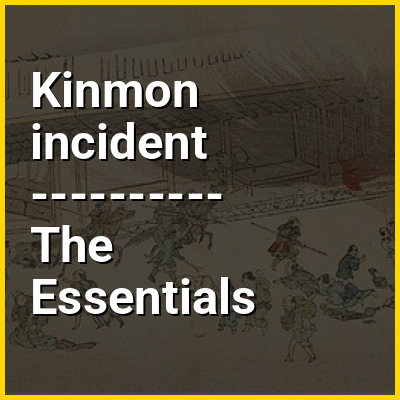
The Kinmon incident (禁門の変, Kinmon no Hen; "Forbidden Gate Incident" or "Imperial Palace Gate Incident"), also known as the Hamaguri Gate Rebellion (蛤御門の変, Hamaguri Gomon no Hen; "Hamaguri Imperial Gate Incident"), was a rebellion against the Tokugawa shogunate in Japan that took place on 20 August [lunar calendar: 19th day, 7th month], 1864, near the Imperial Palace in Kyoto.
HINT:
In this Dossier
Kinmon incident in the context of Kyoto
Kyoto (/ki.ˈoʊ.toʊ/ or /ˈkjoʊ.toʊ/; Japanese: 京都, Kyōto [kʲoꜜː.to] ), officially Kyoto City (京都市, Kyōto-shi; [kʲoː.toꜜ.ɕi] ), is the capital city of Kyoto Prefecture in the Kansai region of Japan's largest and most populous island of Honshu. As of 2020, the city had a population of 1.46 million, making it the ninth-most populous city in Japan. More than half (56.8%) of Kyoto Prefecture's population resides in the city. The city is the cultural anchor of the substantially larger Greater Kyoto, a metropolitan statistical area (MSA) home to a census-estimated 3.8 million people. It is also part of the even larger Keihanshin metropolitan area, along with Osaka and Kobe.
Kyoto is one of the oldest municipalities in Japan, having been chosen in 794 as the new seat of Japan's imperial court by Emperor Kanmu. The original city, named Heian-kyō, was arranged in accordance with traditional Chinese feng shui following the model of the ancient Chinese capitals of Chang'an and Luoyang. The emperors of Japan ruled from Kyoto in the following eleven centuries until 1869. It was the scene of several key events of the Muromachi period, Sengoku period, and the Boshin War, such as the Ōnin War, the Honnō-ji Incident, the Kinmon incident, and the Battle of Toba–Fushimi. The capital was relocated from Kyoto to Tokyo after the Meiji Restoration. The modern municipality of Kyoto was established in 1889. The city was spared from large-scale destruction during World War II and, as a result, its prewar cultural heritage has mostly been preserved.
View the full Wikipedia page for Kyoto