Kingdom of Meath in the context of Westmeath


Kingdom of Meath in the context of Westmeath

⭐ Core Definition: Kingdom of Meath

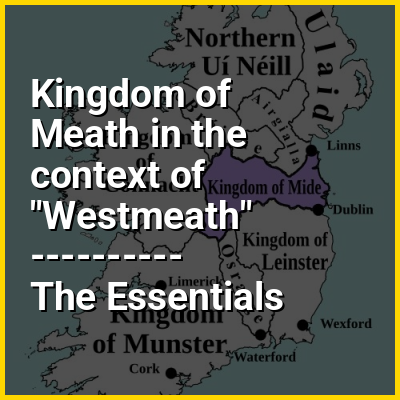
Meath (/mð/ MEEDH; Modern Irish: ; Old Irish: Mide [ˈmʲiðʲe]) was a kingdom in Ireland from the 1st to the 12th century AD. Its name means "middle," denoting its location in the middle of the island.

At its greatest extent, it included all of County Meath (which takes its name from the kingdom), all of County Westmeath, and parts of counties Cavan, Dublin, Kildare, Longford, Louth and Offaly.

↓ Menu
HINT:

In this Dossier

Kingdom of Meath in the context of Early Scandinavian Dublin

Early Scandinavian Dublin was a major Viking settlement and pivotal center of Hiberno-Norse power in Ireland from its establishment in the mid-9th century until the Anglo-Norman invasion in 1170. The First Viking Age in Ireland began in 795, when Vikings began carrying out hit-and-run raids on Gaelic Irish coastal settlements. Over the following decades the raiding parties became bigger and better organized; inland settlements were targeted as well as coastal ones; and the raiders built naval encampments known as longphorts to allow them to remain in Ireland throughout the winter.

In the mid 9th century, Viking leader Turgeis or Thorgest founded a stronghold at Dublin, plundered Leinster and Meath, and raided other parts of Ireland. He was killed by the High King, Máel Sechnaill mac Máele Ruanaid, which was followed by several Irish victories against the Vikings and the seizure of Dublin in 849. Shortly after, a new group of Vikings known as the Dubgaill ("dark foreigners") came to Ireland and clashed with the earlier Viking settlers, now called the Finngaill ("fair foreigners").

View the full Wikipedia page for Early Scandinavian Dublin
↑ Return to Menu

Kingdom of Meath in the context of Provinces of Ireland

There are four provinces of Ireland: Connacht, Leinster, Munster and Ulster. The Irish word for this territorial division, cúige, meaning "fifth part", suggests that there were once five, and at times Meath has been considered to be the fifth province. In the medieval period, however, there were often more than five. The number of provinces and their delineation fluctuated until 1610, when they were permanently set by the administration of James I. The provinces of Ireland no longer serve administrative or political purposes but function as historical and cultural entities.

View the full Wikipedia page for Provinces of Ireland
↑ Return to Menu

Kingdom of Meath in the context of Leinster

Leinster (/ˈlɛnstər/ LEN-stər; Irish: Laighin [ˈl̪ˠəinʲ] or Cúige Laighean [ˌkuːɟə ˈl̪ˠəinˠ]) is one of the four provinces of Ireland, in the southeast of Ireland.

The modern province comprises the ancient Kingdoms of Meath, Leinster and Osraige, which existed during Gaelic Ireland. Following the 12th-century Norman invasion of Ireland, the historic "fifths" of Leinster and Meath gradually merged, mainly due to the impact of the Pale, which straddled both, thereby forming the present-day province of Leinster. The ancient kingdoms were shired into a number of counties for administrative and judicial purposes. In later centuries, local government legislation has prompted further sub-division of the historic counties.

View the full Wikipedia page for Leinster
↑ Return to Menu

Kingdom of Meath in the context of County Westmeath

County Westmeath (/wɛstˈmð/; Irish: Contae na hIarmhí or simply An Iarmhí) is a county in Ireland. It is in the province of Leinster and is part of the Eastern and Midland Region. It formed part of the historic Kingdom of Meath, which was named Mide because the kingdom was located in the geographical centre of Ireland (the word Mide meaning 'middle'). Westmeath County Council is the administrative body for the county, and the county town is Mullingar. At the 2022 census, the population of the county was 95,840.

View the full Wikipedia page for County Westmeath
↑ Return to Menu

Kingdom of Meath in the context of Kingdom of Leinster

The Kingdom of Leinster (Irish: Ríocht Laighean) was a kingdom of Gaelic Ireland which existed in the east of the island from the Irish Iron Age until the 17th century Early Modern Ireland. According to traditional Irish history found in the Annals of the Four Masters, the kingdom was founded as the territory of the Laighin, a Heremonian tribe of Irish Gaels. Some of the early kings of Leinster were also High Kings of Ireland and Kings of Tara, such as Úgaine Mór, Labraid Loingsech and Cathair Mór.

The Leinstermen had originally achieved hegemony in Ireland to the detriment of the Ulster-based Érainn, another group of Irish Gaels, but eventually lost out to their kinsmen the Connachta. This fall from power had lasting consequences in terms of territory for Leinster, as the Southern Uí Néill carved out the Kingdom of Meath to the north, and control of Osraige to the west was lost to the Corcu Loígde, becoming part of the Kingdom of Munster. The kingdom had different borders and internal divisions at different times during its history.

View the full Wikipedia page for Kingdom of Leinster
↑ Return to Menu

Kingdom of Meath in the context of Boann

Boann or Boand is the Irish goddess of the River Boyne (Bóinn), an important river in Ireland's historical province of Meath. According to the Lebor Gabála Érenn and Táin Bó Fraích she was the sister of Befind and daughter of Delbáeth, son of Elada, of the Tuatha Dé Danann. Her husband is variously Nechtan or Elcmar. With her lover the Dagda, she is the mother of Aengus.

View the full Wikipedia page for Boann
↑ Return to Menu