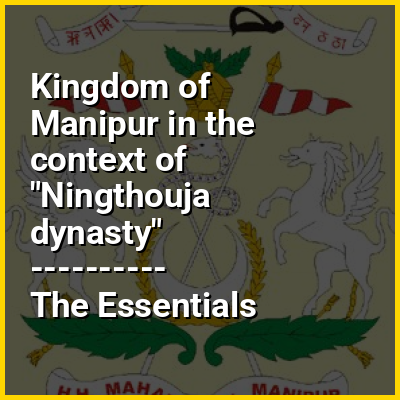
The Manipur Kingdom, also known as Meckley,was an ancient kingdom at the India–Burma frontier. Historically, Manipur was an independent kingdom ruled by a Meitei dynasty. But it was also invaded and ruled over by Burmese kingdom at various point of time. It became a protectorate of the British East India Company from 1824, and a princely state of the British Raj in 1891. The princely state bordered the Assam Province in the west and British Burma in the east, and in the 20th century covered an area of 22,327 square kilometres (8,621 sq mi) and contained 467 villages. The capital of the state was Imphal.
HINT:
In this Dossier
- ⭐ Core Definition: Kingdom of Manipur
- Kingdom of Manipur in the context of Imphal
- Kingdom of Manipur in the context of Manipuri Raas Leela
- Kingdom of Manipur in the context of List of Meitei kings
Kingdom of Manipur in the context of Imphal
Imphal (Meitei: [im.pʰal]; English: UK: /ˈɪmfəl/, US: /ˈɪmpˌhʌl/) is the capital city of the Indian state of Manipur. The metropolitan centre of the city contains the ruins of Kangla Palace (officially known as Kangla Fort), the royal seat of the former Kingdom of Manipur, surrounded by a moat. Spread over parts of the districts of Imphal West and Imphal East, the former contains the majority of the city's area and population. Imphal is part of the Smart Cities Mission under the Ministry of Housing and Urban Affairs. Being a mega commercial hub, Imphal is known for its weaving, brass-ware, bronze-ware, and other cottage industries. Meitei language (officially known as Manipuri language) is the most widely spoken language in the city.
INS Imphal, the third ship of the Visakhapatnam-class stealth guided missile destroyer of the Indian Navy, was named in recognition of the Indian soldiers who fought in Battle of Imphal during World War II, and is the first Indian Navy Ship (INS) named after a city in Northeast India.
View the full Wikipedia page for ImphalKingdom of Manipur in the context of Manipuri Raas Leela
Manipuri dance, sometimes also referred to as the Manipuri Raas Leela (Meitei: Jagoi Raas/Raas Jagoi), is a jagoi and is one of the major Indian classical dance forms, originating from the state of Manipur. It is one of the Meitei intangible cultural heritage. The "Manipuri dance" is a confluence of four ritualistic traditions – Lai Haraoba, Huyen Langlon, Meitei Nata Sankirtana and Raaslila. Owing to the Meitei civilization, the classical dance form, first formally developed by Meitei Hindu king Ching Thang Khomba (Meitei for 'Rajarshi Bhagyachandra') of the Kingdom of Manipur, is considered to be the highest spiritual expression of the worship of Hindu deity Krishna. Owing to its huge influences on the diverse cultural heritages across the Indian subcontinent, it is recognised by the Sangeet Natak Akademi of the Ministry of Culture of the Government of India as one of the few primary classical dance forms of the Republic of India, and is honoured with the Sangeet Natak Akademi Award for Manipuri annually.It is referred to as the "national dance" during the Armenia-India joint issue of postage stamps, as a part of the Armenia-India international relations.
It is imbued with the devotional themes of Madhura Raas of Radha-Krishna and characterised by gentle eyes and soft peaceful body movements. The facial expressions are peaceful mostly expressing Bhakti Rasa or the emotion of devotion, no matter if a dancer is Hindu or not. The dance form is based on Hindu scriptures of Vaishnavism and is exclusively attached to the worship of Radha and Krishna. It is a portrayal of the dance of divine love of Krishna with goddess Radha and the cowherd damsels of Vrindavan, famously known as the Raas Leela.
View the full Wikipedia page for Manipuri Raas LeelaKingdom of Manipur in the context of List of Meitei kings
This is a list of monarchs that ruled the Kingdom of Manipur (present-day Manipur state) as they are recorded in the Royal Chronicle of Manipur (Cheitharol Kumbaba). The Chronicle was reconstructed during the 18th century, with unknown provenance of the earlier sections and, according to scholars, its historicity is assured only for the portions after 1485.
The Kingdom of Kangleipak with written constitution was established in 1110 CE by Loiyumba, ruler of Kangleipak State who incorporated most neighboring principalities. The Kangleipak kings expanded their territory, reaching their zenith under king Khagemba (1597–1652 CE). In 1714, a king named Pamheiba adopted Hinduism. He adopted the name Gharib Nawaz, and in 1724 renamed the kingdom as "Manipur" (Sanskrit for "abode of jewels"). Manipur was conquered by Burma in 1819 CE, and became a Princely State within the British Raj in 1825 CE till 1947 CE.
View the full Wikipedia page for List of Meitei kings