Khreshchatyk in the context of Maidan Nezalezhnosti


Khreshchatyk in the context of Maidan Nezalezhnosti

⭐ Core Definition: Khreshchatyk

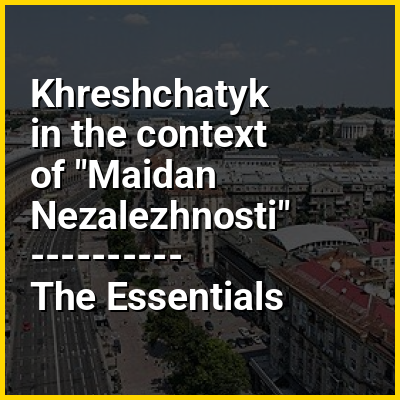
Khreshchatyk (Ukrainian: Хрещатик, pronounced [xreˈʃtʃɑtɪk]) is the main street of Kyiv, the capital city of Ukraine. The street is 1.2 kilometres (0.75 mi) long, and runs in a northeast-southwest direction from European Square through the Maidan to Bessarabska Square and the Besarabsky Market. The offices of the Kyiv City Council, the Post Office, the Ministry of Agrarian Policy and Food, the State Committee of Television and Radio Broadcasting, the TsUM department store, and the Ukrainian House, are all located on Khreshchatyk.

Khreshchatyk was deliberately destroyed during World War II by retreating Red Army troops. Among the notable buildings that were dynamited were the Kyiv City Duma, the Kyiv Stock Exchange, the National Hotel [uk], and the Ginsburg Skyscraper. The street was rebuilt in a Stalinist neo-classical style after the end of the war, and has been renovated since Ukraine's independence.
↓ Menu
HINT:

In this Dossier

Khreshchatyk in the context of General Secretariat of Ukraine

The General Secretariat of Ukraine (Ukrainian: Генеральний секретаріат УЦР—УНР, romanizedHeneralnyi sekretariat UTsR–UNR) was the autonomous Ukrainian executive government of the Russian Republic from June 28, 1917, to January 22, 1918. For most of its existence it was headed by Volodymyr Vynnychenko.

The secretariat was created after the Central Council of Ukraine accepted a proposal of the Ukrainian Party of Socialist Revolutionaries. According to the Encyclopedia of Ukraine, this event took place five days after the proclamation of the 1st Universal of the Central Council of Ukraine, however many contemporary historians have other opinions in that regard. The initial composition of the secretariat included eight General Secretaries (ministers) and one General Scribe (secretary).

View the full Wikipedia page for General Secretariat of Ukraine
↑ Return to Menu

Khreshchatyk in the context of Lypky

Lypky (Ukrainian: Липки) is an historic neighborhood of the Ukrainian capital Kyiv located in the administrative Pecherskyi District. The name is derived from a lime tree (Lypa). Lypky is the de facto government quarter of Ukraine hosting the buildings of the Verkhovna Rada (Parliament), Presidential Administration and Government, as well as ceremonial residences and hotels traditionally used by politicians.

Lypky became known only recently since the 19th century. During that time it has become known as an elite district. Lypky is located between the Old Kyiv neighborhood (bordering by Khreshchatyk) and the Pechersk neighborhood across the Klovskyi Descent and Mechnykova Street.

View the full Wikipedia page for Lypky
↑ Return to Menu

Khreshchatyk in the context of Liuteranska Street

Liuteranska Street (Ukrainian: Вулиця Лютеранська, lit.'Lutheran Street') is a street located in the Lypky neighborhood of the Pecherskyi District in central Kyiv, the capital of Ukraine. One of the most distinguishing features are the House of the Weeping Widow and the Lutheran Church of Saint Catherine.

The street stretches for about half of a mile between Khreshchatyk and Shovkovychna Street. Among other streets that connect to Liuteranska Street are Bankova Street, Zankovetska Street, and Kruhlouniversytetska Street.

View the full Wikipedia page for Liuteranska Street
↑ Return to Menu

Khreshchatyk in the context of 11 December 2013 Euromaidan assault

The assault of Euromaidan by security forces on 11 December 2013 was an attempt by Viktor Yanukovych's government to break up the Euromaidan protest through a night assault using Berkut special police units and interior ministry troops. Their tactics included the displacement of frontal peaceful protesters from lightly barricaded camps at the Independence Square and part of Khreshchatyk Street which is near Bessarabska Square.

The government claimed the need to maintain public order and the enforcement of a decision made by the Pecherskyi District Court, that was read by state bailiffs to the protesters. However, it was later established that such a procedure was illegal, as state executors only had the right to read decisions until 10pm. The court order was also explicit in the fact that Vitali Klitschko was forbidden to hinder citizens moving along the main streets. Vitali Klitschko himself was not aware of this decision, nor was he given the opportunity to appeal it. People responsible for the assault against the protesters have not been identified.

View the full Wikipedia page for 11 December 2013 Euromaidan assault
↑ Return to Menu