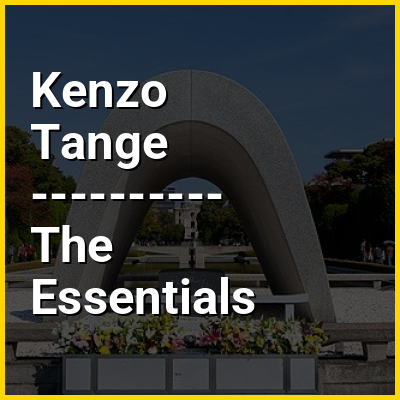
Kenzo Tange in the context of Hiroshima Peace Memorial Park


Kenzo Tange in the context of Hiroshima Peace Memorial Park

⭐ Core Definition: Kenzo Tange

Kenzō Tange (丹下 健三, Tange Kenzō; 4 September 1913 – 22 March 2005) was a Japanese architect. Born in Sakai and raised in China and southern Japan, Tange was inspired from an early age by the work of Le Corbusier and designed his first buildings under Imperial Japan. He first achieved recognition for his projects to reconstruct the destroyed cities of postwar Japan, particularly Hiroshima, where he designed the Hiroshima Peace Memorial Park. His engagement with the Congres Internationaux d'Architecture Moderne in the 1950s made him one of the first Japanese architects to achieve international recognition.

Renowned for synthesizing traditional Japanese styles with modernism, Tange's work was emblematic of the Japanese postwar boom. However, he built major projects on five continents. He was a forerunner, mentor, and patron of the metabolist movement. He was also known as an ambitious, original urban planner whose ideas inspired the reconstruction of cities including Skopje. Tange would continue designing buildings until his death in 2005.
↓ Menu
HINT:

In this Dossier

Kenzo Tange in the context of Tokyo Metropolitan Government Building

The Tokyo Metropolitan Government Building (東京都庁舎, Tōkyō-to Chōsha), also referred to as the Tochō (都庁) for short, is the seat of the Tokyo Metropolitan Government, which governs the special wards, cities, towns, and villages that constitute the Tokyo Metropolis.

Located in Shinjuku ward, the building was designed by architect Kenzo Tange. It consists of a complex of three structures, each taking up a city block. The tallest of the three is the Tokyo Metropolitan Government Building No.1, a tower 48 stories tall that splits into two sections at the 33rd floor. The building also has three levels below ground. The design of the building was meant to resemble an integrated circuit, while also evoking the look of a Gothic cathedral. It is the tallest city hall in the world.

View the full Wikipedia page for Tokyo Metropolitan Government Building
↑ Return to Menu

Kenzo Tange in the context of Metabolism (architecture)

Metabolism (Japanese: メタボリズム, Hepburn: metaborizumu; also shinchintaisha (新陳代謝)) was a post-war Japanese biomimetic architectural movement that fused ideas about architectural megastructures with those of organic biological growth. It had its first international exposure during CIAM's 1959 meeting and its ideas were tentatively tested by students from Kenzo Tange's MIT studio.

During the preparation for the 1960 Tokyo World Design Conference, a group of young architects and designers, including Kiyonori Kikutake, Kisho Kurokawa and Fumihiko Maki, prepared the publication of the Metabolism manifesto. They were influenced by a wide variety of sources, including Marxist theories and biological processes. Their manifesto was a series of four essays entitled: Ocean City, Space City, Towards Group Form, and Material and Man, and it also included designs for vast cities that floated on the oceans and plug-in capsule towers that could incorporate organic growth. Although the World Design Conference gave the Metabolists exposure on the international stage, their ideas remained largely theoretical.

View the full Wikipedia page for Metabolism (architecture)
↑ Return to Menu

Kenzo Tange in the context of Cecil Balmond

Cecil Balmond OBE is a British Sri Lankan designer, artist, and writer. In 1968, Balmond joined Ove Arup & Partners, leading him to become deputy chairman. In 2000, he founded design and research group, the AGU (Advanced Geometry Unit).He currently holds the Paul Philippe Cret Chair at PennDesign as Professor of Architecture where he is also the founding director of the Non Linear Systems Organization, a material and structural research unit. He has also been Kenzo Tange Visiting Design Critic at Harvard Graduate School of Architecture (2000), Eero Saarinen Visiting professor at Yale University School of Architecture (1997–2002) and visiting fellow at London School of Economics Urban Cities Programme (2002–2004).

In 2010, Balmond set up his own practice, Balmond Studio, with offices in London and Colombo. The research led practice is involved with art, architecture, design and consulting.

View the full Wikipedia page for Cecil Balmond
↑ Return to Menu