Kempegowda International Airport in the context of "Solar power"

Play Trivia Questions online!

or

Skip to study material about Kempegowda International Airport in the context of "Solar power"

Ad spacer

⭐ Core Definition: Kempegowda International Airport

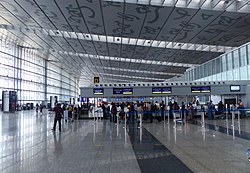
Kempegowda International Airport (IATA: BLR, ICAO: VOBL) is an international airport serving Bengaluru, the capital of the Indian state of Karnataka. Spread over 16 square kilometres (6.2 sq mi), it is located about 35 km (22 mi) north of the city, near the suburb of Devanahalli. It is owned and operated by Bengaluru International Airport Limited (BIAL), a public–private consortium. The airport opened in May 2008, as an alternative to the increasingly congested HAL Airport, the original commercial airport serving the city. It is named after Kempe Gowda I, the founder of Bengaluru. It is Karnataka's first fully solar powered airport, developed by CleanMax Solar.

The airport is the third-busiest in India, behind the airports in Delhi and Mumbai. It is the 26th busiest airport in Asia and the 54th busiest airport in the world as of 2024. In FY2024-25, the airport handled over 41.87 million passengers and 502,509 tonnes (553,921 short tons) of cargo. The airport offers connecting flights to all 6 inhabited continents, and direct flights to 5.
↓ Menu

>>>PUT SHARE BUTTONS HERE<<<
In this Dossier

Kempegowda International Airport in the context of Airport

An airport is an aerodrome with extended facilities, mostly for commercial air transport. They usually consist of a landing area, which comprises an aerially accessible open space including at least one operationally active surface such as a runway for a plane to take off and to land or a helipad, and often includes adjacent utility buildings such as control towers, hangars and terminals, to maintain and monitor aircraft. Larger airports may have airport aprons, taxiway bridges, air traffic control centres, passenger facilities such as restaurants and lounges, and emergency services. In some countries, the US in particular, airports also typically have one or more fixed-base operators, serving general aviation.

Airport operations are extremely complex, with a complicated system of aircraft support services, passenger services, and aircraft control services contained within the operation. Thus airports can be major employers, as well as important hubs for tourism and other kinds of transit. Because they are sites of operation for heavy machinery, a number of regulations and safety measures have been implemented in airports, in order to reduce hazards. Additionally, airports have major local environmental impacts, as both large sources of air pollution, noise pollution and other environmental impacts, making them sites that acutely experience the environmental effects of aviation. Airports are also vulnerable infrastructure to extreme weather, climate change caused sea level rise and other disasters.

↑ Return to Menu

Kempegowda International Airport in the context of Devanahalli

Devanahalli, also called "Devandahalli", "Dyaavandalli", Devanadoddi, and Devanapura, is a town in Bengaluru North District in the state of Karnataka in India. The town is located next to Nandi Hills and 40 kilometres (25 mi) to the north-east of Bengaluru.

Devanahalli is the site of Kempegowda International Airport. A multibillion-dollar Devanahalli Business Park with two IT Parks are coming up on nearly 400 acres (1.6 km) adjoining the airport. An Aerospace Park, Science Park and a 10 billion (US$120 million) Financial City are also coming up. A new satellite ring road will connect the city with Doddaballapur. Devanahalli is situated near the upcoming 1,500 billion (US$18 billion), 12,000-acre (49 km) BIAL IT Investment Region, to be the largest IT region in India.

↑ Return to Menu

Kempegowda International Airport in the context of HAL Airport

HAL Airport (ICAO: VOBG) is an airport that serves Bengaluru, the capital of the Indian state of Karnataka. Located about 12 km east of the city centre, it has one runway and operates 24/7. Hindustan Aeronautics Limited (HAL), a state-owned defence company, owns the airfield and runs a testing facility in conjunction with the Indian Armed Forces. The airport also caters to non-scheduled civilian traffic, including general, business and VIP aviation. For over 60 years, it received all domestic and international flights to the city; the Airports Authority of India shut down its civil enclave, officially known as "Bangalore International Airport", upon the opening of the Kempegowda International Airport in Devanahalli in 2008.

The airport commenced operations in January 1941 as the home of India's first aircraft factory, established by the company Hindustan Aircraft. The Allies employed the airfield during the Second World War, and by 1946 commercial flights had begun. Activity at the airport grew gradually over the next several decades until the 1990s, when it started to increase rapidly in parallel to Bangalore's economic expansion. In response, the airport underwent a series of expansions and upgrades. Meanwhile, HAL declared it wanted the airport completely to itself, resulting in the planning of another airfield to replace the civil enclave. Although HAL later modified its stance and some residents of the city protested, an agreement between the new airport's operator and the state and national governments obligated the enclave to close. Consequently, airlines moved to the Devanahalli airport on the night of 23–24 May 2008.

↑ Return to Menu

Kempegowda International Airport in the context of List of the busiest airports in India

India's busiest airports is the list of the top fifty busiest commercially operational airports in the country. The tables below contain the busiest airports ranked by the following parameters as per the data published by Airports Authority of India.

  1. Total passenger traffic (in number of persons) - includes any passenger that arrives at, departs from or is on a transit from that airport
  2. Total aircraft movements (in airplane-times) - includes all the takeoffs and landings of all kinds of aircraft in scheduled or charter conditions
  3. Total cargo handled (in metric tonnes) - includes all the freight and mail that arrives at or departs from the airport
↑ Return to Menu

Kempegowda International Airport in the context of Skidmore, Owings, and Merrill

SOM, an initialism of its original name Skidmore, Owings & Merrill LLP, is a Chicago-based architectural, urban planning, and engineering firm. It was founded in 1936 by Louis Skidmore and Nathaniel Owings. In 1939, they were joined by engineer John O. Merrill. The firm opened its second office, in New York City, in 1937 and has since expanded, with offices in San Francisco, Los Angeles, Washington, D.C., London, Melbourne, Hong Kong, Shanghai, Seattle, and Dubai.

Notable for its role as a pioneer of modernist architecture in America and for its groundbreaking work in skyscraper design and construction, SOM has designed some of the world's most significant architectural and urban projects including several of the tallest buildings in the world: John Hancock Center (1969, second tallest in the world when built), Willis Tower (1973, tallest in the world for almost twenty-five years), One World Trade Center (2014, currently the seventh tallest in the world), and Burj Khalifa (2010, currently the world's tallest building). The firm's notable current work includes the new headquarters for the Walt Disney Company, the global headquarters for Citigroup, Moynihan Train Hall and the expanded Penn Station complex, and the restoration and renovation of the Waldorf Astoria in New York City; airport projects at O'Hare International Airport, Kansas City International Airport, and Kempegowda International Airport; urban master plans for the Charenton-Bercy district in Paris, New Covent Garden in London, Treasure Island in San Francisco, the East Riverfront in Detroit; P.S. 62, the first net-zero-energy school in New York City; and the design of the Moon Village, a concept for the first permanent lunar settlement, developed with the European Space Agency and Massachusetts Institute of Technology.

↑ Return to Menu

Kempegowda International Airport in the context of FedEx Express

FedEx Express is an American cargo airline based in Memphis, Tennessee, United States. As of 2023, it was the world's largest cargo airline in terms of fleet size and freight tons flown. It is the namesake and leading subsidiary of FedEx Corporation, delivering freight and packages to more than 375 destinations over 220 countries and territories across six continents each day.

The company's global "Super Hub" is located at Memphis International Airport. In the United States, FedEx Express has a national hub at Indianapolis International Airport, and regional hubs at airports in Anchorage, Fort Worth, Greensboro, Miami, Newark, Oakland and Ontario. International regional hubs are located at airports in Cologne/Bonn, Dubai, Bengaluru, Delhi, Guangzhou, Liege, Milan, Mumbai, Osaka, Paris, Seoul, Shanghai, Singapore, Taipei, Tokyo, and Toronto.

↑ Return to Menu