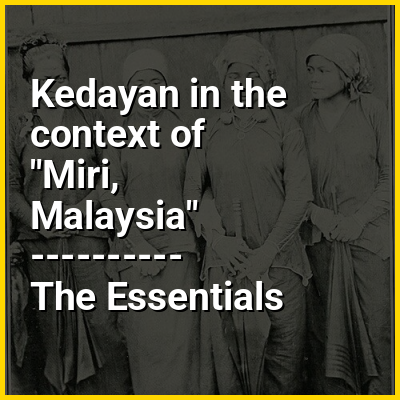
The Kedayan (also known as Kadayan, Kadaian or Kadyan) are an ethnic group residing in Brunei, Federal Territory of Labuan, southwest of Sabah, and north of Sarawak on the island of Borneo. According to the Language and Literature Bureau of Brunei, the Kedayan language (ISO 639-3: kxd) is spoken by about 30,000 people in Brunei, and it has been claimed that there are a further 46,500 speakers in Sabah and 37,000 in Sarawak. In Sabah, the Kedayan mainly live in the southern districts of Sipitang and Beaufort, where they are counted as a part of the local Malay populace (and they are often considered as Bruneians owing to assimilation as well as mixed marriage factors). Whilst in Sarawak, the Kedayans mostly reside in the towns of Lawas, Limbang and Miri (especially the Subis area).
- ⭐ Core Definition: Kedayan
- Kedayan in the context of West Coast Division
- Kedayan in the context of Islam in Brunei
- Kedayan in the context of Muslim Southeast Asia
- Kedayan in the context of Interior Division
Kedayan in the context of West Coast Division
West Coast Division (Malay: Bahagian Pantai Barat) is an administrative division of Sabah, Malaysia. It occupies the northwest portion of Sabah. With an area of 7,588 square kilometres, it occupies 10.3% of Sabah's territory. It also has approximately 30% of Sabah's total population, with the main indigenous inhabitants comprising the Bajau, Bisaya, Bruneian Malay, Dusun, Illanun, Kadazan and Kedayan, as well with a significant numbers of Chinese. The division is divided into the districts of Ranau, Kota Belud, Tuaran, Penampang, Papar, Putatan and the state capital Kota Kinabalu. The main towns are as in the names of the districts, plus other towns including Petagas, Lok Kawi, Menggatal, Inanam, Telipok, Tamparuli, Tenghilan, Kiulu, Kundasang, Pekan Nabalu, Kinarut, Kimanis and Bongawan.
Kota Kinabalu Harbour is the main sea ports in the state's capital with an estimate size of 1,440 kilometres long coast. It serves as the gateway for water transport in Sabah. It handles and handles 4,031,000 freight tonne annually. The Kota Kinabalu International Airport serves as the main gateway into the state by air.
View the full Wikipedia page for West Coast DivisionKedayan in the context of Islam in Brunei
Islam is Brunei's official religion, 83% of the population is Muslim, most of the other Muslim groups are Malay Kedayans (converts from indigenous tribal groups), local Chinese and Dayak Iban converts. Islam was introduced to Brunei by traders arriving from Persia, Arabia, India, China and by the 14th century the royal house had by then converted to Islam.
The official religion of Brunei is Sunni Islam. With the noteworthy exception of Sultan Omar Ali Saifuddien III's tomb, which has been turned into a pilgrimage destination during Ramadan, Brunei Malay Muslims do not often revere saints or holy tombs, unlike in other Muslim societies. Brunei's pre-Islamic ancestor worship customs had an impact on the custom of visiting cemeteries during Ramadan to purify and offer prayers for the deceased.
View the full Wikipedia page for Islam in BruneiKedayan in the context of Muslim Southeast Asia
Muslim Southeast Asia refers to the areas of Southeast Asia that have significant populations of Muslims. It includes:
- Most parts of Indonesia including most of Java, Sumatra, Kalimantan, West Nusa Tenggara, Maluku Islands and Sulawesi (Java and Sumatra alone have the majority of Indonesia's population).
- Peninsular Malaysia and Sabah
- Brunei
- Southern Philippines (Bangsamoro)
- Patani region and Satun
- Westernmost parts of Myanmar, near the Bangladeshi border.
Culturally, it would also include the Malay people of Singapore (which was historically a Malay Muslim populated island), several (mainly coastal) ethnic groups of Sarawak such as Melanau, Bisaya, Narom, Seru, Miriek, Kedayan and Sarawak Malays, Cham people of Cambodia and Vietnam, and other Muslim community in Southeast Asia.
View the full Wikipedia page for Muslim Southeast AsiaKedayan in the context of Interior Division
The Interior Division (Malay: Bahagian Pedalaman) is an administrative division of the state of Sabah, Malaysia. It occupies the southwest portion of Sabah, bordered by the neighbouring state of Sarawak on its west. With an area of 18,298 square kilometres, it covers 24.9% of Sabah's territory and is home to approximately 14.7% of Sabah's total population. The largest town in the Interior Division is Keningau. Other main towns in this division include Beaufort, Kuala Penyu, Sipitang, Tambunan and Tenom.
The coastal parts of the Division are settled mainly by Bisaya, Bruneian Malays and Kedayan, whereas the inland areas to the east of the Crocker Range are mostly settled by various subgroups of the Dusun people. The town of Tambunan is considered to be a major centre of Dusun culture, while Tenom is the largest town in the heartland of the Murut people. The Long Pasia and Long Mio are the gateway to the Lun Bawang/ Lun Dayeh tribes in Sipitang. In addition, there are large numbers of Chinese people in most of the towns, particularly Beaufort, Keningau and Tenom. The majority of the Division's ethnic Chinese residents are of the Hakka subgroup.
View the full Wikipedia page for Interior Division