Kaziuko mugė or Saint Casimir's Fair is a large annual folk arts and crafts fair in Lithuania, dating to the beginning of the 17th century. The fair is traditionally held in city's markets and streets on the Sunday nearest to 4 March (Feast of St. Casimir), the anniversary of Saint Casimir's death. In Lithuanian, Kaziukas is a diminutive of Casimir. Today, Saint Casimir's fair also features music, dance, theater performances; it attracts tens of thousands of visitors and many craftsmen from across Lithuania as well as from neighbouring countries such as Latvia, Estonia, and Poland. In recent years, the fair has expanded into other cities in Lithuania, Belarus, Poland.
HINT:
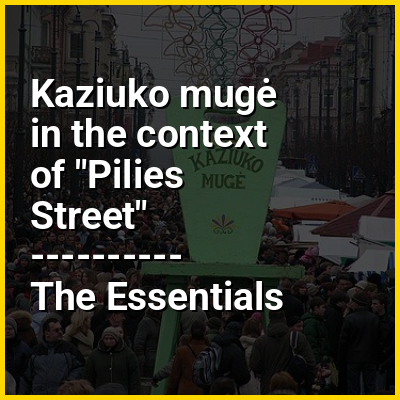
👉 Kaziuko mugė in the context of Pilies Street
Pilies Street (literally, "Castle Street"; Lithuanian: Pilies gatvė) is one of the main streets in the Old Town of Vilnius, the capital of Lithuania. It is a rather short street, running from Cathedral Square to the Town Hall Square.
Pilies Street is a popular location for market traders to sell the wares of folk artists. It has a natural advantage over the Town Hall Square as the street is generally busy and less likely to be interrupted by the political or cultural events commonly held at the Town Hall. Souvenir shops offer amberware and amber jewelry as well as linen clothes. The street is also known for the Kaziukas Fair, when folk artists from all over Lithuania gather here to display and sell their latest merchandise.
In this Dossier
- ⭐ Core Definition: Kaziuko mugė
- 👉 Kaziuko mugė in the context of Pilies Street
- Kaziuko mugė in the context of Saint Casimir
Kaziuko mugė in the context of Saint Casimir
Casimir Jagiellon (/ˈkæzɪmɪər/; Latin: Casimirus; Lithuanian: Kazimieras; Polish: Kazimierz; 3 October 1458 – 4 March 1484) was a prince of the Kingdom of Poland and of the Grand Duchy of Lithuania. The second son of King Casimir IV Jagiellon, he was tutored by Johannes Longinus, a Polish chronicler, diplomat, and priest. After his elder brother Vladislaus was elected as King of Bohemia in 1471, Casimir became the heir apparent. At the age of 13, Casimir participated in the failed military campaign to install him as King of Hungary. He became known for his piety, devotion to God, and generosity towards the sick and poor. He became ill (most likely with tuberculosis) and died at the age of 25. He was buried in Vilnius Cathedral. His canonization was initiated by his brother King Sigismund I the Old in 1514 and the tradition holds that he was canonized in 1521. Saint Casimir the Prince is the patron saint of Poland, Lithuania and Lithuanian youth and the only saint with this name.
Veneration of Casimir saw a resurgence in the 17th century when his feast day was confirmed by the pope in 1602 and the dedicated Chapel of Saint Casimir was completed in 1636. Casimir became a patron saint of Lithuania and Lithuanian youth. In Vilnius, his feast day is marked annually with Kaziuko mugė (a trade fair) held on the Sunday nearest to 4 March, the anniversary of his death. There are more than 50 churches named after Casimir in Lithuania and Poland, including Church of St. Casimir, Vilnius and St. Kazimierz Church, Warsaw, and more than 50 churches in Lithuanian and Polish diaspora communities in America. Women's congregation Sisters of Saint Casimir was established in 1908 and remains active in the United States.
View the full Wikipedia page for Saint Casimir