Karlovo in the context of "Stryama"

Play Trivia Questions online!

or

Skip to study material about Karlovo in the context of "Stryama"

Ad spacer

⭐ Core Definition: Karlovo

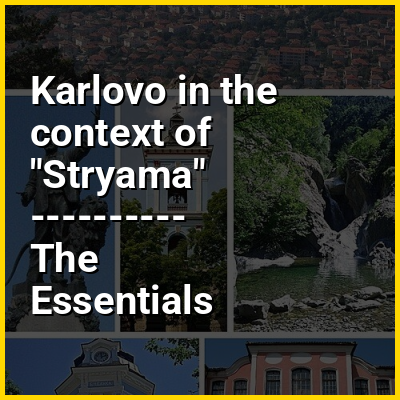
Karlovo (Bulgarian: Карлово [ˈkarɫovo]) is a historically important town in central Bulgaria located in a fertile valley along the river Stryama at the southern foot of the Balkan Mountains. It is administratively part of Plovdiv Province and has a population of about 19,373 (as of 2021), the mayor being Dr. Emil Kabaivanov. Karlovo is famous for the worldwide-known rose oil, which is grown there and used in producing perfume. In addition to this, Karlovo is the birthplace of Vasil Levski, the most distinguished Bulgarian to start preparing the national liberation from the Ottoman rule in the late 19th century. There is a museum and large monument dedicated to him. Karlovo is also a popular location for tourism in the region.

During the 2000s, Bulgarian archaeologists made discoveries in Central Bulgaria which were summarized as 'The Valley of the Thracian Kings'. On 19 August 2005, some archaeologists announced they had found the first Thracian capital, which was situated near Karlovo in Bulgaria. Many polished ceramic artifacts (pieces of roof-tiles and Greek-like vases) were discovered revealing the fortune of the town. The Bulgarian Ministry of Culture declared its support to the excavations.
↓ Menu

>>>PUT SHARE BUTTONS HERE<<<
In this Dossier

Karlovo in the context of Central Balkan National Park

The Central Balkan National Park (Bulgarian: Национален парк Централен Балкан) is a national park in the heart of Bulgaria, nestled in the central and higher portions of the Balkan Mountains. Its altitude varies from 550 metres (1,800 ft) near the town of Karlovo to 2,376 metres (7,795 ft) at Botev Peak, the highest summit in the range. It was established on 31 October 1991.

The park is the third-largest protected territory in Bulgaria, spanning an area of 716.69 km with a total length of 85 km from west to east and an average width of 10 km. It occupies parts of 5 of the country's 28 provinces: Lovech, Gabrovo, Sofia, Plovdiv and Stara Zagora. The national park also includes nine nature reserves, covering 28% of its territory: Boatin, Tsarichina, Kozya Stena, Steneto, Severen Dzhendem, Peeshti Skali, Sokolna, Dzhendema and Stara Reka.

↑ Return to Menu

Karlovo in the context of Vasil Levski

Vasil Levski (Bulgarian: Васил Левски, spelled in old Bulgarian orthography as Василъ Львскій, pronounced [vɐˈsiɫ ˈlɛfski]), born Vasil Ivanov Kunchev (Васил Иванов Кунчев; 18 July 1837 – 18 February 1873), was a Bulgarian revolutionary who is, today, a national hero of Bulgaria. Dubbed the Apostle of Freedom, Levski ideologised and strategised a revolutionary movement to liberate Bulgaria from Ottoman rule. Levski founded the Internal Revolutionary Organisation, and sought to foment a nationwide uprising through a network of secret regional committees.

Born in the Sub-Balkan town of Karlovo to middle-class parents, Levski became an Orthodox monk before emigrating to join the two Bulgarian Legions in Serbia and other Bulgarian revolutionary groups. Abroad, he acquired the nickname Levski ("Lionlike"). After working as a teacher in Bulgarian lands, he propagated his views and developed the concept of his Bulgaria-based revolutionary organisation, an innovative idea that superseded the foreign-based detachment strategy of the past. In Romania, Levski helped institute the Bulgarian Revolutionary Central Committee, composed of Bulgarian expatriates. During his tours of Bulgaria, Levski established a wide network of insurrectionary committees. Ottoman authorities, however, captured him at an inn near Lovech and executed him by hanging in Sofia.

↑ Return to Menu

Karlovo in the context of Kalofer

Kalofer (Bulgarian: Калофер pronounced:[kɐˈɫɔfɛr]) is a town in central Bulgaria, located on the banks of the Tundzha between the Balkan Mountains to the north and the Sredna Gora to the south. Kalofer is part of Plovdiv Province and the Karlovo municipality. It is best known as the birthplace of Bulgarian poet and revolutionary Hristo Botev.

The modern settlement of Kalofer emerged in the 16th century, managing to preserve its Bulgarian character in the Ottoman Empire and to develop as a centre of craftsmanship, primarily cord production. The Kalofer monastery has been in operation since 1640 and the convent since 1700. During the Bulgarian National Revival the town became a centre of revolutionary activity, being the birthplace of figures such as Hristo Botev, Exarch Joseph, Dimitar Panichkov, and Nikola Ivanov. Today, it is best known for the imposing Hristo Botev Monument (one of many in the country).

↑ Return to Menu

Karlovo in the context of Karlovo Valley

Karlovo Valley (Bulgarian: Карловска котловина) is situated in central Bulgaria. It is named after the town of Karlovo, its main settlement. It is the sixth of the eleven Sub-Balkan valleys in direction west–east. Together with the neighbouring Kazanlak Valley, it forms part of the Rose Valley region.

↑ Return to Menu