The Chūetsu offshore earthquake (新潟県中越沖地震, Niigata-ken Chūgoshi Oki Jishin) was a powerful magnitude 6.6 earthquake that occurred 10:13 local time (01:13 UTC) on July 16, 2007, in the northwest Niigata Prefecture of Japan. The earthquake, which occurred at a previously unknown offshore fault shook Niigata and neighbouring prefectures. The city of Kashiwazaki and the villages of Iizuna and Kariwa registered the highest seismic intensity of a strong 6 on Japan's shindo scale, and the quake was felt as far away as Tokyo. Eleven deaths and at least 1,000 injuries were reported, and 342 buildings were completely destroyed, mostly older wooden structures. Prime Minister Shinzō Abe broke off from his election campaign to visit Kashiwazaki and promised to "make every effort towards rescue and also to restore services such as gas and electricity".
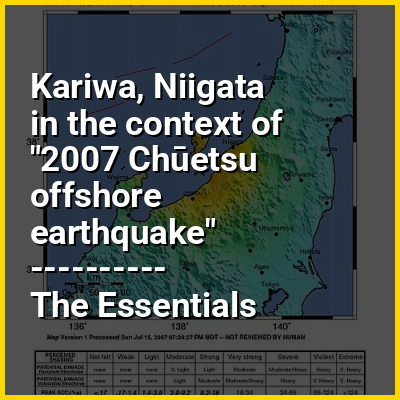
- 👉 Kariwa, Niigata in the context of 2007 Chūetsu offshore earthquake
- Kariwa, Niigata in the context of Kashiwazaki-Kariwa Nuclear Power Plant
Kariwa, Niigata in the context of Kashiwazaki-Kariwa Nuclear Power Plant
The Kashiwazaki-Kariwa Nuclear Power Plant (柏崎刈羽原子力発電所, Kashiwazaki-Kariwa genshiryoku-hatsudensho; Kashiwazaki-Kariwa NPP) is a large, modern (housing the world's first advanced boiling water reactor or ABWR) nuclear power plant on a 4.2-square-kilometer (1,000-acre) site. The campus spans the towns of Kashiwazaki and Kariwa in Niigata Prefecture, Japan, on the coast of the Sea of Japan, where it gets cooling water. The plant is owned and operated by Tokyo Electric Power Company (TEPCO), and it is the largest nuclear generating station in the world by net electrical power rating.
On 16 July 2007, the Chūetsu offshore earthquake took place, with its epicenter located only 19 km (12 mi) from the plant. The earthquake registered Mw 6.6, ranking it among the strongest earthquakes to occur in the immediate range of a nuclear power plant. This shook the plant beyond design basis and initiated an extended shutdown for inspection, which indicated that greater earthquake-proofing was needed before the operation could be resumed. The plant was completely shut down for 21 months following the earthquake. Unit 7 was restarted after seismic upgrades on 19 May 2009, followed later by units 1, 5, and 6. (Units 2, 3, and 4 were not restarted by the time of the March 2011 earthquake.)
View the full Wikipedia page for Kashiwazaki-Kariwa Nuclear Power Plant