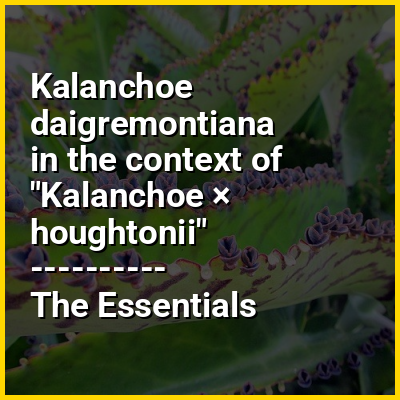
Kalanchoe daigremontiana, formerly known as Bryophyllum daigremontianum and commonly called mother of thousands, alligator plant or Mexican hat plant, is a succulent plant native to Madagascar. Like other members of Bryophyllum (now included in the genus Kalanchoe), it can propagate vegetatively from plantlets that develop on its leaf margins, as well as through upshoots from lateral roots, and seeds. All parts of this species contain a very toxic steroid known as daigremontianin.
It is often confused with Kalanchoe laetivirens, Kalanchoe delagoensis and Kalanchoe × houghtonii. The leaves of Kalanchoe laetivirens are completely green, while Kalanchoe daigremontiana has bands or spots on the back of leaves. The leaves of Kalanchoe delagoensis are linear, while Kalanchoe daigremontiana has lanceolate, oblong, ovate or triangular leaves. Kalanchoe × houghtonii is a hybrid between Kalanchoe daigremontiana and Kalanchoe delagoensis, therefore has characteristics in between; its leaves are narrower than those of Kalanchoe daigremontiana and its leaf base is attenuate, cuneate to weakly cordate or auriculate, while Kalanchoe daigremontiana has strongly cordate to auriculate or even peltate leaves.