Juan Manuel de Rosas in the context of Federal Pact


Juan Manuel de Rosas in the context of Federal Pact

⭐ Core Definition: Juan Manuel de Rosas

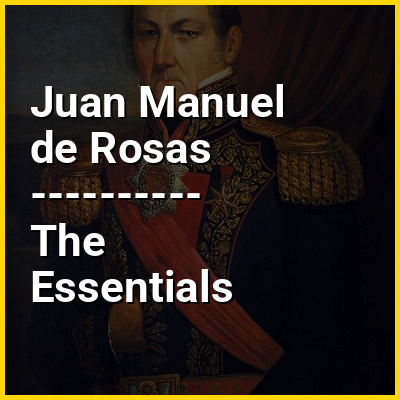
Juan Manuel José Domingo Ortiz de Rozas y López de Osornio (30 March 1793 – 14 March 1877), nicknamed "Restorer of the Laws", was an Argentine politician and army officer who ruled Buenos Aires Province and briefly the Argentine Confederation. Born into a wealthy family, Rosas independently amassed a personal fortune, acquiring large tracts of land in the process. Rosas enlisted his workers in a private militia, as was common for rural proprietors, and took part in the disputes that led to numerous civil wars in his country. Victorious in warfare, personally influential, and with vast landholdings and a loyal private army, Rosas became a caudillo, as provincial warlords in the region were known. He eventually reached the rank of brigadier general, the highest in the Argentine Army, and became the undisputed leader of the Federalist Party.

In December 1829, Rosas became governor of the province of Buenos Aires and established a dictatorship backed by state terrorism. In 1831, he signed the Federal Pact, recognising provincial autonomy and creating the Argentine Confederation. When his term of office ended in 1832, Rosas departed to the frontier to wage war on the indigenous peoples. After his supporters launched a coup in Buenos Aires, Rosas was asked to return and once again took office as governor. Rosas reestablished his dictatorship and formed the repressive Mazorca, an armed parapolice that killed thousands of citizens. Elections became a farce, and the legislature and judiciary became docile instruments of his will. Rosas created a cult of personality and his regime became totalitarian in nature, with all aspects of society rigidly controlled.
↓ Menu
HINT:

In this Dossier

Juan Manuel de Rosas in the context of Caudillo

A caudillo (/kɔːˈd(l)j, kˈ-/ kaw-DEE(L)-yoh, kow-, Spanish: [kawˈðiʎo]; Old Spanish: cabdillo, from Latin capitellum, diminutive of caput "head") is a type of personalist leader wielding military and political power. There is no precise English translation for the term, though it is often used interchangeably with "military dictator," "warlord" and "strongman". The term is historically associated with Spain and Hispanic America, after virtually all of the regions in the latter won independence in the early nineteenth century.

The roots of caudillismo may be tied to the framework of rule in medieval and early modern Spain during the Reconquista from the Moors. Spanish conquistadors such as Hernán Cortés and Francisco Pizarro exhibit characteristics of the caudillo, being successful military leaders, having mutual reliance on the leader and their supporters, and rewarding them for their loyalty. An important characteristic of the caudillo is their charisma, which drew in followers who could be utilized to change the political climate and shape state-formation in the post colonial era. The followers of caudillos, called gauchos, were common people whom the caudillos could charm and persuade into joining their cause. Often the caudillo would take on the role of the provider as a substitute for the shortcomings of those in the government. It created a type of father-child bond between the caudillo and gaucho that strengthened loyalties and made the caudillos powerful. However, the paternalist view towards the relationship between the caudillo and the gaucho assumes that the caudillo has all of the power in the relationship and ignores that much of that power comes from the gaucho's decision to follow a particular caudillo.

View the full Wikipedia page for Caudillo
↑ Return to Menu

Juan Manuel de Rosas in the context of Argentine Confederation

The Argentine Confederation (Spanish: Confederación Argentina) was the last predecessor state of modern Argentina; its name is still one of the official names of the country according to the Argentine Constitution, Article 35. It was the name of the country from 1831 to 1852, when the provinces were organized as a confederation without a head of state. The governor of Buenos Aires Province (Juan Manuel de Rosas during most of the period) managed foreign relations during this time, Under his rule, the Argentine Confederation engaged in conflicts with Brazil, Bolivia, Uruguay, France and the United Kingdom, as well as other Argentine factions during the Argentine Civil Wars.

Rosas was ousted from power in 1852 by Justo José de Urquiza, after the battle of Caseros. Urquiza convened the 1853 Constituent Assembly to write a national constitution. Buenos Aires resisted Urquiza and seceded from the Confederation in 1852, becoming the State of Buenos Aires; the province would return to Argentina in 1861.

View the full Wikipedia page for Argentine Confederation
↑ Return to Menu

Juan Manuel de Rosas in the context of János Czetz

János Czetz (June 8, 1822 – September 6, 1904) was a prominent Hungarian freedom fighter of Armenian and Hungarian-Székely origin, a military commander during the Hungarian Revolution of 1848, and the organizer of Argentina's first national military academy.

After the defeat, he emigrated to Germany and England. From there, he went to Spain, where he met Prudencio Rosas. Upon his return to England, he visited Juan Manuel de Rosas and married Basilia Ortiz de Rozas, daughter of Prudencio Rosas, in Seville. These connections convinced him that his future would lie in Argentina.

View the full Wikipedia page for János Czetz
↑ Return to Menu

Juan Manuel de Rosas in the context of Colegio Militar de la Nación

The National Military College (Spanish: Colegio Militar de la Nación) is the institution in charge of the undergraduate education of officers of the Argentine Army. It is located at El Palomar, Buenos Aires.

Established on October 11, 1869, by President Domingo Sarmiento at the height of the Paraguayan War, its original quarters were opened in where the Parque Tres de Febrero stands today, with Col. Juan F. Czetz as the first superintendent. It was transferred to San Martín in 1892, and to its present location, the site of the 1852 Battle of Caseros that deposed mid-19th century strongman Juan Manuel de Rosas, in 1938.

View the full Wikipedia page for Colegio Militar de la Nación
↑ Return to Menu

Juan Manuel de Rosas in the context of Desert Campaign (1833–1834)

The Desert Campaign (1833–1834) was a military campaign in Argentina led by Juan Manuel de Rosas against the indigenous people of the southern Pampas and northern Patagonia. The campaign was later followed by the Conquest of the Desert, which took place in the 1870s and 1880s.

View the full Wikipedia page for Desert Campaign (1833–1834)
↑ Return to Menu

Juan Manuel de Rosas in the context of Francisco Solano López

Francisco Solano López Carrillo (24 July 1827 or 1826 – 1 March 1870) was a Paraguayan statesman, military officer and politician who served as President of Paraguay between 1862 and 1870, of which he served mostly during the Paraguayan War (1864–1870). He is the only Paraguayan president to have been killed in action.

At a very young age, he served in the Paraguayan Army fighting against Juan Manuel de Rosas in the sporadic hostilities sustained by Paraguay and Argentina during the Platine Wars. After the downfall of Rosas, he became Ambassador of Paraguay, as Minister Plenipotentiary, in several European countries from 1853 to 1855. At his return to Asunción, he was appointed Vice-President of the Supreme Government of his father Carlos Antonio López, and then assumed the presidency when his father died. He is one of only two Paraguayans to have received the rank of Marshal, along with José Félix Estigarribia.

View the full Wikipedia page for Francisco Solano López
↑ Return to Menu

Juan Manuel de Rosas in the context of Bolivian annexation of northern Argentina

The Tarija War (Spanish: Guerra por Tarija), also known as the War between Argentina and the Peru–Bolivian Confederation (Spanish: Guerra entre Argentina y la Confederación Perú-Boliviana), was an armed conflict that occurred between 1837 and 1839. Because it happened while the Peru–Bolivian Confederation was engaged in a parallel war against the Republic of Chile during the so-called War of the Confederation, both conflicts are often confused. The Tarija War began on May 19, 1837, when Juan Manuel de Rosas, who was in charge of managing foreign relations for the Argentine Confederation and was governor of the Province of Buenos Aires, declared war directly on President Andres de Santa Cruz because of the Tarija Question and Confederation's support for the Unitarian Party.

The operations began in August 1837, when Bolivian Confederate troops invaded most of the Province of Jujuy, the Puna de Jujuy, and the north of the Province of Salta. The war continued with a series of combats and skirmishes between both forces, all of them without conclusive results. In May and June 1838, the Confederate army defeated Rosas's troops in a series of engagements, the most important of which was the Battle of Montenegro, which in practice led to Argentina's withdrawal from the war, which from then on had a defensive posture being maintained, but the state of war continued until the victory of the Chilean-Peruvian restorative army at the Battle of Yungay, which put an end to the Peru-Bolivian Confederation.

View the full Wikipedia page for Bolivian annexation of northern Argentina
↑ Return to Menu