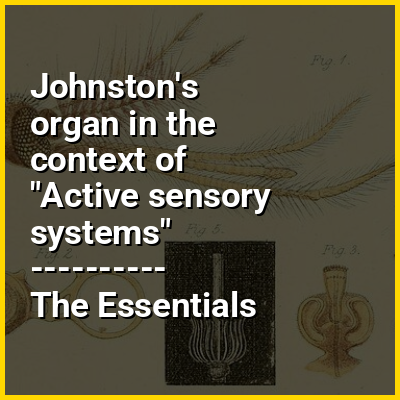
Johnston's organ is a collection of sensory cells found in the pedicel (the second segment) of the antennae in the class Insecta. Johnston's organ detects motion in the flagellum (third and typically final antennal segment). It consists of scolopidia arrayed in a bowl shape, each of which contains a mechanosensory chordotonal neuron. The number of scolopidia varies between species. In homopterans, the Johnston's organs contain 25–79 scolopidia. The presence of Johnston's organ is a defining characteristic which separates the class Insecta from the other hexapods belonging to the group Entognatha. Johnston's organ was named after the physician Christopher Johnston (1822-1891) father of the physician and Assyriologist Christopher Johnston.
HINT:
In this Dossier
Johnston's organ in the context of Tympanal organ
A tympanal organ (or tympanic organ) is a hearing organ in insects, consisting of a tympanal membrane (tympanum) stretched across a frame backed by an air sac and associated sensory neurons. Sounds vibrate the membrane, and the vibrations are sensed by a chordotonal organ. Hymenoptera (bees, wasps, ants, etc.) do not have a tympanal organ, but they do have a Johnston's organ.
Tympanal organs have evolved in at least seven different orders of insects. Tympanal organs can occur in just about any part of the insect: the thorax, the base of the wing, the abdomen, the legs, etc., depending on the group of insects. The structures are thought to have evolved independently many times. As a result, their position and structures are often used to help determine the taxonomy of the species. For example, all members of the Geometridae share distinctive paired abdominal tympanal organs that open towards the front side of the first abdominal segment. Within the organ, particular structures vary in shape and are used to indicate shared ancestry of subfamilies. In other families of Lepidoptera having abdominal tympanal organs, the opening may be in a different orientation and the structures differ in shape.
View the full Wikipedia page for Tympanal organ