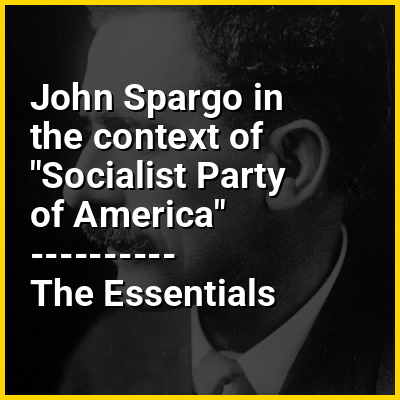
John Spargo (January 31, 1876 – August 17, 1966) was a British political writer who, later in life, became an expert in the history and crafts of Vermont. At first Spargo was active in the Socialist Party of America. A Methodist preacher, he tried to meld the Protestant Social Gospel with Marxist socialism in Marxian Socialism and Religion: A Study of the Relation of the Marxian Theories to the Fundamental Principles of Religion (1915). He also founded a settlement house in Yonkers, N.Y. Spargo moved steadily to the right after 1917 when he supported American intervention in World War I. With the AFL leader Samuel Gompers he organized the American Alliance for Labor and Democracy in 1917. Spargo helped draft the Colby Note that formalised the Wilson administration's anti-communist policies. He strongly denounced the Bolshevik Revolution in Bolshevism: The Enemy of Political and Industrial Democracy (1919). He opposed the foreign policy of the New Deal, especially its recognition of the USSR in 1933. He supported the House Un-American Activities Committee in the late 1930s and Senator Joseph McCarthy in the early 1950s. He endorsed Barry Goldwater In the 1964 Elections.
HINT:
In this Dossier
John Spargo in the context of Leon Dabo
Leon Dabo (July 9, 1864 – November 7, 1960) was an American tonalist landscape artist best known for his paintings of New York State, particularly the Hudson Valley. His paintings were known for their feeling of spaciousness, with large areas of the canvas that had little but land, sea, or clouds. During his peak, he was considered a master of his art, earning praise from John Spargo, Bliss Carman, Benjamin De Casseres, Edwin Markham, and Anatole Le Braz. His brother, Scott Dabo, was also a noted painter.
View the full Wikipedia page for Leon Dabo