James Wolfe in the context of Battle of the Plains of Abraham


James Wolfe in the context of Battle of the Plains of Abraham

⭐ Core Definition: James Wolfe

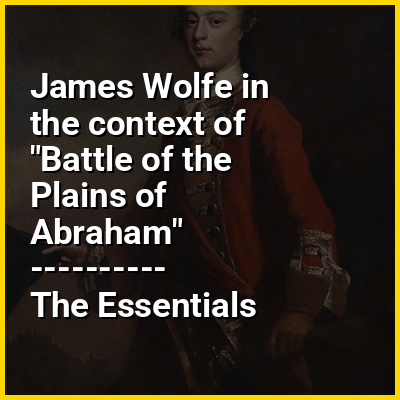
Major-General James Wolfe (2 January 1727 – 13 September 1759) was a British Army officer known for his training reforms and, as a major general, remembered chiefly for his victory in 1759 over the French at the Battle of the Plains of Abraham in Quebec.

The son of a distinguished general, Edward Wolfe, he received his first commission at a young age and saw extensive service in Europe during the War of the Austrian Succession. His service in Flanders and in Scotland, where he took part in the suppression of the Jacobite Rebellion, brought him to the attention of his superiors. The advancement of his career was halted by the Peace Treaty of 1748 and he spent much of the next eight years on garrison duty in the Scottish Highlands. Already a brigade major at the age of 18, he was a lieutenant-colonel by 23.
↓ Menu
HINT:

In this Dossier

James Wolfe in the context of Siege of Quebec (1759)

The Battle of the Plains of Abraham, also known as the Battle of Quebec (French: Bataille des Plaines d'Abraham, Première bataille de Québec), was a pivotal battle in the Seven Years' War – referred to as the French and Indian War in describing the North American theatre. The battle, which took place on 13 September 1759, was fought by the British Army and Royal Navy against the French Army on the Promontory of Quebec, a plateau just outside the walls of Quebec City on land that was originally owned by a farmer named Abraham Martin, hence the name of the location. The battle involved fewer than 10,000 troops in total, but proved to be a deciding moment in the conflict between France and Britain over the fate of New France, influencing the later creation of Canada.

The culmination of a three-month siege by the British, the battle lasted about an hour. British troops commanded by General James Wolfe successfully resisted the column advance of French troops and Canadien militia under General Louis-Joseph, Marquis de Montcalm, employing new tactics that proved extremely effective against standard military formations used in most large European conflicts. Both generals were mortally wounded during the battle; Wolfe died of gunshot wounds just as the French began to retreat and Montcalm died the next morning after receiving a musket ball wound just below his ribs. In the wake of the battle, the French evacuated the city.

View the full Wikipedia page for Siege of Quebec (1759)
↑ Return to Menu

James Wolfe in the context of Great Britain in the Seven Years' War

Great Britain was one of the major participants in the Seven Years' War, which for Britain in fact lasted nine years, between 1754 and 1763. British involvement in the conflict began in 1754 in what became known as the French and Indian War. However the warfare in the European theatre involving countries other than Britain and France commenced in 1756 (hence the name "Seven Years' War"). Britain emerged from the war as the world's leading colonial power, having gained all of New France in North America, ending France's role as a colonial power there. Following Spain's entry in the war in alliance with France in the third Family Compact, Britain captured the major Spanish ports of Havana, Cuba and Manila, in the Philippines in 1762, and agreed to return them in exchange for Spanish Florida. The Treaty of Paris in 1763 formally ended the conflict and Britain established itself as the world's pre-eminent naval power.

The war started poorly for Britain, at the hands of France in North America during 1754–1755, and in the fall of Menorca in 1756. The same year Britain's major ally Austria switched sides and aligned itself with France, and Britain was hastily forced to conclude a new alliance with Frederick the Great's Prussia. For the next seven years these two nations were ranged against a growing number of enemy powers led by France. After a period of political instability, the rise of a government headed by the Duke of Newcastle and William Pitt the Elder provided Britain with firmer leadership, enabling it to consolidate and achieve its war aims.

View the full Wikipedia page for Great Britain in the Seven Years' War
↑ Return to Menu

James Wolfe in the context of Robert Monckton

Lieutenant-General Robert Monckton (24 June 1726 – 21 May 1782) was a British Army officer, politician and colonial administrator. He had a distinguished military and political career, being second in command to General James Wolfe at the Battle of the Plains of Abraham and later being named the governor of New York. Monckton is also remembered for his role in a number of other important events in the French and Indian War, most notably the capture of Fort Beauséjour in Acadia, and the island of Martinique in the West Indies, as well as for his role in the expulsion of the Acadians from Nova Scotia and Acadia.

Monckton sat in the House of Commons of Great Britain between 1774 and 1782. Although never legally married, he had three sons and a daughter. The city of Moncton, New Brunswick (about 50 kilometres (31 mi) west of Fort Beauséjour) and Fort Monckton in Port Elgin, New Brunswick are named for him. A second more important Fort Monckton in Gosport, England is also named for him. It remains an active military establishment, and currently houses the training section of MI6.

View the full Wikipedia page for Robert Monckton
↑ Return to Menu

James Wolfe in the context of William Howe, 5th Viscount Howe

General William Howe, 5th Viscount Howe (10 August 1729 – 12 July 1814), was a British Army officer and politician who rose to become Commander-in-Chief, America, during the American War of Independence. Howe was one of three brothers who had distinguished military careers. In historiography of the American war, he is usually referred to as Sir William Howe to distinguish him from his brother Richard, who was 4th Viscount Howe at that time.

Howe joined the army in 1746 and saw extensive service in the War of the Austrian Succession and Seven Years' War. He became known for his role in the capture of Quebec in 1759 when he led a British force to capture the cliffs at Anse-au-Foulon, allowing James Wolfe to land his army and engage the French in the Battle of the Plains of Abraham. Howe also participated in the British offensive campaigns of Louisbourg, Belle Île and Havana. He was appointed Lieutenant-Governor of the Isle of Wight, a post he held until 1795.

View the full Wikipedia page for William Howe, 5th Viscount Howe
↑ Return to Menu

James Wolfe in the context of The Death of General Wolfe

The Death of General Wolfe is a 1770 painting by Anglo-American artist Benjamin West, commemorating the 1759 Battle of Quebec, where General James Wolfe died at the moment of victory. The painting, containing vivid suggestions of martyrdom, broke a standard rule of historical portraiture by featuring individuals who had not been present at the scene and dressed in modern, instead of classical, costumes. The painting has become one of the best-known images in 18th-century art.

View the full Wikipedia page for The Death of General Wolfe
↑ Return to Menu