James IV, King of Scots in the context of Royal College of Surgeons of Edinburgh


James IV, King of Scots in the context of Royal College of Surgeons of Edinburgh

⭐ Core Definition: James IV, King of Scots

James IV (17 March 1473 – 9 September 1513) was King of Scotland from 11 June 1488 until his death at the Battle of Flodden in 1513. He inherited the throne at the age of fifteen on the death of his father, James III, at the Battle of Sauchieburn, following a rebellion in which the younger James was the figurehead of the rebels. James IV is generally regarded as the most successful of the Stewart monarchs of Scotland. He was responsible for a major expansion of the Scottish royal navy, which included the founding of two royal dockyards and the acquisition or construction of 38 ships, including the Great Michael, the largest warship of its time.

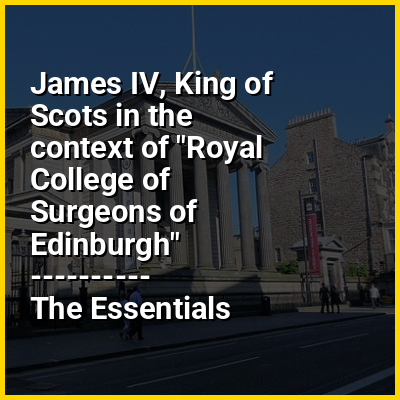
James was a patron of the arts and took an active interest in the law, literature and science. With his patronage the printing press came to Scotland, the University of Aberdeen and the Royal College of Surgeons of Edinburgh were founded, and he commissioned the building of the Palace of Holyroodhouse and Falkland Palace. The Education Act 1496 passed by the Parliament of Scotland introduced compulsory schooling. During James's twenty-five-year reign, royal income doubled, the Crown exercised firm control over the Scottish church, and by 1493 had overcome the last independent Lord of the Isles. Relations with England improved with the Treaty of Perpetual Peace in 1502 and James's marriage to Margaret Tudor in 1503, which led to the Union of the Crowns in 1603.
↓ Menu
HINT:

In this Dossier

James IV, King of Scots in the context of University of Aberdeen

The University of Aberdeen (abbreviated Aberd. in post-nominals; Scottish Gaelic: Oilthigh Obar Dheathain) is a public research university in Aberdeen, Scotland. It was founded in 1495 when William Elphinstone, Bishop of Aberdeen and Chancellor of Scotland, petitioned Pope Alexander VI on behalf of James IV, King of Scots to establish King's College, making it one of Scotland's four ancient universities and the fifth-oldest university in the English-speaking world. Along with the universities of St Andrews, Glasgow, and Edinburgh, the university was part of the Scottish Enlightenment during the 18th century.

The university as it is currently constituted was formed in 1860 by a merger between King's College and Marischal College, a second university founded in 1593 as a Protestant alternative to the former. The university's iconic buildings act as symbols of wider Aberdeen, particularly Marischal College in the city centre and the crown steeple of King's College in Old Aberdeen. There are two campuses; the predominantly utilised King's College campus dominates the section of the city known as Old Aberdeen, which is approximately two miles north of the city centre. Although the original site of the university's foundation, most academic buildings apart from the King's College Chapel and Quadrangle were constructed in the 20th century during a period of significant expansion. The university's Foresterhill campus is next to Aberdeen Royal Infirmary and houses the School of Medicine and Dentistry as well as the School of Medical Sciences. Together these buildings form one of Europe's largest health campuses. The annual income of the institution for 2023–24 was £264 million of which £56.9 million was from research grants and contracts, with an expenditure of £188.9 million.

View the full Wikipedia page for University of Aberdeen
↑ Return to Menu