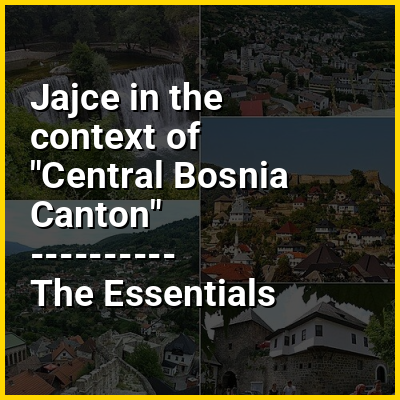
Jajce (Serbian Cyrillic: Јајце) is a town and municipality in the Central Bosnia Canton of the Federation of Bosnia and Herzegovina, an entity of Bosnia and Herzegovina. According to the 2013 census, the town has a population of 7,172 inhabitants, with 27,258 inhabitants in the municipality, It is situated in the region of Bosanska Krajina, on the crossroads between Banja Luka, Mrkonjić Grad, and Donji Vakuf, and on the confluence of the rivers Pliva and Vrbas.
HINT:
In this Dossier
- ⭐ Core Definition: Jajce
- Jajce in the context of Anti-Fascist Council for the National Liberation of Yugoslavia
- Jajce in the context of Stanak
Jajce in the context of Anti-Fascist Council for the National Liberation of Yugoslavia
The Anti-Fascist Council for the National Liberation of Yugoslavia, commonly abbreviated as the AVNOJ, was a deliberative and legislative body that was established in Bihać, Yugoslavia, in November 1942. It was established by Josip Broz Tito, the leader of the Yugoslav Partisans, an armed resistance movement led by the Communist Party of Yugoslavia to resist the Axis occupation of the country during World War II.
The AVNOJ reconvened in Jajce in 1943 and in Belgrade in 1945, shortly after the war in Europe ended. Between the sessions, it operated through its presidency, its executive council, and the National Committee for the Liberation of Yugoslavia. The committee was granted authority normally wielded by cabinets. While Tito presided over the committee, the AVNOJ sessions and its presidency were chaired by Ivan Ribar. The second session of the AVNOJ proclaimed itself Yugoslavia's new legislative body and decided that it should be a multi-ethnic federal state.
View the full Wikipedia page for Anti-Fascist Council for the National Liberation of YugoslaviaJajce in the context of Stanak
Stanak is the most common name used to refer to the assembly of nobility in medieval Bosnia. The assembly, in the original Bosančica: Сmɖɴɖк (Serbo-Croatian Cyrillic: Станак), was also known as the Rusag (from the Hungarian word orszag, meaning "state" or "nation"), Rusag bosanski, Zbor, Sva Bosna (meaning "Whole of Bosnia") or just Bosna, with the officials of the Republic of Ragusa employing several Latin terms as well. The term "stanak sve zemlje Bosne", is first attested in the charter of Tvrtko I in 1354. Its influence peaked between the 1390s and the 1420s. The Serbian historian Sima Ćirković and most other Yugoslav scholars believed that the existence of the stanak proved a unity and feeling of belonging to a Bosnian identity and integrity, but also illustrated weakness of the monarch and decentralization of the state, as argued by American colleague John Van Antwerp Fine, Jr.
The right to take part in the sessions of the stanak was enjoyed by every Bosnian knez, from magnates to petty lords, collectively known as vlastela, but the ultimate authority belonged to the highest nobility. The stanak was convoked when required, usually by the ruler, who presided over it and led its sessions. If male, his wife was allowed to attend, but his children were not. The Bosnian Church clergy, not belonging to the vlastela, were also barred, but influenced decision-making in the stanak through the great lords associated with them. The magnates of the country convoked the stanak themselves when the country experienced greater domestic issues, such as succession crisis or deposition of the ruler, domestic conflicts or wars. It normally took place wherever the monarch held court: in Mile, Milodraž, Bobovac, Kraljeva Sutjeska and Jajce.
View the full Wikipedia page for Stanak