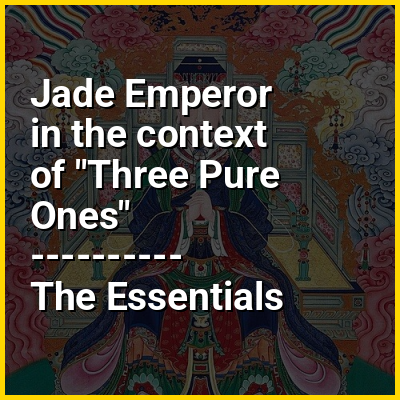
Jade Emperor in the context of Three Pure Ones


Jade Emperor in the context of Three Pure Ones

⭐ Core Definition: Jade Emperor

In the myths and folk religion of Chinese culture, the Jade Emperor or Yudi is one of the representations of the primordial god.

In Taoist theology, he is the assistant of Yuanshi Tianzun, who is one of the Three Pure Ones, the three primordial emanations of the Tao. However, some Taoists in history were skeptical of his benevolence because his buildings and infrastructure in heaven and earth were sometimes seen as interfering with the many natural laws or dao.
↓ Menu
HINT:

In this Dossier

Jade Emperor in the context of Mount Tai

Mount Tai (Chinese: 泰山; pinyin: Tài Shān) is a mountain of historical and cultural significance located north of the city of Tai'an. It is the highest point in Shandong province, China. The tallest peak is the Jade Emperor Peak (simplified Chinese: ; traditional Chinese: ; pinyin: Yùhuáng Dǐng), which is commonly reported as being 1,545 meters (5,069 ft) tall.

Mount Tai is known as the eastern mountain of the Sacred Mountains of China. It is associated with sunrise, birth, and renewal, and is often regarded the foremost of the five. Mount Tai has been a place of worship for at least 3,000 years and served as one of the most important ceremonial centers of China during large portions of this period. Because of its sacred importance and dramatic landscape, it was made a UNESCO World Heritage Site in 1987. It meets 7 of the 10 evaluation standards for World Heritage sites, and is listed as a World Heritage site that meets the most of the standards, along with the Tasmanian Wilderness World Heritage Area in Australia.

View the full Wikipedia page for Mount Tai
↑ Return to Menu

Jade Emperor in the context of Tai Sui

Tai Sui is a Chinese name for stars directly opposite the planet Jupiter (Chinese: 木星; pinyin: Mùxīng) in its roughly 12-year orbital cycle. Personified as deities, they are important features of Chinese astrology, Feng Shui, Taoism, and to a lesser extent Chinese Buddhism.

The 12 signs of the Chinese zodiac were based on divisions of the Jovian orbital cycle, rather than as in the western zodiac—the apparent motion of the sun relative to the celestial sphere. The star thought to oppose Jupiter during each year of the cycle was personified as a heavenly general [zh] or cycle god and was believed to help the Jade Emperor control the mortal world.

View the full Wikipedia page for Tai Sui
↑ Return to Menu

Jade Emperor in the context of Zaoshen

The kitchen deity – also known as the Stove God, named Zao Jun, Zao Shen, Zao kimjah, Cokimjah or Zhang Lang – is the most important of a plethora of Chinese domestic gods that protect the hearth and family. The Kitchen God is recognized in Chinese folk religion, Chinese mythology, and Taoism. He is also celebrated throughout the Sinosphere.

It is believed that on the twenty-third day of the twelfth lunisolar month, just before Chinese New Year, the Kitchen deity returns to Heaven to report the activities of every household over the past year to Yu Huang Da Di (Chinese: 玉皇大帝; pinyin: Yùhuángdàdì), the Jade Emperor. The Jade Emperor, emperor of the heavens, either rewards or punishes a family based on Zao Jun's yearly report.

View the full Wikipedia page for Zaoshen
↑ Return to Menu

Jade Emperor in the context of Laojun

Daode Tianzun (Chinese: 道德天尊; lit. 'The Heavenly Lord of Way and Virtue'), also known as Ultra Supreme Elder Lord (Chinese: 太上老君) is a supreme Taoist divinity. He is the Ultra Purity (太清) among the Three Pure Ones, the highest divinities of Taoism.

The historical Lao Tzu who authored the Scripture of Way and Virtue is considered a manifestation of Ultra Supreme Elder Lord. Taoism typically presents the Jade Emperor as the official head of heaven, while the Three Pure Ones are at the top of the pantheon of gods.

View the full Wikipedia page for Laojun
↑ Return to Menu

Jade Emperor in the context of Zhengyi Taoism

Zhengyi Dao (Chinese: 正一道; pinyin: Zhèng Yī Dào), also known as the Way of Orthodox Unity, Teaching of the Orthodox Unity, and Branch of the Orthodox Unity is a Chinese Taoist movement that traditionally refers to the same Taoist lineage as the Way of the Five Pecks of Rice and Way of the Celestial Masters, but in the period of the Tang dynasty and its history thereafter. Like the Way of Celestial Masters (Tianshi Dao), the leader of Zhengyi Taoism was known as the Celestial Master.

View the full Wikipedia page for Zhengyi Taoism
↑ Return to Menu