Italian wolf in the context of "Central Apennines"

Play Trivia Questions online!

or

Skip to study material about Italian wolf in the context of "Central Apennines"

Ad spacer

⭐ Core Definition: Italian wolf

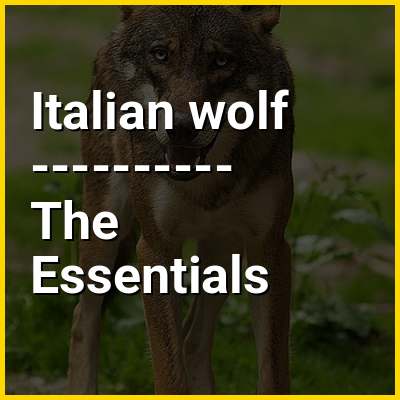
The Italian wolf (Canis lupus italicus or Canis lupus lupus), also known as the Apennine wolf, is a subspecies of the grey wolf native to the Italian Peninsula. It inhabits the Apennine Mountains and the Western Alps, though it is undergoing expansion towards the north and east. As of 2022 the wolf population within Italy is estimated to be 3,307 individuals. Although not universally recognised as a distinct subspecies, it nonetheless possesses a unique mtDNA haplotype and a distinct skull morphology.

It has been strictly protected in Italy since the 1970s, when the population reached a low of 70–100 individuals. The population is increasing in number, though illegal hunting and persecution still constitute a threat. Since the 1990s, the Italian wolf's range has expanded into southeastern France and Switzerland.
↓ Menu

>>>PUT SHARE BUTTONS HERE<<<
In this Dossier

Italian wolf in the context of She-wolf (Roman mythology)

In the Roman foundation myth, the She-Wolf (lupa in Latin) was an Italian wolf who nursed and sheltered the twins Romulus and Remus after they were abandoned in the wild by decree of King Amulius of Alba Longa. She cared for the infants at her den, a cave known as the Lupercal, until they were discovered by a shepherd, Faustulus. Romulus would later become the founder and first king of Rome and both twins became famous throughout history as the founders of the Rome we know today. The image of the She-Wolf suckling the twins has been a symbol of Rome since ancient times and is one of the most recognizable icons of ancient mythology.

↑ Return to Menu

Italian wolf in the context of Apennine Mountains

The Apennines or Apennine Mountains (/ˈæpənn/ AP-ə-nyne; Italian: Appennini [appenˈniːni]) are a mountain range consisting of parallel smaller chains extending c. 1,200 km (750 mi) the length of peninsular Italy. In the northwest they join the Ligurian Alps at Altare. In the southwest they end at Reggio di Calabria, the coastal city at the tip of the peninsula. Since 2000 the Environment Ministry of Italy, following the recommendations of the Apennines Park of Europe Project, has defined the Apennines System to include the mountains of north Sicily, a total distance of 1,500 kilometres (930 mi). The system forms an arc enclosing the east of the Ligurian and Tyrrhenian seas.

The Apennines conserve some intact ecosystems that have survived human intervention. In these are some of the best-preserved forests and montane grasslands in Europe, now protected by national parks and, within them, a high diversity of flora and fauna. These mountains are one of the last refuges of the big European predators such as the Italian wolf and the Marsican brown bear, now extinct in the rest of Central Europe.

↑ Return to Menu

Italian wolf in the context of Parco Nazionale d'Abruzzo, Lazio e Molise

Abruzzo, Lazio and Molise National Park (Italian: Parco Nazionale d'Abruzzo, Lazio e Molise) is an Italian national park established in 1923. The majority of the park is located in the Abruzzo region, with smaller parts in Lazio and Molise. It is sometimes called by its former name Abruzzo National Park. The park headquarters are in Pescasseroli in the Province of L'Aquila. The park's area is 496.80 km (191.82 sq mi).

It is the oldest park in the Apennine Mountains, and the second oldest in Italy, with an important role in the preservation of species such as the Italian wolf, Abruzzo chamois and Marsican brown bear. Other characteristic fauna of the park are red deer and roe deer, wild boar and the white-backed woodpecker. The protected area is around two thirds beech forest, though many other tree species grow in the area, including silver birch and black and mountain pines.

↑ Return to Menu