Italian fascism in the context of "Italian Syndicalist Union"

Play Trivia Questions online!

or

Skip to study material about Italian fascism in the context of "Italian Syndicalist Union"

Ad spacer

⭐ Core Definition: Italian fascism

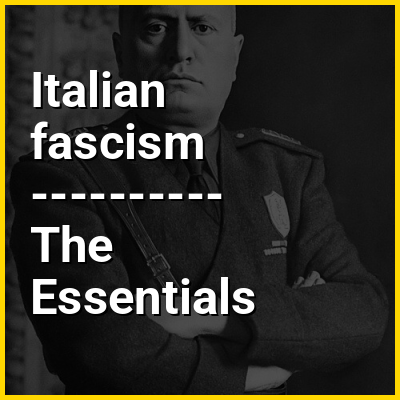
Italian fascism (Italian: fascismo italiano), also called classical fascism and fascism, is the original fascist ideology, which Giovanni Gentile and Benito Mussolini developed in Italy. The ideology of Italian fascism is associated with a series of political parties led by Mussolini: the National Fascist Party (PNF), which governed the Kingdom of Italy from 1922 until 1943, and the Republican Fascist Party (PFR), which governed the Italian Social Republic from 1943 to 1945. Italian fascism also is associated with the post–war Italian Social Movement (MSI) and later Italian neo-fascist political organisations.

Italian fascism originated from ideological combinations of ultranationalism and Italian nationalism, national syndicalism and revolutionary nationalism, and from the militarism of Italian irredentism to regain "lost overseas territories of Italy" deemed necessary to restore Italian nationalist pride. Italian Fascists also claimed that modern Italy was an heiress to the imperial legacy of Ancient Rome, and that there existed historical proof which supported the creation of an Imperial Fascist Italy to provide spazio vitale (vital space) for the Second Italo-Senussi War of Italian settler colonisation en route to establishing hegemonic control of the terrestrial basin of the Mediterranean Sea.
↓ Menu

>>>PUT SHARE BUTTONS HERE<<<
In this Dossier

Italian fascism in the context of Fascism in Europe

Fascist movements in Europe were the set of various fascist ideologies which were practiced by governments and political organizations in Europe during the 20th century. Fascism was born in Italy following World War I, and other fascist movements, influenced by Italian fascism, subsequently emerged across Europe. Among the political doctrines which are identified as ideological origins of fascism in Europe are the combining of a traditional national unity and revolutionary anti-democratic rhetoric which was espoused by the integral nationalist Charles Maurras and the revolutionary syndicalist Georges Sorel.

The earliest foundations of fascism in practice can be seen in the Italian Regency of Carnaro, led by the Italian nationalist Gabriele D'Annunzio, many of whose politics and aesthetics were subsequently used by Benito Mussolini and his Italian Fasces of Combat which Mussolini had founded as the Fasces of Revolutionary Action in 1914. Despite the fact that its members referred to themselves as "fascists", the ideology was based around national syndicalism. The ideology of fascism would not fully develop until 1921, when Mussolini transformed his movement into the National Fascist Party, which then in 1923 incorporated the Italian Nationalist Association. The INA established fascist tropes such as colored shirt uniforms and also received the support of important proto-fascists like D'Annunzio and nationalist intellectual Enrico Corradini.

↑ Return to Menu

Italian fascism in the context of Fascism

Fascism (/ˈfæʃɪzəm/ FASH-iz-əm) is a far-right, authoritarian, and ultranationalist political ideology and movement that rose to prominence in early-20th-century Europe. Fascism is characterized by support for a dictatorial leader, centralized autocracy, militarism, forcible suppression of opposition, belief in a natural social hierarchy, subordination of individual interests for the perceived interest of the nation or race, and strong regimentation of society and the economy. Opposed to communism, democracy, liberalism, pluralism, and socialism, fascism is at the far-right of the traditional left–right spectrum.

The first fascist movements emerged in Italy during World War I before spreading to other European countries, most notably Germany. Fascism also had adherents outside of Europe. Fascists saw World War I as a revolution that brought massive changes to the nature of war, society, the state, and technology. The advent of total war and the mass mobilization of society erased the distinction between civilians and combatants. A military citizenship arose, in which all citizens were involved with the military in some manner. The war resulted in the rise of a powerful state capable of mobilizing millions of people to serve on the front lines, providing logistics to support them, and having unprecedented authority to intervene in the lives of citizens.

↑ Return to Menu

Italian fascism in the context of Federal State of Austria

The Federal State of Austria (Austrian German: Bundesstaat Österreich; colloquially known as the "Ständestaat") was a continuation of the First Austrian Republic between 1934 and 1938 when it was a one-party state led by the conservative, nationalist, corporatist, clerical fascist and Catholic Fatherland Front. The Ständestaat concept, derived from the notion of Stände ("estates" or "corporations"), was advocated by leading regime politicians such as Engelbert Dollfuss and Kurt Schuschnigg. The result was a authoritarian government based on a mix of Italian Fascist and conservative Catholic influences.

It ended in March 1938 with the Anschluss, the German annexation of Austria. Austria would not become an independent country again until 1955, when the Austrian State Treaty ended the Allied occupation of Austria.

↑ Return to Menu

Italian fascism in the context of Mare Nostrum

In the Roman Empire, Mare Nostrum was a term that referred to the Mediterranean Sea. Meaning "Our Sea" in Latin, it denoted the body of water in the context of borders and policy; Rome remains the only state in history to have controlled the entire Mediterranean coast. The phrase would have been pronounced [ˈma.rɛ ˈnɔs.t̪rʊ̃ː] in Classical Latin, while it is pronounced [ˈmaː.rɛ ˈnɔs.t̪rum] in Ecclesiastical Latin.

The concept of "Mare Nostrum" is noteworthy for having risen to political significance after the unification of Italy in the 19th century, particularly among Italian nationalists and classical fascists, who attempted to revive the term with the connotation of Italy (and the Italian Empire shortly thereafter) being Rome's successor.

↑ Return to Menu

Italian fascism in the context of Slovene Littoral

The Slovene Littoral, or simply Littoral (Slovene: Primorska, pronounced [pɾiˈmóːɾska] ; Italian: Litorale; German: Küstenland), is one of the traditional regions of Slovenia. The littoral in its name – for a coastal-adjacent area – recalls the former Austrian Littoral (Avstrijsko Primorje), the Habsburg possessions on the upper Adriatic coast, of which the Slovene Littoral was part. Today, the Littoral is often associated with the Slovenian ethnic territory that, in the first half of the 20th century, found itself in Italy to the west of the Rapallo Border, which separated a quarter of Slovenes from the rest of the nation, and was strongly influenced by Italian fascism.

↑ Return to Menu

Italian fascism in the context of Benito Mussolini

Benito Amilcare Andrea Mussolini (29 July 1883 – 28 April 1945) was an Italian politician and journalist who was the dictator of Italy during the Fascist era from the March on Rome in 1922 until his overthrow in 1943. He founded the National Fascist Party (PNF) and served as Prime Minister of Italy from 1922, later adopting the title Duce ("leader") of Italian fascism. Mussolini first organized the Italian Fasces of Combat in 1919, which evolved into the PNF that established a totalitarian regime. As the founder of fascism, Mussolini was a key inspiration and contributor to the rise of similar movements across Europe during the interwar period.

Mussolini was originally a socialist politician and journalist at the Avanti! newspaper. In 1912, he became a member of the National Directorate of the Italian Socialist Party (PSI), but was expelled for advocating military intervention in World War I. In 1914, Mussolini founded a newspaper, Il Popolo d'Italia, and served in the Royal Italian Army until he was wounded and discharged in 1917. He eventually denounced the PSI, his views pivoting to focus on Italian nationalism, and founded the fascist movement which opposed egalitarianism and class conflict, instead advocating "revolutionary nationalism" transcending class lines. In October 1922, following the March on Rome, he was appointed prime minister by King Victor Emmanuel III. After removing opposition through his secret police and outlawing labour strikes, Mussolini and his followers consolidated power through laws that transformed the nation into a one-party dictatorship. Within five years, he established dictatorial authority by legal and illegal means and aspired to create a totalitarian state. In 1929, he signed the Lateran Treaty to establish Vatican City.

↑ Return to Menu

Italian fascism in the context of Italian Fasces of Combat

The Fasci Italiani di Combattimento (English: Italian Fasces of Combat, also translatable as 'Italian Fighting Bands' or 'Italian Fighting Leagues') was an Italian fascist organisation created by Benito Mussolini in 1919. It was the successor of the Fasci d'Azione Rivoluzionaria, being notably further right than its predecessor. The Fasci Italiani di Combattimento was reorganised into the National Fascist Party in 1921.

The Fasci Italiani di Combattimento was founded by Mussolini and his supporters in the aftermath of World War I, at a meeting held in Milan in March 1919. It was an ultranationalist organisation that intended to appeal to war veterans from across the political spectrum, at first without a clear political orientation. It was closely associated with Mussolini's newspaper, Il Popolo d'Italia, and Mussolini served as the leader (Duce) of the movement throughout its existence.

↑ Return to Menu

Italian fascism in the context of National Fascist Party

The National Fascist Party (Italian: Partito Nazionale Fascista, PNF) was a political party in Italy, created by Benito Mussolini as the political expression of Italian fascism and as a reorganisation of the previous Italian Fasces of Combat. The party ruled the Kingdom of Italy from 1922 when Fascists took power with the March on Rome until the fall of the Fascist regime in 1943, when Mussolini was deposed by the Grand Council of Fascism. The National Fascist Party was succeeded by the Republican Fascist Party in the territories under the control of the Italian Social Republic, and it was ultimately dissolved at the end of World War II.

The National Fascist Party was rooted in Italian nationalism and the desire to restore and expand Italian territories, which Italian Fascists deemed necessary for a nation to assert its superiority and strength and to avoid succumbing to decay. Italian Fascists claimed that modern Italy was the heir to ancient Rome and its legacy and historically supported the idea of ​​continued expansion of the Italian Empire to provide spazio vitale ("living space") for colonisation by Italian settlers and to establish control over the Mediterranean Sea. The party also supported social conservative stances.

↑ Return to Menu