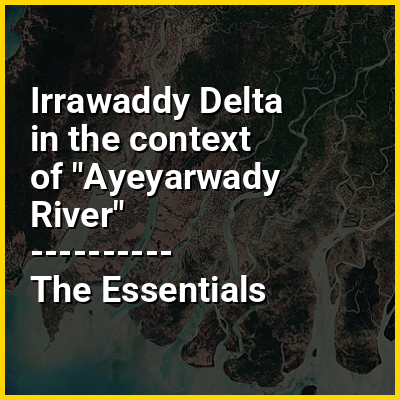
The Irrawaddy Delta or Ayeyarwady Delta lies in the Irrawaddy Division, the lowest expanse of land in Myanmar that fans out from the limit of tidal influence at Myan Aung to the Bay of Bengal and Andaman Sea, 290 kilometres (180 mi) to the south at the mouth of the Ayeyarwady River. The delta region is densely populated, and plays a dominant role in rice cultivation in its rich alluvial soil as low as just 3 metres (9.8 ft) above sea level. It also includes fishing communities in a vast area full of rivers and streams.
HINT:
In this Dossier
- ⭐ Core Definition: Irrawaddy Delta
- Irrawaddy Delta in the context of Lower Burma
- Irrawaddy Delta in the context of Mon people
- Irrawaddy Delta in the context of Irrawaddy River
- Irrawaddy Delta in the context of Hanthawaddy Kingdom
- Irrawaddy Delta in the context of Karen people
Irrawaddy Delta in the context of Lower Burma
Lower Myanmar (Burmese: အောက်မြန်မာပြည်, also called Lower Burma) is a geographic region of Myanmar and includes the low-lying Irrawaddy Delta (Ayeyarwady, Bago and Yangon Regions), as well as coastal regions of the country (Rakhine, Kayin and Mon States and Tanintharyi Region).
In the Burmese language, people originating from Upper Myanmar are typically called a-nya-tha for men and a-nya-thu for women, whereas those from Lower Myanmar are called auk tha (အောက်သား) for men and auk thu for women.
View the full Wikipedia page for Lower BurmaIrrawaddy Delta in the context of Mon people
The Mon (Mon: ဂကူမန်; Thai Mon: ဂကူမည်; Burmese: မွန်လူမျိုး, pronounced [mʊ̀ɰ̃ lù mjó]; Thai: มอญ, pronounced [mɔ̄ːn] ) are an ethnic group who inhabit Lower Myanmar's Mon State, Kayin State, Kayah State, Tanintharyi Region, Bago Region, the Irrawaddy Delta, and several areas in Thailand (mostly in Pathum Thani province, Phra Pradaeng and Nong Ya Plong). The native language is Mon, which belongs to the Monic branch of the Austroasiatic language family and shares a common origin with the Nyah Kur language, which is spoken by the people of the same name that live in Northeastern Thailand. A number of languages in Mainland Southeast Asia are influenced by the Mon language, which is also in turn influenced by those languages.
The Mon were one of the earliest to reside in Southeast Asia, and were responsible for the spread of Theravada Buddhism in Mainland Southeast Asia. The civilizations founded by the Mon were some of the earliest in Thailand as well as Myanmar and Laos. The Mon are regarded as a large exporter of Southeast Asian culture. Historically, many cities in Myanmar, Thailand, and Laos today, including Yangon, Pathum Thani, Lamphun, Lampang, and Vientiane were founded either by the Mon people or Mon rulers.
View the full Wikipedia page for Mon peopleIrrawaddy Delta in the context of Irrawaddy River
The Irrawaddy River (Burmese: ဧရာဝတီမြစ်, pronounced [ʔèjàwədì mjɪʔ], official romanisation: Ayeyarwady) is the principal river of Myanmar, running through the centre of the country. Myanmar's most important commercial waterway, it is about 1,350 miles (2,170 km) long. Originating from the confluence of the N'mai and Mali rivers, it flows from north to south before emptying through the Irrawaddy Delta in the Ayeyarwady Region into the Andaman Sea. Its drainage basin of about 404,000 square kilometres (156,000 sq mi) covers 61% of the land area of Burma, and contains five of its largest cities.
As early as the sixth century, the river was used for trade and transport, and an extensive network of irrigation canals was developed to support agriculture. The river is still of great importance as the largest commercial waterway of Myanmar. It also provides important ecosystem services to different communities and economic sectors, including agriculture, fisheries, and tourism.
View the full Wikipedia page for Irrawaddy RiverIrrawaddy Delta in the context of Hanthawaddy Kingdom
The Hanthawaddy kingdom (Mon: ဍုၚ် ဟံသာဝတဳ, [hɔŋsawətɔe]; Burmese: ဟံသာဝတီ နေပြည်တော်; also Rone Hongsarwatoi or simply Pegu) was the polity that ruled lower Burma (Myanmar) from 1287 to 1539 and from 1550 to 1552. The Mon-speaking kingdom was founded as Ramaññadesa (Mon: ရးမည, Burmese: ရာမည ဒေသ) by King Wareru following the collapse of the Pagan kingdom in 1287 as a nominal vassal state of the Sukhothai kingdom and of the Mongol Yuan dynasty. The kingdom became formally independent of Sukhothai in 1330 but remained a loose federation of three major regional power centres: the Irrawaddy Delta, Bago, and Mottama. Its kings had little or no authority over the vassals. Mottama was in open rebellion from 1363 to 1388.
View the full Wikipedia page for Hanthawaddy KingdomIrrawaddy Delta in the context of Karen people
The Karen (/kəˈrɛn/ kə-REN), also known as the Kayin, are an ethnolinguistic group of peoples who speak Karenic languages and are indigenous to southern and southeastern Myanmar, including the Irrawaddy delta and Kayin State. The Karen account for around 6.69% of the Burmese population. The Karen consist of approximately 20 subgroups, the largest of whom are the S'gaw and the Pwo peoples. Other Karenic-speaking peoples like the Pa'O, Karenni, and the Kayan, have formed distinct identities.
The ethnic identity of the Karen peoples has significantly been shaped by British colonial rule, Christian missionaries, decolonisation, and sociopolitical developments in Myanmar. The group as a whole is heterogeneous and disparate, as many Karenic ethnic groups do not share a common language, culture, religion, or material characteristics. A pan-Karen ethnic identity is a relatively modern creation, established in the 19th century with the conversion of some Karen to Christianity, and mediated by British colonial policies and practices.
View the full Wikipedia page for Karen people