Iris flower data set in the context of "Iris setosa"

Play Trivia Questions online!

or

Skip to study material about Iris flower data set in the context of "Iris setosa"

Ad spacer

⭐ Core Definition: Iris flower data set

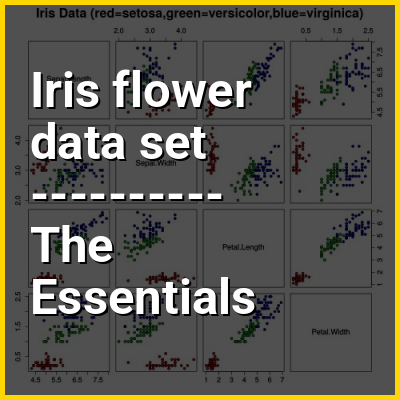
The Iris flower data set or Fisher's Iris data set is a multivariate data set used and made famous by the British statistician and biologist Ronald Fisher in his 1936 paper The use of multiple measurements in taxonomic problems as an example of linear discriminant analysis. It is sometimes called Anderson's Iris data set because Edgar Anderson collected the data to quantify the morphologic variation of Iris flowers of three related species. Two of the three species were collected in the Gaspé Peninsula "all from the same pasture, and picked on the same day and measured at the same time by the same person with the same apparatus".

The data set consists of 50 samples from each of three species of Iris (Iris setosa, Iris virginica and Iris versicolor). Four features were measured from each sample: the length and the width of the sepals and petals, in centimeters. Based on the combination of these four features, Fisher developed a linear discriminant model to distinguish each species. Fisher's paper was published in the Annals of Eugenics (today the Annals of Human Genetics).
↓ Menu

>>>PUT SHARE BUTTONS HERE<<<
In this Dossier

Iris flower data set in the context of Statistics

Statistics (from German: Statistik, orig. "description of a state, a country") is the discipline that concerns the collection, organization, analysis, interpretation, and presentation of data. In applying statistics to a scientific, industrial, or social problem, it is conventional to begin with a statistical population or a statistical model to be studied. Populations can be diverse groups of people or objects such as "all people living in a country" or "every atom composing a crystal". Statistics deals with every aspect of data, including the planning of data collection in terms of the design of surveys and experiments.

When census data (comprising every member of the target population) cannot be collected, statisticians collect data by developing specific experiment designs and survey samples. Representative sampling assures that inferences and conclusions can reasonably extend from the sample to the population as a whole. An experimental study involves taking measurements of the system under study, manipulating the system, and then taking additional measurements using the same procedure to determine if the manipulation has modified the values of the measurements. In contrast, an observational study does not involve experimental manipulation.

↑ Return to Menu

Iris flower data set in the context of Data set

A data set (or dataset) is a collection of data. In the case of tabular data, a data set corresponds to one or more database tables, where every column of a table represents a particular variable, and each row corresponds to a given record of the data set in question. The data set lists values for each of the variables, such as for example height and weight of an object, for each member of the data set. Data sets can also consist of a collection of documents or files.

In the open data discipline, a data set is a unit used to measure the amount of information released in a public open data repository. The European data.europa.eu portal aggregates more than a million data sets.

↑ Return to Menu

Iris flower data set in the context of Iris virginica

Iris virginica, with the common name Virginia blueflag, Virginia iris, great blue flag, or southern blue flag, is a perennial species of flowering plant in the Iridaceae (iris) family, native to central and eastern North America.

It was identified as a separate species by Edgar Anderson, and is one of the three Iris species in Anderson's Iris flower data set, used by Ronald Fisher in his 1936 paper "The use of multiple measurements in taxonomic problems" as an example of linear discriminant analysis.

↑ Return to Menu