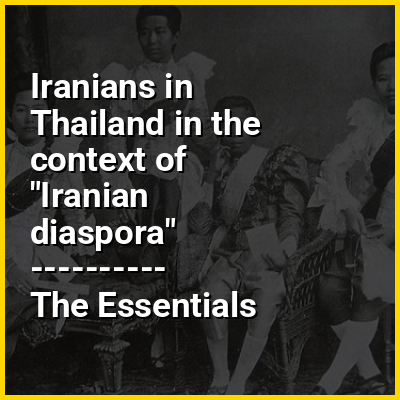
Iranian migration to Thailand began as early as the 17th century. Thai citizens of Iranian descent may be called in Thai as Khaek Ma-ngon, Khaek Mahon or Khaek Chaosen. There is a community of Thai people of Iranian descent who still practice Shia Islam in many districts throughout Bangkok, such as Yan Nawa, Bueng Kum, Saphan Sung, and Min Buri, as well as parts of Chachoengsao Province.
HINT:
In this Dossier
- ⭐ Core Definition: Iranians in Thailand
- Iranians in Thailand in the context of Culture of Thailand
- Iranians in Thailand in the context of Ethnic groups in Thailand
Iranians in Thailand in the context of Culture of Thailand
The culture of Thailand is a unique blend of various influences that have evolved over time. Local customs, animist beliefs, Hindu, Buddhist traditions, and regional ethnic and cultural practices have all played a role in shaping Thai culture. Thainess, which refers to the distinctive qualities that define the national identity of Thailand, is evident in the country's history, customs, and traditions. While Buddhism remains the dominant religion in Thailand with more than 40,000 temples, Islam, Christianity, and other faiths are also practiced.
Thailand's historical and cultural heritage has been shaped by interactions with neighboring cultures as well as far-reaching cultures such as Indian, Chinese, Japanese, Khmer, Portuguese, and Persian, with the ancient city of Ayutthaya serving as a global trade center. Early European visitors also recognized Ayutthaya as one of the great powers of Asia, alongside China and India, highlighting the city's importance and influence in the region. In modern times, Thailand's cultural landscape has been shaped by the influence of global trends. This includes the adoption of modern educational practices and the promotion of science and technology, while also preserving traditional customs and practices.
View the full Wikipedia page for Culture of ThailandIranians in Thailand in the context of Ethnic groups in Thailand
Thailand is a country of some 70 ethnic groups, including at least 24 groups of ethnolinguistically Tai peoples, mainly the Central, Southern, Northeastern, and Northern Thais; 22 groups of Austroasiatic peoples, with substantial populations of Northern Khmer and Kuy; 11 groups speaking Sino-Tibetan languages ('hill tribes'), with the largest in population being the Karen; 3 groups of Austronesian peoples, i.e., the Malay, the majority ethnic group in the southernmost three provinces, together with the Moken and Urak Lawoi ('sea gypsies'); and both groups of Hmong-Mien. Other ethnic groups include longstanding immigrant communities such as the Chinese, Indians, Persian, and Portuguese.
View the full Wikipedia page for Ethnic groups in Thailand