Iranian Plateau in the context of "Parthia"

Play Trivia Questions online!

or

Skip to study material about Iranian Plateau in the context of "Parthia"

Ad spacer

⭐ Core Definition: Iranian Plateau

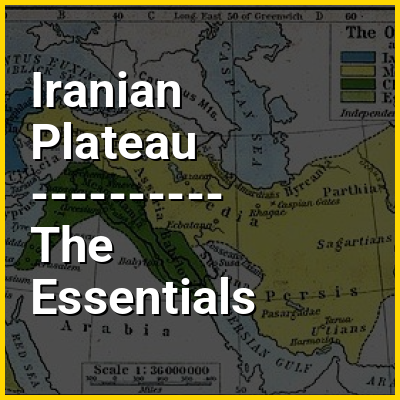
The Iranian plateau or Persian plateau is a geological feature spanning parts of the Caucasus, Central Asia, South Asia, and West Asia. It makes up part of the Eurasian plate, and is wedged between the Arabian plate and the Indian plate. The plateau is situated between the Zagros Mountains to the west, the Caspian Sea and the Köpet Dag to the north, the Armenian Highlands and the Caucasus Mountains to the northwest, the Strait of Hormuz and the Persian Gulf to the south, and the Indian subcontinent to the southeast.

As a historical region, it includes Parthia, Media, Persis, and some of the previous territories of Greater Iran. The Zagros form the plateau's western boundary, and its eastern slopes may also be included in the term. The Encyclopædia Britannica excludes "lowland Khuzestan" explicitly and characterizes Elam as spanning "the region from the Mesopotamian plain to the Iranian Plateau".

↓ Menu

>>>PUT SHARE BUTTONS HERE<<<
In this Dossier

Iranian Plateau in the context of Caspian Sea

The Caspian Sea is the world's largest inland body of water, described as the world's largest lake and usually referred to as a full-fledged sea. An endorheic basin, it is situated in both Europe and Asia: east of the Caucasus, west of the broad steppe of Central Asia, south of the fertile plains of Southern Russia in Eastern Europe, and north of the mountainous Iranian Plateau. It covers a surface area of 371,000 km (143,000 sq mi) (excluding the highly saline lagoon of Garabogazköl to its east), an area approximately equal to that of Japan, with a volume of 78,200 km (19,000 cu mi). It has a salinity of approximately 1.2% (12 g/L), about a third of the salinity of average seawater. It is bounded by Kazakhstan to the northeast, Russia to the northwest, Azerbaijan to the southwest, Iran to the south, and Turkmenistan to the southeast. The name of the Caspian Sea is derived from the ancient Iranic Caspi people.

The lake stretches 1,200 km (750 mi) from north to south, with an average width of 320 km (200 mi). Its gross coverage is 386,400 km (149,200 sq mi) and the surface is about 27 m (89 ft) below sea level. Its main freshwater inflow, Europe's longest river, the Volga, enters at the shallow north end. Two deep basins form its central and southern zones. These lead to horizontal differences in temperature, salinity, and ecology. The seabed in the south reaches 1,023 m (3,356 ft) below sea level, which is the third-lowest natural non-oceanic depression on Earth after Baikal and Tanganyika lakes.

↑ Return to Menu

Iranian Plateau in the context of Armenian highland

The Armenian highlands (Armenian: Հայկական լեռնաշխարհ, romanizedHaykakan leṙnašxarh; also known as the Eastern Anatolian highlands, Armenian upland, Armenian plateau, or Armenian tableland) comprise the most central and the highest of the three plateaus that together form the northern sector of West Asia. Clockwise starting from the west, the Armenian highlands are bounded by the Anatolian plateau, the Caucasus, the Kura-Aras lowlands, the Iranian Plateau, and Mesopotamia. The highlands are divided into western and eastern regions, defined by the Ararat Valley where Mount Ararat is located. Since the turn of the 20th century, Western Armenia has been relabeled as "Eastern Anatolia" by Ottoman and Turkish authorities. Eastern Armenia is part of Lesser Caucasus, which was historically known by some as the Anti-Caucasus, meaning "opposite of the Caucasus".

During the Iron Age, the region was known by variations of the name Ararat (Urartu, Uruatri, Urashtu). Later, the Highlands were known as Armenia Major, a central region to the history of Armenians, and one of the four geopolitical regions associated with Armenians, the other three being Armenia Minor, Sophene, and Commagene. The highlands are primarily defined by the geographical dispersal of its native inhabitants, the Armenians. Prior to the appearance of nominally Armenian people in historical records, historians have hypothesized that the region must have been home to various ethnic groups who became homogenous when the Armenian language came to prominence. The population of the Armenian highlands has had a high level of regional genetic continuity for over 6,000 years. Recent studies indicate that the Armenian people descend from the indigenous people of the Armenian highlands and form a distinct genetic isolate in the region. The region was also inhabited during Antiquity by minorities such as Assyrians, Georgians, Greeks, Jews, and Iranians. During the Middle Ages, Arabs and particularly Turkmens and Kurds settled in large numbers in the Armenian highlands.
↑ Return to Menu

Iranian Plateau in the context of Ancient Iranian peoples

Iranian peoples, or Iranic peoples, are a diverse ethnolinguistic group who are identified chiefly by their native usage of any of the Iranian languages, which are a branch of the Indo-Iranian languages within the Indo-European language family.

The Proto-Iranians are believed to have emerged as a separate branch of the Indo-Iranians in Central Asia around the mid-2nd millennium BC. At their peak of expansion in the mid-1st millennium BC, the territory of the Iranian peoples stretched across the entire Eurasian Steppe; from the Danubian Plains in the west to the Ordos Plateau in the east and the Iranian Plateau in the south.

↑ Return to Menu

Iranian Plateau in the context of Iranian religions

The Iranian religions, also known as the Persian religions, are, in the context of comparative religion, a grouping of religious movements that originated in the Iranian plateau, which accounts for the bulk of what is called "Greater Iran".

↑ Return to Menu

Iranian Plateau in the context of Zoroastrianism in India

Zoroastrianism, an Iranian religion, has been present in India for thousands of years. Though it split into a separate branch, it shares a common origin with Hinduism and other Indian religions, having been derived from the Indo-Iranian religion. Though it was once the majority and official religion of the Iranian nation, Zoroastrianism eventually shifted to the Indian subcontinent in light of the Muslim conquest of Iran, which saw the Rashidun Caliphate annex the Sasanian Empire by 651 CE. Owing to the persecution of Zoroastrians in the post-Sasanian period, a large wave of Iranian migrants fled to India, where they became known as the Parsi people, who now represent India's oldest Zoroastrian community. Later waves of Zoroastrian immigration to India took place over the following centuries, with a spike in the number of these refugees occurring during the Safavid conversion of Iran to Shia Islam and again during the reign of the Qajar dynasty, whose persecution of Zoroastrians prompted many to flee to British India, where they became known as the Irani people. Though Zoroastrian, the Parsis and the Iranis are culturally, linguistically, and socially distinct from each other due to their inception in separate periods of migration.

The comparatively liberal atmosphere of India and the protection provided by historical Indian kingdoms to their Zoroastrian subjects enabled the religion to flourish outside of the Iranian plateau. Today, India is home to the largest Zoroastrian population in the world, and despite their overall low population number, Indian Zoroastrians have had a significant impact on India's economy, culture, politics and military, and also played a major role in the Indian independence movement.

↑ Return to Menu

Iranian Plateau in the context of Zoroastrianism in Iran

Zoroastrianism is considered to be the oldest religion still practiced in Iran. It is an Iranian religion that emerged around the 2nd millennium BCE, spread through the Iranian plateau, and eventually gained official status under the Achaemenid Empire in the 6th century BCE. It remained the Iranian state religion until the 7th century CE, when the Arab conquest of Persia resulted in the fall of the Sasanian Empire to the nascent Rashidun Caliphate. Over time, Zoroastrians became a religious minority amidst the Islamization of Iran, as due to persecution many fled east to take refuge in India. Some of Zoroastrianism's holiest sites are located in Iran, such as Yazd.

Today, Iran has the second largest Zoroastrian population in the world, behind only India and possibly the Kurdistan Region. The official Iranian census of 2011 recorded a total of 25,271 Zoroastrians in the country, but several unofficial accounts suggest higher figures.

↑ Return to Menu