Inverness-shire in the context of Na h-Eileanan an Iar


Inverness-shire in the context of Na h-Eileanan an Iar

⭐ Core Definition: Inverness-shire

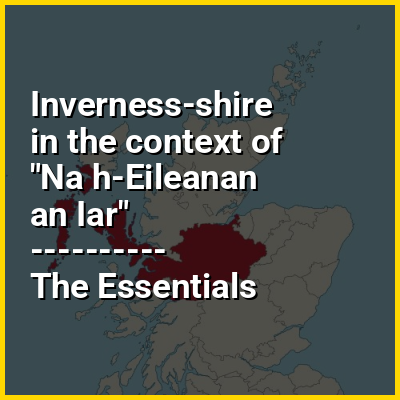
Inverness-shire (Scottish Gaelic: Siorrachd Inbhir Nis) or the County of Inverness, is a historic county in Scotland. It is named after Inverness, its largest settlement, which was also the county town. Covering much of the Highlands and some of the Hebrides, it is Scotland's largest county by land area. It is generally rural and sparsely populated, containing only three towns which held burgh status, being Inverness, Fort William and Kingussie. The county is crossed by the Great Glen, which contains Loch Ness and separates the Grampian Mountains to the south-east from the Northwest Highlands. The county also includes Ben Nevis, the highest mountain in both Scotland and the United Kingdom.

The county ceased to be used for local government purposes in 1975. Since then, the parts of the county on the mainland and in the Inner Hebrides have been part of the Highland region, which was redesignated a council area in 1996. The Outer Hebrides parts of the county became part of the Western Isles, which since 1998 has used only the Scots Gaelic version of its name, Na h-Eileanan an Iar. The neighbouring counties prior to the 1975 reforms were (clockwise from north) Ross and Cromarty, Nairnshire, Moray, Banffshire, Aberdeenshire, Perthshire and Argyll. The mainland part of the county had a coast to the east onto the Moray Firth, and a much longer coast to the west onto the Sea of the Hebrides.
↓ Menu
HINT:

In this Dossier

Inverness-shire in the context of Inverness

Inverness (/ˌɪnvərˈnɛs/ ; Scots: Innerness; from the Scottish Gaelic: Inbhir Nis [iɲɪɾʲˈniʃ], meaning "Mouth of the River Ness") is a city in the Scottish Highlands, having been granted city status in 2000. It is the administrative centre for The Highland Council and is regarded as the capital of the Highlands.

Historically it served as the county town of the county of Inverness-shire. Inverness lies near two important battle sites: the 11th-century battle of Blàr nam Fèinne against Norway which took place on the Aird, and the 18th century Battle of Culloden which took place on Culloden Moor. It is the northernmost city in the United Kingdom and lies within the Great Glen (Gleann Mòr) at its north-eastern extremity where the River Ness enters the Beauly Firth.

View the full Wikipedia page for Inverness
↑ Return to Menu

Inverness-shire in the context of Lochaber

Lochaber (/lɒxˈɑːbər/ lokh-AH-bər; Scottish Gaelic: Loch Abar) is a name applied to a part of the Scottish Highlands. Historically, it was a provincial lordship consisting of the parishes of Kilmallie and Kilmonivaig. Lochaber once extended from the Northern shore of Loch Leven, a district called Nether Lochaber, to beyond Spean Bridge and Roybridge, which area is known as Brae Lochaber or Braigh Loch Abar in Gaelic. For local government purposes, the name was used for one of the landward districts of Inverness-shire from 1930 to 1975, and then for one of the districts of the Highland region from 1975 to 1996. Since 1996 the Highland Council has had a Lochaber area committee.

The main town of Lochaber is Fort William. Other moderate sized settlements in Lochaber include Mallaig, Ballachulish and Glencoe.

View the full Wikipedia page for Lochaber
↑ Return to Menu

Inverness-shire in the context of Aberdeenshire (historic)

Aberdeenshire or the County of Aberdeen (Scots: Coontie o Aiberdeen, Scottish Gaelic: Siorrachd Obar Dheathain) is a historic county in Scotland. The county gives its name to the modern Aberdeenshire council area, which covers a larger area than the historic county. The historic county ceased to be used for local government purposes in 1975, but its boundaries are still used for certain functions, being a registration county. The area of the historic county excluding the Aberdeen City council area is also a lieutenancy area.

The area is generally hilly. The south-west of the county includes part of the Grampian Mountains. The historic county borders Kincardineshire, Angus and Perthshire to the south, Inverness-shire and Banffshire to the west, and the North Sea to the north and east.

View the full Wikipedia page for Aberdeenshire (historic)
↑ Return to Menu

Inverness-shire in the context of Perthshire

Perthshire or the County of Perth, is a historic county and registration county in central Scotland.

Geographically Perthshire extends from Strathmore in the east, to the Pass of Drumochter in the north, Rannoch Moor and Ben Lui in the west, and Aberfoyle in the south; it borders the counties of Inverness-shire and Aberdeenshire to the north, Angus to the east, Fife, Kinross-shire, Clackmannanshire, Stirlingshire and Dunbartonshire to the south and Argyllshire to the west.

View the full Wikipedia page for Perthshire
↑ Return to Menu

Inverness-shire in the context of Nairnshire

The County of Nairn, or Nairnshire, (Scottish Gaelic: Siorrachd Inbhir Narann) is a historic county, registration county and lieutenancy area of Scotland. The county was named after Nairn, its only town. The county was used for local government until 1975 when the area was redesignated as the Nairn District, one of the eight districts of the two-tier Highland region. Nairn district was abolished in 1996 when Highland became a single-tier council area.

The county borders Inverness-shire to the west and south, Moray to the east, and has a coastline along the Moray Firth to its north.

View the full Wikipedia page for Nairnshire
↑ Return to Menu

Inverness-shire in the context of Kingussie

Kingussie (/kɪŋˈjsi/ king-YOO-see; Scottish Gaelic: Ceann a' Ghiùthsaich pronounced [ˈkʲʰaun̪ˠə ˈʝuːs̪ɪç]) is a small town in the Badenoch and Strathspey ward of the Highland council area of Scotland. Historically in Inverness-shire, it lies beside the A9 road, although the old route of the A9 serves as the town's main street which has been bypassed since 1979. Kingussie is 42 miles (68 kilometres) south of Inverness, 12 mi (19 km) south of Aviemore, and 3 mi (5 km) north of Newtonmore.

View the full Wikipedia page for Kingussie
↑ Return to Menu

Inverness-shire in the context of The Aird

The Aird (from Scottish Gaelic An Àird, "the high place") is a district of Inverness-shire lying on the south side of the Beauly Firth, between the rivers Beauly and Ness. It includes the villages of Kirkhill, Kiltarlity, Lentran and Inchmore.

The Aird is the traditional heart of the Clan Fraser of Lovat's territory, containing their family seat of Beaufort Castle. The first known Lord of the Aird, however, was Iain Mac Eoin Nan Gleann or "John Bisset of the Glens" in English.

View the full Wikipedia page for The Aird
↑ Return to Menu

Inverness-shire in the context of Small Isles

The Small Isles (Scottish Gaelic: Na h-Eileanan Tarsainn) are a small archipelago in the Inner Hebrides, off the west coast of Scotland. They lie south of Skye and north of Mull and Ardnamurchan; the most westerly point of mainland Scotland.

Until 1891, Canna, Rùm and Muck belonged to the county of Argyll, while Eigg belonged to Inverness-shire. In that year, the entire archipelago was transferred to Inverness-shire. They now belong to the Highland council area.

View the full Wikipedia page for Small Isles
↑ Return to Menu

Inverness-shire in the context of Kilmonivaig

Kilmonivaig (Scottish Gaelic: Cill Mo Naomhaig) is a small village, situated close to the southeast end of Loch Lochy in Spean Bridge, Inverness-shire, Scottish Highlands and is in the Scottish council area of Highland.

Fort William lies approximately 15 miles southwest of Kilmonivaig.

View the full Wikipedia page for Kilmonivaig
↑ Return to Menu