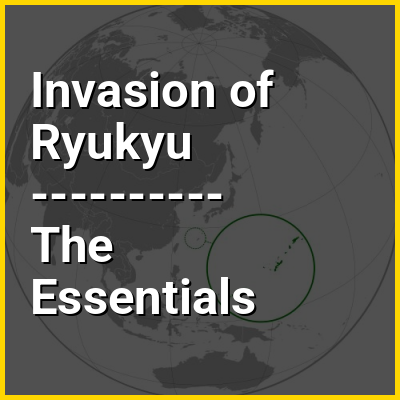
The invasion of Ryukyu (琉球侵攻, Ryūkyū Shinkō) by forces of the Japanese feudal domain of Satsuma took place from March to May of 1609, and marked the beginning of the Ryukyu Kingdom's status as a vassal state under the Satsuma domain.Former Satsuma territories that had been invaded by the Ryukyu Kingdom, such as the Amami Islands, were reintegrated into the Satsuma domain. The invasion force was met with stiff resistance from the Ryukyuan military on all but one island during the campaign. Ryukyu would remain a vassal state under Satsuma, alongside its already long-established tributary relationship with China, until it was formally annexed by Japan in 1879 as the Okinawa Prefecture.
HINT:
In this Dossier
- ⭐ Core Definition: Invasion of Ryukyu
- Invasion of Ryukyu in the context of Ryukyu Kingdom
- Invasion of Ryukyu in the context of Karate
- Invasion of Ryukyu in the context of Shunten
- Invasion of Ryukyu in the context of Kingdom of Ryukyu
Invasion of Ryukyu in the context of Ryukyu Kingdom
The Ryukyu Kingdom was a kingdom in the Ryukyu Islands from 1429 to 1872. It was ruled as a tributary state of the Ming dynasty by the Ryukyuan monarchy, who unified Okinawa Island to end the Sanzan period, and subsequently extended the kingdom to the Amami Islands and Sakishima Islands. The Ryukyu Kingdom played a central role in the maritime trade networks of medieval East Asia and Southeast Asia despite its small size. The Ryukyu Kingdom became a vassal state of the Satsuma Domain of Japan after the invasion of Ryukyu in 1609 but retained de jure independence until it was transformed into the Ryukyu Domain by the Empire of Japan in 1872. The Ryukyu Domain was formally annexed by Japan in 1879 and reorganized as Okinawa Prefecture, and the Ryukyuan monarchy was integrated into the new Japanese nobility.
View the full Wikipedia page for Ryukyu KingdomInvasion of Ryukyu in the context of Karate
Karate (空手) (/kəˈrɑːti/; Japanese pronunciation: [kaɾate] ; Okinawan pronunciation: [kaɾati]), also karate-do (空手道, Karate-dō), is a martial art developed in the Ryukyu Kingdom. It developed from the indigenous Ryukyuan martial arts (called te (手), "hand"; tī in Okinawan) under the influence of Chinese martial arts. While modern karate is primarily a striking art that uses punches and kicks, traditional karate training also employs throwing and joint locking techniques. A karate practitioner is called a karate-ka (空手家).
Beginning in the 1300s, early Chinese martial artists brought their techniques to Okinawa. Despite the Ryukyu Kingdom being turned into a puppet state by Japanese samurai in 1609, after the Invasion of Ryukyu, its cultural ties to China remained strong. Since Ryukyuans were banned from carrying swords under samurai rule, groups of young aristocrats created unarmed combat methods as a form of resistance, combining Chinese and local styles of martial arts. Training emphasized self-discipline. This blend of martial arts became known as kara-te 唐手, which translates to "Chinese hand." Initially, there were no uniforms, colored belts, ranking systems, or standardized styles. Many elements essential to modern karate were actually incorporated a century ago.
View the full Wikipedia page for KarateInvasion of Ryukyu in the context of Shunten
Shunten (舜天, traditionally dated c. 1165 – 1237) was the legendary first king of Chūzan and a ruler of Okinawa. The official histories of the Ryukyu Kingdom claim that he was the son of the samurai Minamoto no Tametomo and a local noblewoman during his exile following the Hōgen rebellion. He became the aji of Urasoe at age 15. Seven years later, he led a popular revolt against Riyū, who had usurped the throne of the ancient and mythical Tenson dynasty. He gained recognition as the overlord of all Okinawan chieftains, ruling from Urasoe Castle until his death in 1237. He inaugurated the Shunten dynasty, which lasted until 1260, when his grandson Gihon disappeared.
The mythology surrounding Shunten and Tametomo likely spread to Okinawa from Kyushu folklore around 1400. It was recorded in both Ryukyuan and Japanese histories by the 1500s and 1600s. His descent from Tametomo was used to justify the Satsuma Domain's invasion of Ryukyu in 1609; by the early 20th century, it was used to justify the 1879 Japanese annexation of the Ryukyu Kingdom. No evidence exists to authenticate Shunten or his unification of Okinawa, which was historically unified by the end of the 15th century.
View the full Wikipedia page for ShuntenInvasion of Ryukyu in the context of Kingdom of Ryukyu
The Ryukyu Kingdom was a kingdom in the Ryukyu Islands from 1429 to 1879. It was ruled as a tributary state of the Ming dynasty by the Ryukyuan monarchy, who unified Okinawa Island to end the Sanzan period, and subsequently extended the kingdom to the Amami Islands and Sakishima Islands. The Ryukyu Kingdom played a central role in the maritime trade networks of medieval East Asia and Southeast Asia despite its small size. The Ryukyu Kingdom became a vassal state of the Satsuma Domain of Japan after the invasion of Ryukyu in 1609 but retained de jure independence until it was transformed into the Ryukyu Domain by the Empire of Japan in 1872. The Ryukyu Domain was formally annexed by Japan in 1879 and reorganized as Okinawa Prefecture, and the Ryukyuan monarchy was integrated into the new Japanese nobility.
View the full Wikipedia page for Kingdom of Ryukyu