Internal Revolutionary Organization in the context of BRCK


Internal Revolutionary Organization in the context of BRCK

⭐ Core Definition: Internal Revolutionary Organization

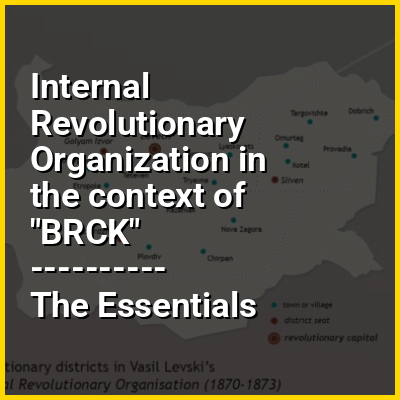
The Internal Revolutionary Organisation (IRO; Bulgarian: Вътрешна революционна организация (ВРО), romanizedVatreshna revolyutsionna organizatsia (VRO)) was a Bulgarian revolutionary organisation founded and built up by Bulgarian revolutionary Vasil Levski between 1869 and 1871. The organisation represented a network of regional revolutionary committees which were governed by a Central Committee in the town of Lovech. The foundation of IRO reflected Levski's ideas that the centre of revolutionary activity be transferred from the Bulgarian emigrant circles in Romania to Bulgaria proper. In 1871 Levski prepared the Charter of the organisation in the spirit of his own political views: liberation of Bulgaria from the Ottomans through a nationwide revolution and establishment of the country as a democratic republic with guarantees for the equality of all of its citizens regardless of their ethnicity or religion.

By the end of 1872, both Levski and Lyuben Karavelov, the chairman of the Bulgarian Revolutionary Central Committee (BRCC), which was situated in Bucharest, had concluded that the future success of the armed struggle against the Ottomans depended on the co-operation of both: external and internal committees. To this end the two organisations prepared and adopted a joint programme and charter and voted on the merger of the two organisations under the name of BRCK at a general meeting held in Bucharest in May, 1872. The goals and fundamental principles which governed the work of the Internal Revolutionary Organisation influenced the formation and guiding principles of subsequent Bulgarian revolutionary organisations, namely the Internal Macedonian-Adrianople Revolutionary Organisation (active in the Ottoman Empire from 1893 to 1912), the Internal Macedonian Revolutionary Organisation (active in Greek and Yugoslav Macedonia from 1919 to 1934), the Internal Thracian Revolutionary Organisation (active in Western Thrace from 1922 to 1934), the Internal Dobrudjan Revolutionary Organisation (active in Dobruja from 1923 to 1940) and the Internal Western Outland Revolutionary Organisation (active in the Western Outlands from 1921 to 1934).
↓ Menu
HINT:

In this Dossier

Internal Revolutionary Organization in the context of Internal Macedonian Revolutionary Organization

The Internal Macedonian Revolutionary Organization (IMRO; Bulgarian: Вътрешна македонска революционна организация (ВМРО), romanizedVatreshna Makedonska Revolyutsionna Organizatsiya (VMRO); Macedonian: Внатрешна македонска револуционерна организација (ВМРО), romanizedVnatrešna Makedonska Revolucionerna Organizacija (VMRO)), was a secret revolutionary society founded in the Ottoman territories in Europe, that operated in the late 19th and early 20th centuries.

Founded in 1893 in Salonica, it sought sovereignty for Macedonia under the slogan Macedonia for the Macedonians. Initially it aimed to gain autonomy for Macedonia and Adrianople regions in the Ottoman Empire, however, it later became an agent serving Bulgarian interests in Balkan politics. IMRO modeled itself after the earlier Bulgarian Internal Revolutionary Organization of Vasil Levski and accepted its motto "Freedom or Death" (Свобода или смърть). According to the memoirs of some founding and ordinary members, in the Organization's earliest statute from 1894, the membership was reserved exclusively for Bulgarians. This was later changed on the initiative of Gotse Delchev, who wanted IMRO to depart from its exclusively Bulgarian nature, so he opened the membership for all inhabitants of European Turkey and the organization begun to acquire a more separatist stance. However, these new formulas as a whole failed to attract other ethnic groups, from whom it was seen as a pro-Bulgarian society, thus IMRO remained with base only among Bulgarian Exarchist affiliated Slavic speakers in Ottoman Macedonia. It used the Bulgarian language in all its documents and in its correspondence. The Organisation founded in 1896 its Foreign Representation in Sofia, the capital of Bulgaria. Starting in the same year, it fought the Ottomans using guerrilla tactics, and in this, they were successful, even establishing a state within a state in some regions, including their tax collectors. This struggle escalated in 1903 with the Ilinden–Preobrazhenie Uprising. The fighting involved about 15,000 IMRO irregulars and 40,000 Ottoman soldiers, lasting for over seven weeks. After the uprising failed, and the Ottomans destroyed some 100 villages, the IMRO resorted to more systematic forms of terrorism targeting civilians. More important, the Ilinden disaster splintered IMRO and signalled the beginning of a fratricidal conflict between the left-wing faction ("federalists") who continued to favor autonomy as step towards independent Macedonia and its inclusion into a future Balkan Federation, and the right-wing faction ("centralists") which favored unification with Bulgaria. In fact, the division was a culmination of a conflict which existed within IMRO since its formation. It was based partially on ideology, and partly in terms of personality and locality, and it would plague the Macedonian revolutionary movement over the next decades.

View the full Wikipedia page for Internal Macedonian Revolutionary Organization
↑ Return to Menu