Intelligent agent in the context of "Technological singularity"

Play Trivia Questions online!

or

Skip to study material about Intelligent agent in the context of "Technological singularity"


⭐ Core Definition: Intelligent agent

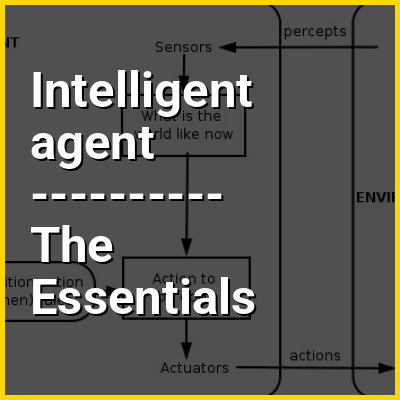
In artificial intelligence, an intelligent agent is an entity that perceives its environment, takes actions autonomously to achieve goals, and may improve its performance through machine learning or by acquiring knowledge. AI textbooks define artificial intelligence as the "study and design of intelligent agents," emphasizing that goal-directed behavior is central to intelligence.

A specialized subset of intelligent agents, agentic AI (also known as an AI agent or simply agent), expands this concept by proactively pursuing goals, making decisions, and taking actions over extended periods.

↓ Menu

In this Dossier

Intelligent agent in the context of Automated planning and scheduling

Automated planning and scheduling, sometimes denoted as simply AI planning, is a branch of artificial intelligence that concerns the realization of strategies or action sequences, typically for execution by intelligent agents, autonomous robots and unmanned vehicles. Unlike classical control and classification problems, the solutions are complex and must be discovered and optimized in multidimensional space. Planning is also related to decision theory.

In known environments with available models, planning can be done offline. Solutions can be found and evaluated prior to execution. In dynamically unknown environments, the strategy often needs to be revised online. Models and policies must be adapted. Solutions usually resort to iterative trial and error processes commonly seen in artificial intelligence. These include dynamic programming, reinforcement learning and combinatorial optimization. Languages used to describe planning and scheduling are often called action languages.

↑ Return to Menu

Intelligent agent in the context of Automated negotiation

Automated negotiation is a form of interaction in systems that are composed of multiple autonomous agents, in which the aim is to reach agreements through an iterative process of making offers.

Automated negotiation can be employed for many tasks human negotiators regularly engage in, such as bargaining and joint decision making. The main topics in automated negotiation revolve around the design of protocols and strategies.

↑ Return to Menu

Intelligent agent in the context of Superintelligence

A superintelligence is a hypothetical agent that possesses intelligence surpassing that of the most gifted human minds. Philosopher Nick Bostrom defines superintelligence as "any intellect that greatly exceeds the cognitive performance of humans in virtually all domains of interest".

Technological researchers disagree about how likely present-day human intelligence is to be surpassed. Some argue that advances in artificial intelligence (AI) will probably result in general reasoning systems that lack human cognitive limitations. Others believe that humans will evolve or directly modify their biology to achieve radically greater intelligence. Several future study scenarios combine elements from both of these possibilities, suggesting that humans are likely to interface with computers, or upload their minds to computers, in a way that enables substantial intelligence amplification. The hypothetical creation of the first superintelligence may or may not result from an intelligence explosion or a technological singularity.

↑ Return to Menu

Intelligent agent in the context of Reinforcement learning

In machine learning and optimal control, reinforcement learning (RL) is concerned with how an intelligent agent should take actions in a dynamic environment in order to maximize a reward signal. Reinforcement learning is one of the three basic machine learning paradigms, alongside supervised learning and unsupervised learning.

While supervised learning and unsupervised learning algorithms respectively attempt to discover patterns in labeled and unlabeled data, reinforcement learning involves training an agent through interactions with its environment. To learn to maximize rewards from these interactions, the agent makes decisions between trying new actions to learn more about the environment (exploration), or using current knowledge of the environment to take the best action (exploitation). The search for the optimal balance between these two strategies is known as the exploration–exploitation dilemma.

↑ Return to Menu

Intelligent agent in the context of Tit for tat

Tit for tat is an English saying meaning "equivalent retaliation". It is an alternation of tip for tap "blow for blow", first recorded in 1558.

It is also a highly effective strategy in game theory. An agent using this strategy will first cooperate, then subsequently replicate an opponent's previous action. If the opponent previously was cooperative, the agent is cooperative. If not, the agent is not. This is similar to reciprocal altruism in biology.

↑ Return to Menu

Intelligent agent in the context of Multi-agent systems

A multi-agent system (MAS or "self-organized system") is a computerized system composed of multiple interacting intelligent agents. Multi-agent systems can solve problems that are difficult or impossible for an individual agent or a monolithic system to solve. Intelligence may include methodic, functional, procedural approaches, algorithmic search or reinforcement learning. With advancements in large language models (LLMs), LLM-based multi-agent systems have emerged as a new area of research, enabling more sophisticated interactions and coordination among agents.

Despite considerable overlap, a multi-agent system is not always the same as an agent-based model (ABM). The goal of an ABM is to search for explanatory insight into the collective behavior of agents (which do not necessarily need to be "intelligent") obeying simple rules, typically in natural systems, rather than in solving specific practical or engineering problems. The terminology of ABM tends to be used more often in the science, and MAS in engineering and technology. Applications where multi-agent systems research may deliver an appropriate approach include online trading, disaster response, target surveillance and social structure modelling.

↑ Return to Menu

Intelligent agent in the context of Situated

In artificial intelligence and cognitive science, the term situated refers to an agent which is embedded in an environment. The term situated is commonly used to refer to robots, but some researchers argue that software agents can also be situated if:

  • they exist in a dynamic (rapidly changing) environment, which
  • they can manipulate or change through their actions, and which
  • they can sense or perceive.

Examples might include web-based agents, which can alter data or trigger processes (such as purchases) over the internet, or virtual-reality bots which inhabit and change virtual worlds, such as Second Life.

↑ Return to Menu

Intelligent agent in the context of Artificial swarm intelligence

Swarm intelligence (SI) is the collective behavior of decentralized, self-organized systems, natural or artificial. The concept is employed in work on artificial intelligence. The expression was introduced by Gerardo Beni and Jing Wang in 1989, in the context of cellular robotic systems.

Swarm intelligence systems consist typically of a population of simple agents or boids interacting locally with one another and with their environment. The inspiration often comes from nature, especially biological systems. The agents follow very simple rules, and although there is no centralized control structure dictating how individual agents should behave, local, and to a certain degree random, interactions between such agents lead to the emergence of "intelligent" global behavior, unknown to the individual agents. Examples of swarm intelligence in natural systems include ant colonies, bee colonies, bird flocking, hawks hunting, animal herding, bacterial growth, fish schooling and microbial intelligence.

↑ Return to Menu