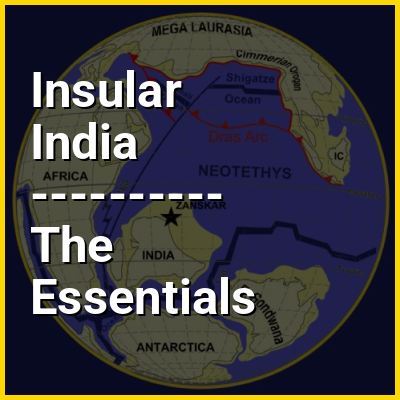
Insular India was an isolated landmass which became the Indian subcontinent. Across the latter stages of the Cretaceous and most of the Paleocene, following the breakup of Gondwana, the Indian subcontinent remained an isolated landmass as the Indian Plate drifted across the Tethys Ocean, forming the Indian Ocean. The process of India's separation from Madagascar first began 88 million years ago, but complete isolation only occurred towards the end of the Maastrichtian, a process that has been suggested to be the creation of the Deccan Traps. Soon after, the land mass moved northward rather quickly, until contact with Asia was established 55 million years ago. Even then, both landmasses did not become fully united until around 35 million years ago, and periods of isolation occurred as recently as 24 million years ago.
Thus, for a period of 53 million years India retained a degree of isolation, 11 of which it was a complete island continent. This allowed its local biota to follow the typical patterns seen in islands and diversify in unique ways, much as in modern Madagascar, its sister landmass. Faunal interchanges with other landmasses, like Africa and Europe (then an archipelago of islands across the Tethys) occurred during this period, and a considerable Asian influence can already be seen long before contact was made. This rendered India rather peculiar as not just an isolated continent but also a "stepping stone" in the dispersal of many animal and plant clades across Africa, Europe, Madagascar, Asia and possibly even Oceania. Still, several "archaic" clades managed to survive. The vast majority of India's terrestrial vertebrate life was wiped out in the Cretaceous-Paleogene extinction event; only 3 extant tetrapod lineages can trace their ancestry to Cretaceous India. Most of India's few other surviving Gondwanan lineages were outcompeted during the Paleogene by newly-arriving lineages. However, plants and invertebrate fauna were less affected.