Inner Hebrides in the context of "Sea of the Hebrides"

Play Trivia Questions online!

or

Skip to study material about Inner Hebrides in the context of "Sea of the Hebrides"

Ad spacer

⭐ Core Definition: Inner Hebrides

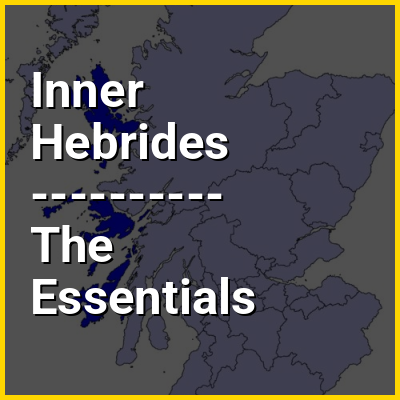
The Inner Hebrides (/ˈhɛbrɪdz/ HEB-rid-eez; Scottish Gaelic: na h-Eileanan a-staigh, lit.'the Inner Isles') is an archipelago off the west coast of mainland Scotland, to the south east of the Outer Hebrides. Together these two island chains form the Hebrides, which experience a mild oceanic climate. The Inner Hebrides comprise 35 inhabited islands as well as 44 uninhabited islands with an area greater than 30 hectares (74 acres). Skye, Mull, and Islay are the three largest, and also have the highest populations. The main commercial activities are tourism, crofting, fishing and whisky distilling. In modern times the Inner Hebrides have formed part of two separate local government jurisdictions, one to the north and the other to the south. Together, the islands have an area of about 4,130 km (1,594 sq mi), and had a population of 18,948 in 2011. The population density is therefore about 4.6 inhabitants per square kilometre (12 inhabitants per square mile).

There are various important prehistoric structures, many of which pre-date the first written references to the islands by Roman and Greek authors. In the historic period the earliest known settlers were Picts to the north and Gaels in the southern kingdom of Dál Riada prior to the islands becoming part of the Suðreyjar kingdom of the Norse, who ruled for over 400 years until sovereignty was transferred to Scotland by the Treaty of Perth in 1266. Control of the islands was then held by various clan chiefs, principally the MacLeans, MacLeods and MacDonalds. The Highland Clearances of the 19th century had a devastating effect on many communities and it is only in recent years that population levels have ceased to decline.
↓ Menu

>>>PUT SHARE BUTTONS HERE<<<
In this Dossier

Inner Hebrides in the context of British Isles

The British Isles are an archipelago in the North Atlantic Ocean off the north-western coast of continental Europe, consisting of the islands of Great Britain, Ireland, the Isle of Man, the Inner and Outer Hebrides, the Northern Isles (Orkney and Shetland), and over six thousand smaller islands. They have a total area of 315,159 km (121,684 sq mi) and a combined population of almost 75 million, and include two sovereign states, the Republic of Ireland (which covers roughly five-sixths of Ireland) and the United Kingdom of Great Britain and Northern Ireland. The Channel Islands, off the north coast of France, are normally taken to be part of the British Isles, even though geographically they do not form part of the archipelago. Under the UK Interpretation Act 1978, the Channel Islands are clarified as forming part of the British Islands, not to be confused with the British Isles.

The oldest rocks are 2.7 billion years old and are found in Ireland, Wales and the north-west of Scotland. During the Silurian period, the north-western regions collided with the south-east, which had been part of a separate continental landmass. The topography of the islands is modest in scale by global standards. Ben Nevis, the highest mountain, rises to only 1,345 metres (4,413 ft), and Lough Neagh, which is notably larger than other lakes in the island group, covers 390 square kilometres (151 sq mi). The climate is temperate marine, with cool winters and warm summers. The North Atlantic drift brings significant moisture and raises temperatures 11 °C (20 °F) above the global average for the latitude. This led to a landscape that was long dominated by temperate rainforest, although human activity has since cleared the vast majority of forest cover. The region was re-inhabited after the last glacial period of Quaternary glaciation, by 12,000 BC, when Great Britain was still part of a peninsula of the European continent. Ireland was connected to Great Britain by the British-Irish Ice Sheet before 14,000 BC, and was not inhabited until after 8000 BC. Great Britain became an island by 7000 BC with the flooding of Doggerland.

↑ Return to Menu

Inner Hebrides in the context of Outer Hebrides

The Outer Hebrides (/ˈhɛbrɪdz/ HEB-rid-eez) or Western Isles (Scottish Gaelic: na h-Eileanan Siar [nə ˈhelanən ˈʃiəɾ] , na h-Eileanan an Iar [nə ˈhelanən əɲ ˈiəɾ] or na h-Innse Gall, 'Islands of the Strangers'), sometimes known as the Long Isle or Long Island (Scottish Gaelic: an t-Eilean Fada), is an island chain off the west coast of mainland Scotland. It is the longest archipelago in the British Isles. The islands form part of the archipelago of the Hebrides, separated from the Scottish mainland and from the Inner Hebrides by the waters of the Minch, the Little Minch, and the Sea of the Hebrides. The Outer Hebrides are considered to be the traditional heartland of the Gaelic language. The islands form one of the 32 council areas of Scotland, which since 1998 has used only the Gaelic form of its name, including in English language contexts. The council area is called Na h-Eileanan an Iar ('the Western Isles') and its council is Comhairle nan Eilean Siar ('Council of the Western Isles').

Most of the islands have a bedrock formed from ancient metamorphic rocks, and the climate is mild and oceanic. The 19 inhabited islands had an estimated population of 26,020 in 2024, and there are more than 50 substantial uninhabited islands. The distance from Barra Head to the Butt of Lewis is roughly 210 kilometres (130 mi).

↑ Return to Menu

Inner Hebrides in the context of Hebrides

The Hebrides (/ˈhɛbrɪdz/ HEB-rid-eez; Scottish Gaelic: Innse Gall, pronounced [ˈĩːʃə ˈkaul̪ˠ]; Old Norse: Suðreyjar, lit.'Southern isles') are the largest archipelago in the United Kingdom, off the west coast of the Scottish mainland. The islands fall into two main groups, based on their proximity to the mainland: the Inner and Outer Hebrides.

These islands have a long history of occupation (dating back to the Mesolithic period), and the culture of the inhabitants has been successively influenced by the cultures of Celtic-speaking, Norse-speaking, and English-speaking peoples. This diversity is reflected in the various names given to the islands, which are derived from the different languages that have been spoken there at various points in their history.

↑ Return to Menu

Inner Hebrides in the context of Iona

Iona (/ˈnə/; Scottish Gaelic: Ì Chaluim Chille [ˈiː ˈxal̪ˠɪm ˈçiʎə] , sometimes simply Ì) is an island in the Inner Hebrides, off the Ross of Mull on the western coast of Scotland. It is mainly known for Iona Abbey, though there are other buildings on the island. Iona Abbey was a centre of Gaelic monasticism for three centuries and is today known for its relative tranquility and natural environment. It is a tourist destination and a place for spiritual retreats. Its modern Scottish Gaelic name means "Iona of (Saint) Columba" (formerly anglicised as "Icolmkill").

Iona's resident population is about 180. In March 1980, the Hugh Fraser Foundation donated much of the main island (and its off-lying islands) to the current owner, the National Trust for Scotland. The abbey and some church buildings are owned by the Iona Cathedral Trust.

↑ Return to Menu

Inner Hebrides in the context of Dál Riata

Dál Riata or Dál Riada (also Dalriada) (/dælˈrədə/) was a Gaelic kingdom that encompassed the western seaboard of Scotland and north-eastern Ireland, on each side of the North Channel. At its height in the 6th and 7th centuries, it covered what is now Argyll ("Coast of the Gaels") in Scotland and part of County Antrim in Northern Ireland. After a period of expansion, Dál Riata eventually became associated with the Gaelic Kingdom of Alba.

In Argyll, it consisted of four main kindreds or tribes, each with their own chief: the Cenél nGabráin (based in Kintyre), the Cenél nÓengusa (based on Islay), the Cenél Loairn (who gave their name to the district of Lorn) and the Cenél Comgaill (who gave their name to Cowal). The hillfort of Dunadd is believed to have been its capital. Other royal forts included Dunollie, Dunaverty and Dunseverick. Within Dál Riata was the important monastery of Iona, which played a key role in the spread of Celtic Christianity throughout northern Britain, and in the development of insular art. Iona was a centre of learning and produced many important manuscripts. Dál Riata had a strong seafaring culture and a large naval fleet.

↑ Return to Menu

Inner Hebrides in the context of Islands of Scotland

This is a list of islands of Scotland, the mainland of which is part of the island of Great Britain. Also included are various other related tables and lists. The definition of an offshore island used in this list is "land that is surrounded by seawater on a daily basis, but not necessarily at all stages of the tide, excluding human devices such as bridges and causeways".

Scotland has around 900 offshore islands, most of which are to be found in four main groups: Shetland, Orkney, and the Hebrides, sub-divided into the Inner Hebrides and Outer Hebrides. There are also clusters of islands in the Firth of Clyde, Firth of Forth, and Solway Firth, and numerous small islands within the many bodies of fresh water in Scotland including Loch Lomond and Loch Maree. The largest island is Lewis and Harris, which extends to 2,179 km (841 sq mi), and there are a further 200 islands which are greater than 40 hectares (100 acres) in area. Of the remainder, several, such as Staffa and the Flannan Isles, are well-known, despite their small size. Some 101 Scottish islands are currently permanently inhabited, of which 96 are offshore islands. Between 2001 and 2011, Scottish island populations as a whole grew by 4% to 103,702 although by 2022 the total had fallen back to just under 103,000.

↑ Return to Menu

Inner Hebrides in the context of Skye

The Isle of Skye, or simply Skye, is the largest and northernmost of the major islands in the Inner Hebrides of Scotland. The island's peninsulas radiate from a mountainous hub dominated by the Cuillin, the rocky slopes of which provide some of the most dramatic mountain scenery in the country. Although Sgitheanach has been suggested to describe a winged shape, no definitive agreement exists as to the name's origin.

The island has been occupied since the Mesolithic period, and over its history has been occupied at various times by Celtic tribes including the Picts and the Gaels, Scandinavian Vikings, and most notably the powerful integrated Norse-Gaels clans of MacLeod and MacDonald. The island was considered to be under Norwegian suzerainty until the 1266 Treaty of Perth, which transferred control over to Scotland.

↑ Return to Menu

Inner Hebrides in the context of Isle of Mull

The Isle of Mull or simply Mull (Scottish Gaelic: Muile [ˈmulə] ) is the second-largest island of the Inner Hebrides (after Skye) and lies off the west coast of Scotland in the council area of Argyll and Bute.

Covering 875.35 square kilometres (337.97 sq mi), Mull is the fourth-largest island in Scotland. Between 2011 and 2022 the population increased from 2,800 to 3,063. It has the eighth largest island population in Scotland. In the summer, these numbers are augmented by an influx of many tourists. Much of the year-round population lives in the colourful main settlement of Tobermory.

↑ Return to Menu