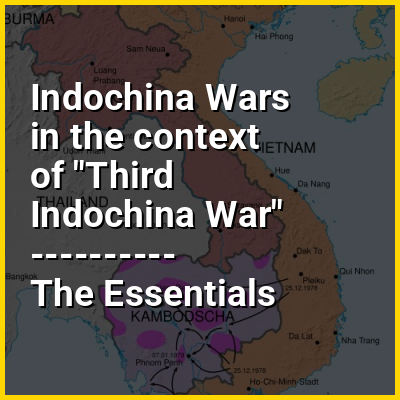
During the aftermath of World War II and the Cold War, the Indochina wars (Vietnamese: Chiến tranh Đông Dương) were a series of wars which were waged in Indochina from 1945 to 1991, by communist forces (mainly ones led by Vietnamese communists) against the opponents (mainly the Vietnamese nationalists, Trotskyists, the State of Vietnam, the Republic of Vietnam, the French, American, Laotian royalist, Cambodian and Chinese communist forces). The term "Indochina" referred to former French Indochina, which included the current states of Vietnam, Laos, and Cambodia. In current usage, it applies largely to a geographic region, rather than to a political area. The wars included:
- The First Indochina War (called the Indochina War in France and the French War in Vietnam) began after the end of World War II with the War in southern Vietnam (1945–1946), which acted as the precursor to the First Indochina War. The conflict officially began in 1946 and lasted until the French defeat in 1954. After a long campaign of unsuccessful resistance against the French and the Japanese, Viet Minh forces claimed a victory in the August Revolution after Japanese forces surrendered to the Allies on 15 August 1945, leading to the fall of the Empire of Vietnam and Nguyễn dynasty. In the War in southern Vietnam (1945–1946), British forces temporarily occupied the South with the objective of disarming Japanese forces, starting from 13 September 1945, only to restore French colonial control in 1946. Meanwhile, the communist Viet Minh sought to consolidate power by terrorizing and purging rival Vietnamese nationalist groups and Trotskyist activists. In the United Nations, and through their alliance with the United Kingdom and the United States, the French demanded return of their former Indochina colony prior to agreeing to participate in the NATO alliance (founded in 1949) opposing Soviet expansion beyond the countries of the Warsaw Pact (founded in 1955) in the Cold War. With support from China and the Soviet Union, the communist Viet Minh continued fighting the French Union, including the anti-communist State of Vietnam, ultimately forcing the NATO-backed French out of North Vietnam as a result of 1954 Geneva Conference.
- The Second Indochina War (called the Vietnam War in the United States and the Anti-American War by North Vietnam) began as a conflict between the United States-backed South Vietnamese government and its opponents, both the North Vietnamese-based communist Viet Cong (National Liberation Front) and the People's Army of Vietnam (PAVN), known in the West as the North Vietnamese Army (NVA). The conflict began in 1955 and lasted until 1975 when the North Vietnamese army conquered South Vietnam. The United States, which had supported France and its native vassal during the First Indochina war, backed the Republic of Vietnam government in opposition to the communist Viet Cong and PAVN. The North benefited from military and financial support from China and the Soviet Union, members of the communist bloc, Fighting also occurred during this time in Cambodia between the US-backed government, the PAVN, and the communist-backed Khmer Rouge, which also fought alongside deposed King Sihanouk's government in exile (known as the Cambodian Civil War, 1967–1975) and in Laos between the US-backed government, the PAVN, and the communist-backed Pathet Lao (known as the Laotian Civil War or Secret War, 1959–1975).
- The Third Indochina War was a period of prolonged conflict following the Second Indochina War. The conflict began in 1978 and lasted until the 1991 Paris Peace Agreements on 23 October 1991, in which several wars were fought: