Indo-Pakistani war of 1947–1948 in the context of "Srinagar"

Play Trivia Questions online!

or

Skip to study material about Indo-Pakistani war of 1947–1948 in the context of "Srinagar"

Ad spacer

⭐ Core Definition: Indo-Pakistani war of 1947–1948

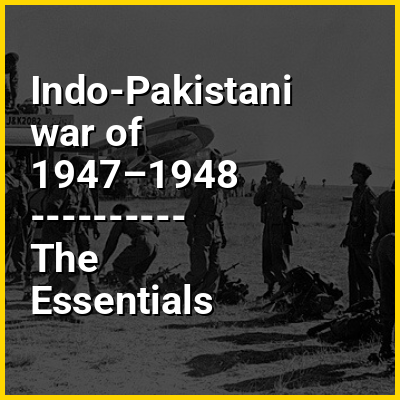
The Indo-Pakistani war of 1947–1948, also known as the first Kashmir war, was a war fought between India and Pakistan over the princely state of Jammu and Kashmir from 1947 to 1948. It was the first of four Indo-Pakistani wars between the two newly independent nations. Pakistan precipitated the war a few weeks after its independence by launching tribal lashkar (militias) from Waziristan, in an effort to capture Kashmir and to preempt the possibility of its ruler joining India.

Hari Singh, the Maharaja of Jammu and Kashmir, was facing an uprising by his Muslim subjects in Poonch, and lost control in portions of the western districts. On 22 October 1947, Pakistan's Pashtun tribal militias crossed the border of the state. These local tribal militias and irregular Pakistani forces moved to take the capital city of Srinagar, but upon reaching Baramulla, they took to plunder and stalled. Maharaja Hari Singh made a plea to India for assistance, and help was offered, but it was subject to his signing of an Instrument of Accession to India.
↓ Menu

>>>PUT SHARE BUTTONS HERE<<<
In this Dossier

Indo-Pakistani war of 1947–1948 in the context of Jammu and Kashmir (princely state)

Jammu and Kashmir, also known as Kashmir and Jammu, was a princely state in a subsidiary alliance with the British East India Company from 1846 to 1858, and under the paramountcy (or tutelage) of the British Crown from 1858 until British withdrawal and the partition of British India in 1947. Following the subsequent First Kashmir War between India and Pakistan, it became a disputed territory, now administered by three countries: China, India, and Pakistan. The princely state was created after the First Anglo-Sikh War, when the East India Company, which had annexed the Kashmir Valley, from the Sikhs as war indemnity, then sold it to the Raja of Jammu, Gulab Singh, for 75 lakh rupees.

At the time of the partition of India and the political integration of India, Hari Singh, the ruler of the state, delayed making a decision about the future of his state. However, an uprising in the western districts by the Gilgit Scouts against Hari Singh supported by informal militias from the neighbouring Northwest Frontier Province, and the Pakistani army personnel, forced his hand. On 26 October 1947, Hari Singh acceded to India in return for the Indian military being airlifted to Kashmir to counter the invasion by tribal militias from Pakistan, which were assisted by the Pakistani government and military leadership. The western and northern districts now known as Azad Kashmir and Gilgit-Baltistan passed to the control of Pakistan with the support of Gilgit Scouts, while the remaining territory stayed under Indian control, later becoming the Indian administered state of Jammu and Kashmir. India and Pakistan defined a cease-fire line dividing the administration of the territory with the intercession of the United Nations which was supposed to be temporary but still persists.

↑ Return to Menu

Indo-Pakistani war of 1947–1948 in the context of Trans-Karakoram Tract

The Trans-Karakoram Tract (Chinese: 喀喇昆仑走廊; pinyin: Kālǎkūnlún zǒuláng), also known as the Shaksgam Tract (Urdu: شکسگام, romanizedShaksgām), is an area of approximately 5,200 km (2,000 sq mi) north of the Karakoram watershed, including the Shaksgam valley. The tract is administered by China as part of its Taxkorgan and Yecheng counties in the Xinjiang Uyghur Autonomous Region. Originally, the Indian government claimed sovereignty over the Shaksgam tract following the accession of Jammu and Kashmir to India in 1947. However, Pakistan took control of the region during the First India-Pakistan War and subsequently ceded it to China in 1963 through the Sino-Pakistan Agreement, and a border based on actual ground positions was recognized as the international border by China and Pakistan. The Shaksgam Tract, along with the entire Kashmir region, is claimed by India. Further, New Delhi has never accepted the China-Pakistan boundary pact, asserting that Islamabad "unlawfully" attempted to cede the area to Beijing.

Most of the tract is composed of the Shaksgam Valley and was formerly administered as part of Shigar, a district (formerly a tehsil) in the Baltistan region. A polo ground in Shaksgam was built by the Amacha Royal family of Shigar, and the Rajas of Shigar used to invite the Amirs of Hotan to play polo there. Most of the names of the mountains, lakes, rivers and passes are in Balti/Ladakhi, suggesting that this land had been part of Baltistan/Ladakh region for a long time.

↑ Return to Menu

Indo-Pakistani war of 1947–1948 in the context of History of India (1947–present)

The history of independent India or history of Republic of India began when the country became an independent sovereign state within the British Commonwealth on 15 August 1947. Direct administration by the British, which began in 1858, affected a political and economic unification of the subcontinent. When British rule came to an end in 1947, the subcontinent was partitioned along religious lines into two separate countries—India, with a majority of Hindus, and Pakistan, with a majority of Muslims. Concurrently the Muslim-majority northwest and east of British India was separated into the Dominion of Pakistan, by the Partition of India. The partition led to a population transfer of more than 10 million people between India and Pakistan and the death of about one million people. Indian National Congress leader Jawaharlal Nehru became the first Prime Minister of India, but the leader most associated with the independence struggle, Mahatma Gandhi, accepted no office. The constitution adopted in 1950 made India a democratic republic with Westminster style parliamentary system of government, both at federal and state level respectively. The democracy has been sustained since then. India's sustained democratic freedoms are unique among the world's newly independent states, despite its history being perforated by several crises and recent worries of democratic backsliding under the premiership of Narendra Modi.

The country has faced religious violence, corruption, poverty, unemployment, language conflicts, naxalism, terrorism, separatist insurgencies in North East India and gender-based violence. India has unresolved territorial disputes over Kashmir and Arunachal Pradesh with China which escalated into a war in 1962 and 1967, Kashmir with Pakistan which resulted in wars in 1947–1948, 1965, 1971 and 1999 and Kalapani with Nepal. India was neutral in the Cold War, and was a leader in the Non-Aligned Movement. However, it made a loose alliance with the Soviet Union from 1971, when Pakistan was allied with the United States and the People's Republic of China.

↑ Return to Menu

Indo-Pakistani war of 1947–1948 in the context of Poonch district, India

Poonch district or Punch district is a district of the Indian-administered Jammu and Kashmir in the disputed Kashmir region. With headquarters in the town of Poonch, it is bounded by the Line of Control (boundary between Indian and Pakistan administered Kashmir) on three sides (north, west and south). The 1947–48 war between India and Pakistan divided the earlier district into two parts. One went to Pakistan and the other became part of the then-Indian state of Jammu and Kashmir.

↑ Return to Menu

Indo-Pakistani war of 1947–1948 in the context of Baramulla

Baramulla (Urdu pronunciation: [bɑːɾɑːmuːlɑː]), also known as Varmul (Kashmiri pronunciation: [ʋarmul]) in Kashmiri, is a city and municipality of the Baramulla district of the Indian-administered Jammu and Kashmir in the disputed Kashmir region. It is also the administrative headquarters of the Baramulla district, located on the banks of the River Jhelum downstream from Srinagar, the summer capital of Jammu and Kashmir. The town was earlier known as gateway of Kashmir, serving as the major distribution centre for goods arriving in Kashmir valley through the Jhelum valley cart road. It is located within the Kashmir Valley on the foothills of the Pir Panjal Range.

The town was earlier known as Varāhamūla. The name is derived from two Sanskrit words, varāha (meaning wild boar) and mūla (meaning root/origin). The town was a major urban settlement and trade centre, before suffering extensive damage during the First Kashmir War. Currently, Baramulla is a major centre of business and education in northern Kashmir.

↑ Return to Menu

Indo-Pakistani war of 1947–1948 in the context of History of the Republic of India

The history of independent India or history of Republic of India began when the country became an independent sovereign state within the British Commonwealth on 15 August 1947. Direct administration by the British, which began in 1858, affected a political and economic unification of the subcontinent. When British rule came to an end in 1947, the subcontinent was partitioned along religious lines into two separate countries—India, with a majority of Hindus, and Pakistan, with a majority of Muslims. Concurrently the Muslim-majority northwest and east of British India was separated into the Dominion of Pakistan, by the Partition of India. The partition led to a population transfer of more than 10 million people between India and Pakistan and the death of about one million people. Indian National Congress leader Jawaharlal Nehru became the first Prime Minister of India, but the leader most associated with the independence struggle, Mahatma Gandhi, accepted no office. The constitution adopted in 1950 made India a democratic republic with Westminster style parliamentary system of government, both at federal and state level respectively. The democracy has been sustained since then. India's sustained democratic freedoms are unique among the world's newly independent states, despite its history being perforated by several crises and recent worries of democratic backsliding under the premiership of Narendra Modi.

The country has faced religious violence, casteism, corruption, malnutrition, poverty, unemployment, language conflicts, naxalism, terrorism, separatist insurgencies in North East India and gender-based violence. India has unresolved territorial disputes over Kashmir and Arunachal Pradesh with China which escalated into a war in 1962 and 1967, Kashmir with Pakistan which resulted in wars in 1947–1948, 1965, 1971 and 1999 and Kalapani with Nepal. India was neutral in the Cold War, and was a leader in the Non-Aligned Movement. However, it made a loose alliance with the Soviet Union from 1971, when Pakistan was allied with the United States and the People's Republic of China.

↑ Return to Menu