Improper integral in the context of Riemann integral


Improper integral in the context of Riemann integral

Improper integral Study page number 1 of 1

Play TriviaQuestions Online!

or

Skip to study material about Improper integral in the context of "Riemann integral"


⭐ Core Definition: Improper integral

In mathematical analysis, an improper integral is an extension of the notion of a definite integral to cases that violate the usual assumptions for that kind of integral. In the context of Riemann integrals (or, equivalently, Darboux integrals), this typically involves unboundedness, either of the set over which the integral is taken or of the integrand (the function being integrated), or both. It may also involve bounded but not closed sets or bounded but not continuous functions. While an improper integral is typically written symbolically just like a standard definite integral, it actually represents a limit of a definite integral or a sum of such limits; thus improper integrals are said to converge or diverge. If a regular definite integral (which may retronymically be called a proper integral) is worked out as if it is improper, the same answer will result.

In the simplest case of a real-valued function of a single variable integrated in the sense of Riemann (or Darboux) over a single interval, improper integrals may be in any of the following forms:

↓ Menu
HINT:

In this Dossier

Improper integral in the context of Absolute convergence

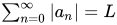
In mathematics, an infinite series of numbers is said to converge absolutely (or to be absolutely convergent) if the sum of the absolute values of the summands is finite. More precisely, a real or complex series is said to converge absolutely if for some real number Similarly, an improper integral of a function, is said to converge absolutely if the integral of the absolute value of the integrand is finite—that is, if A convergent series that is not absolutely convergent is called conditionally convergent.

Absolute convergence is important for the study of infinite series, because its definition guarantees that a series will have some "nice" behaviors of finite sums that not all convergent series possess. For instance, rearrangements do not change the value of the sum, which is not necessarily true for conditionally convergent series.

View the full Wikipedia page for Absolute convergence
↑ Return to Menu

Improper integral in the context of Gamma function

In mathematics, the gamma function (represented by , capital Greek letter gamma) is the most common extension of the factorial function to complex numbers. First studied by Daniel Bernoulli, the gamma function is defined for all complex numbers except non-positive integers, and for every positive integer . The gamma function can be defined via a convergent improper integral for complex numbers with positive real part:

The gamma function then is defined in the complex plane as the analytic continuation of this integral function: it is a meromorphic function which is holomorphic except at zero and the negative integers, where it has simple poles.

View the full Wikipedia page for Gamma function
↑ Return to Menu