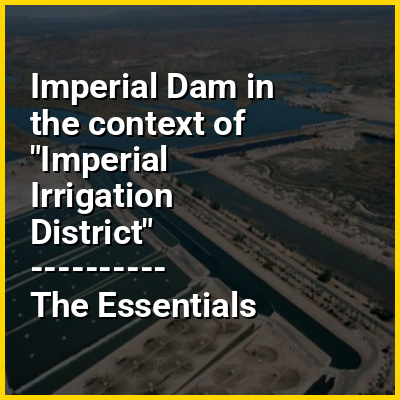
The Imperial Diversion Dam (National ID # CA10159) is a concrete slab and buttress, ogee weir structure across the California/Arizona border, 18 miles (29 km) northeast of Yuma. Completed in 1938, the dam retains the waters of the Colorado River into the Imperial Reservoir before desilting and diversion into the All-American Canal and the Gila Project aqueduct. Between 1932 and 1940, the Imperial Irrigation District (IID) relied on the Inter-California Canal and the Imperial Canal and Alamo River.
HINT:
In this Dossier
Imperial Dam in the context of Diversion dam
A diversion dam is a dam that diverts all or a portion of the flow of a river from its natural course. Diversion dams do not generally impound water in a reservoir; instead, the water is diverted into an artificial water course or canal, which may be used for irrigation or return to the river after passing through hydroelectric generators, flow into a different river or be itself dammed forming an on-ground or groundwater reservoir or a storm drain.
An early diversion dam is the Ancient Egyptian Sadd el-Kafara Dam at Wadi Al-Garawi, which was located about twenty five kilometres south of Cairo. Built around 2600 BC for flood control, the structure was 102 metres long at its base and 87 metres wide. It was destroyed by a flood while it was still under construction.
View the full Wikipedia page for Diversion dam