Immunoglobulin heavy chain in the context of Immunoglobulin domain


Immunoglobulin heavy chain in the context of Immunoglobulin domain

⭐ Core Definition: Immunoglobulin heavy chain

The immunoglobulin heavy chain (IgH) is the large polypeptide subunit of an antibody (immunoglobulin). In the human genome, the IgH gene loci are on chromosome 14.

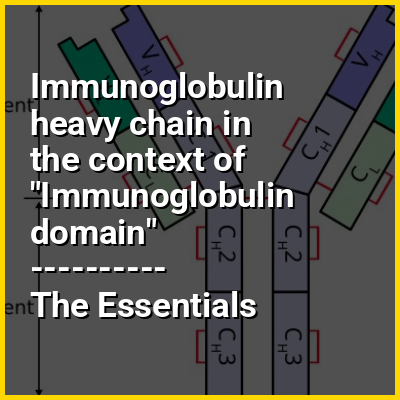
A typical antibody is composed of two immunoglobulin (Ig) heavy chains and two Ig light chains. Several different types of heavy chain exist that define the class or isotype of an antibody. These heavy chain types vary between different animals. All heavy chains contain a series of immunoglobulin domains, usually with one variable domain (VH) that is important for binding antigen and several constant domains (CH1, CH2, etc.). Production of a viable heavy chain is a key step in B cell maturation. If the heavy chain is able to bind to a surrogate light chain and move to the plasma membrane, then the developing B cell can begin producing its light chain.
↓ Menu
HINT:

In this Dossier

Immunoglobulin heavy chain in the context of Enhancer (genetics)

In genetics, an enhancer is a short (50–1500 bp) region of DNA that can be bound by proteins (activators) to increase the likelihood that transcription of a particular gene will occur. These proteins are usually referred to as transcription factors. Enhancers are cis-acting. They can be located up to 1 Mbp (1,000,000 bp) away from the gene, upstream or downstream from the start site. There are hundreds of thousands of enhancers in the human genome. They are found in both prokaryotes and eukaryotes. Active enhancers typically get transcribed as enhancer or regulatory non-coding RNA, whose expression levels correlate with mRNA levels of target genes.

The first discovery of a eukaryotic enhancer was in the immunoglobulin heavy chain gene in 1983. This enhancer, located in the large intron, provided an explanation for the transcriptional activation of rearranged Vh gene promoters while unrearranged Vh promoters remained inactive. Lately, enhancers have been shown to be involved in certain medical conditions, for example, myelosuppression. Since 2022, scientists have used artificial intelligence to design synthetic enhancers and applied them in animal systems, first in a cell line, and one year later also in vivo.

View the full Wikipedia page for Enhancer (genetics)
↑ Return to Menu

Immunoglobulin heavy chain in the context of Paratope

In immunology, a paratope, also known as an antigen-binding site, is the part of an antibody which recognizes and binds to an antigen. It is a small region at the tip of the antibody's antigen-binding fragment and contains parts of the antibody's heavy and light chains. Each paratope is made up of six complementarity-determining regions - three from each of the light and heavy chains - that extend from a fold of anti-parallel beta sheets. Each arm of the Y-shaped antibody has an identical paratope at the end.

Paratopes make up the parts of the B-cell receptor that bind to and make contact with the epitope of an antigen. All the B-cell receptors on any one individual B cell have identical paratopes. The uniqueness of a paratope allows it to bind to only one epitope with high affinity and as a result, each B cell can only respond to one epitope. The paratopes on B-cell receptors binding to their specific epitope is a critical step in the adaptive immune response.

View the full Wikipedia page for Paratope
↑ Return to Menu

Immunoglobulin heavy chain in the context of FcεRI

The high-affinity IgE receptor, also known as FcεRI, or Fc epsilon RI, is the high-affinity receptor for the Fc region of immunoglobulin E (IgE), an antibody isotype involved in allergy disorders and parasite immunity. FcεRI is a tetrameric receptor complex that binds Fc portion of the ε heavy chain of IgE. It consists of one alpha (FcεRIα – antibody binding site), one beta (FcεRIβ – which amplifies the downstream signal), and two gamma chains (FcεRIγ – the site where the downstream signal initiates) connected by two disulfide bridges on mast cells and basophils. It lacks the beta subunit on other cells. It is constitutively expressed on mast cells and basophils and is inducible in eosinophils.

View the full Wikipedia page for FcεRI
↑ Return to Menu