An imaginary number is the product of a real number and the imaginary uniti, which is defined by its property i = −1. The square of an imaginary number bi is −b. For example, 5i is an imaginary number, and its square is −25. The number zero is considered to be both real and imaginary.
Originally coined in the 17th century by René Descartes as a derogatory term and regarded as fictitious or useless, the concept gained wide acceptance following the work of Leonhard Euler in the 18th century, and Augustin-Louis Cauchy and Carl Friedrich Gauss in the early 19th century.
The complex plane allows for a geometric interpretation of complex numbers. Under addition, they add like vectors. The multiplication of two complex numbers can be expressed more easily in polar coordinates: the magnitude or modulus of the product is the product of the two absolute values, or moduli, and the angle or argument of the product is the sum of the two angles, or arguments. In particular, multiplication by a complex number of modulus 1 acts as a rotation.
In mathematics, a complex number is an element of a number system that extends the real numbers with a specific element denoted i, called the imaginary unit and satisfying the equation ; every complex number can be expressed in the form , where a and b are real numbers. Because no real number satisfies the above equation, i was called an imaginary number by René Descartes. For the complex number ,a is called the real part, and b is called the imaginary part. The set of complex numbers is denoted by either of the symbols or C. Despite the historical nomenclature, "imaginary" complex numbers have a mathematical existence as firm as that of the real numbers, and they are fundamental tools in the scientific description of the natural world.
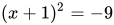
Complex numbers allow solutions to all polynomial equations, even those that have no solutions in real numbers. More precisely, the fundamental theorem of algebra asserts that every non-constant polynomial equation with real or complex coefficients has a solution which is a complex number. For example, the equationhas no real solution, because the square of a real number cannot be negative, but has the two nonreal complex solutions and .
Combining the real numbers with the imaginary unit using addition and multiplication generates a new number system called the complex numbers, which consists of all numbers of the form a + bi with real numbers a and b.
Imaginary number in the context of Argument (complex analysis)
In mathematics (particularly in complex analysis), the argument of a complex number z, denoted arg(z), is the angle between the positive realaxis and the line joining the origin and z, represented as a point in the complex plane, shown as in Figure 1. By convention the positive real axis is drawn pointing rightward, the positive imaginary axis is drawn pointing upward, and complex numbers with positive real part are considered to have an anticlockwise argument with positive sign.
When any real-valued angle is considered, the argument is a multivalued function operating on the nonzero complex numbers. The principal value of this function is single-valued, typically chosen to be the unique value of the argument that lies within the interval (−π, π]. In this article the multi-valued function will be denoted arg(z) and its principal value will be denoted Arg(z), but in some sources the capitalization of these symbols is exchanged.
Imaginary number in the context of Function of several real variables
In mathematical analysis and its applications, a function of several real variables or real multivariate function is a function with more than one argument, with all arguments being real variables. This concept extends the idea of a function of a real variable to several variables. The "input" variables take real values, while the "output", also called the "value of the function", may be real or complex. However, the study of the complex-valued functions may be easily reduced to the study of the real-valued functions, by considering the real and imaginary parts of the complex function; therefore, unless explicitly specified, only real-valued functions will be considered in this article.
The domain of a function of n variables is the subset of for which the function is defined. As usual, the domain of a function of several real variables is supposed to contain a nonempty open subset of .
In mathematics, a complex number is an element of a number system that extends the real numbers with a specific element denoted i, called the imaginary unit and satisfying the equation ; because no real number satisfies the above equation, i was called an imaginary number by René Descartes. Every complex number can be expressed in the form , where a and b are real numbers, a is called the real part, and b is called the imaginary part. The set of complex numbers is denoted by either of the symbols or C. Despite the historical nomenclature, "imaginary" complex numbers have a mathematical existence as firm as that of the real numbers, and they are fundamental tools in the scientific description of the natural world.
Complex numbers allow solutions to all polynomial equations, even those that have no solutions in real numbers. More precisely, the fundamental theorem of algebra asserts that every non-constant polynomial equation with real or complex coefficients has a solution which is a complex number. For example, the equationhas no real solution, because the square of a real number cannot be negative, but has the two nonreal complex solutions and .
Imaginary number in the context of Complex conjugate
In mathematics, the complex conjugate of a complex number is the number with an equal real part and an imaginary part equal in magnitude but opposite in sign. That is, if and are real numbers, then the complex conjugate of is The complex conjugate of is often denoted as or .
In polar form, if and are real numbers then the conjugate of is This can be shown using Euler's formula.