Ifni War in the context of "Spanish Navy"

Play Trivia Questions online!

or

Skip to study material about Ifni War in the context of "Spanish Navy"

Ad spacer

⭐ Core Definition: Ifni War

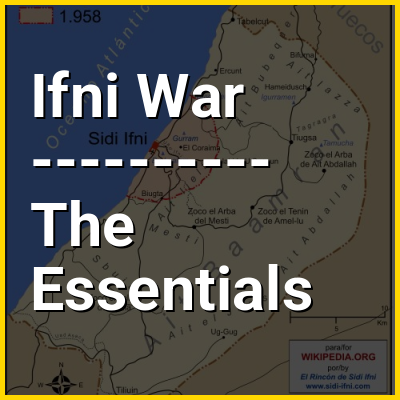
The Ifni War, sometimes called the Forgotten War (la Guerra Olvidada) in Spain, was a series of armed incursions into Spanish West Africa by Moroccan insurgents that began in November 1957 and culminated with the abortive siege of Sidi Ifni.

The city of Sidi Ifni had been ceded to the Spanish Empire in 1860 at the end of the Hispano-Moroccan War. After Morocco achieved independence in 1956, it sought to claim Spain's remaining possessions in West Africa. Violent demonstrations against Spanish rule broke out in Ifni in April 1957, and in October Moroccan militias began converging near the territory. Moroccan forces attacked in November, forcing the Spanish to abandon most of the territory and retreat to a defensive perimeter around Ifni. Supplied by the Spanish Navy from the sea, the Spanish garrison was able to resist the siege, which lasted into June 1958. In Spanish Sahara, Moroccan units, now reorganised as the Moroccan Army of Liberation, engaged in heavy fighting with Spanish forces at El Aaiún and Edchera. By February 1958, a joint Spanish and French offensive had driven the Moroccans out of Spanish Sahara.
↓ Menu

>>>PUT SHARE BUTTONS HERE<<<
In this Dossier

Ifni War in the context of Spanish Sahara

Spanish Sahara (Spanish: Sáhara Español; Arabic: الصحراء الإسبانية, romanizedaṣ-Ṣaḥrā' al-Isbānīyah), officially the Spanish Possessions in the Sahara from 1884 to 1958, then Province of the Sahara between 1958 and 1976, was the name used for the modern territory of Western Sahara when it was occupied and ruled by Spain between 1884 and 1976. It had been one of the most recent acquisitions as well as one of the last remaining holdings of the Spanish Empire, which had once extended from the Americas to the Spanish East Indies.

Between 1946 and 1958, the Spanish Sahara was amalgamated with the nearby Spanish-protected Cape Juby and Spanish Ifni to form a new colony, Spanish West Africa. This was reversed during the Ifni War when Ifni and the Sahara became provinces of Spain separately, two days apart, while Cape Juby was ceded to Morocco in the peace deal.

↑ Return to Menu

Ifni War in the context of Spanish West Africa

Spanish West Africa (Spanish: África Occidental Española, AOE) was a grouping of Spanish colonies along the Atlantic coast of northwest Africa. It was formed in 1946 by joining the southern zone (the Cape Juby Strip) of the Spanish protectorate in Morocco with the colonies of Ifni, Saguia el-Hamra and Río de Oro into a single administrative unit. Following the Ifni War (1957–58), Spain ceded the Cape Juby Strip to Morocco by the Treaty of Angra de Cintra, and created separate provinces for Ifni and the Sahara in 1958.

Spanish West Africa was formed by a decree of 20 July 1946. The new governor sat at Ifni. He was ex officio the delegate of the Spanish high commissioner in Morocco in the southern zone of the protectorate, to facilitate its government along the same lines as the other Spanish possessions on the coast. On 12 July 1947, Ifni and the Sahara were raised into distinct entities, but still under the authority of the governor in Ifni. On 10 and 14 January 1958, respectively, the Sahara and Ifni were raised into regular Spanish overseas provinces completely independent of one another.

↑ Return to Menu

Ifni War in the context of Spanish protectorate in Morocco

The Spanish protectorate in Morocco was established on 27 November 1912 by a treaty between France and Spain that converted the Spanish sphere of influence in Morocco into a formal protectorate.

The Spanish protectorate consisted of a northern strip on the Mediterranean and the Strait of Gibraltar, and a southern part of the protectorate around Cape Juby, bordering the Spanish Sahara. The northern zone became part of independent Morocco on 7 April 1956, shortly after France relinquished its protectorate. Spain finally ceded its southern zone through the Treaty of Angra de Cintra on 1 April 1958, after the short Ifni War. The city of Tangier was excluded from the Spanish protectorate and received a special internationally controlled status as Tangier International Zone.

↑ Return to Menu

Ifni War in the context of Tarfaya

Tarfaya (Arabic: طرفاية - Ṭarfāya; Berber languages: ⵟⵔⴼⴰⵢⴰ) is a coastal Moroccan town, located at the level of Cape Juby, in western Morocco, on the Atlantic coast. It is located about 890 km southwest of the capital Rabat, and around 100 km from both Laayoune and Lanzarote, in the far east of the Canary Islands. During the colonial era, Tarfaya was a Spanish colony known as Villa Bens. It was unified with Morocco in 1958 after the Ifni War, which started one year after the independence of other regions of Morocco.

Tarfaya is the capital and main town in the Tarfaya Province, and counts a population of 8,027 inhabitants according to the 2014 census. Although founded in the twentieth century, the city has a big historical symbolic in the Moroccan history, dating back to the era of the Green March in November 1975.

↑ Return to Menu

Ifni War in the context of Treaty of Angra de Cintra

The Treaty of Angra de Cintra, signed by Spain and Morocco on 1 April 1958, ended the Spanish protectorate in Morocco and helped end the Ifni War.

The Spanish foreign minister, Fernando María Castiella y Maíz, and his Moroccan counterpart, Ahmed Balafrej, as well as their respective secretaries, met on the Bay of Cintra in the Spanish colony of Río de Oro between 31 March and 2 April in utmost secrecy to negotiate an end to the clashes between Spain and Moroccan-supported rebels that had begun in October 1957. The resulting treaty was signed on 1 April.

↑ Return to Menu