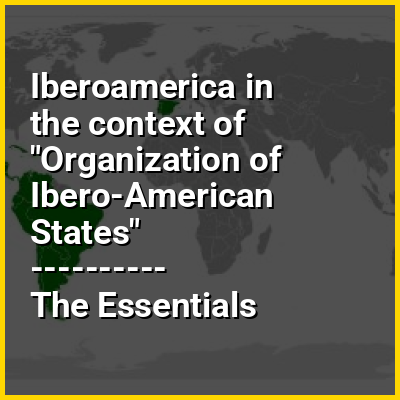
Ibero-America (Spanish: Iberoamérica, Portuguese: Ibero-América) or Iberian America is generally considered to be the region in the Americas comprising countries or territories where Spanish or Portuguese are predominant languages (usually former territories of Spain or Portugal). Spain and Portugal are themselves sometimes included in some Ibero-American diplomatic circles, such as the Ibero-American Summit and the Organization of Ibero-American States. The Organization of Ibero-American States also includes Spanish-speaking Equatorial Guinea, in Central Africa, but not the Portuguese-speaking African countries. The Latin Recording Academy, the organization responsible for the Latin Grammy Awards, also includes Spain and Portugal as well as the Latino population of Canada and the United States in their definition of Ibero-America.
The prefix Ibero- and the adjective Iberian refer to the Iberian Peninsula in Europe, which includes Portugal and Spain. Ibero-America includes all Hispanic American countries in North, Central, and South America plus the Hispanophone Caribbean, as well as Portuguese-speaking Brazil. Ibero-America makes up the overwhelming bulk of and is synonymous with the common definition of Latin America, but is differentiated from the expanded definition of Latin America by the exclusion of the French-speaking country of Haiti, the French overseas departments of French Guiana, Guadeloupe and Martinique, and the French collectivities of Saint Barthélemy and Saint Martin, which are sometimes included in a few definitions of Latin America. Belize and Guyana, whose official language is English, and Dutch-speaking Suriname, Aruba, Bonaire, Curaçao, Saba, Sint Eustatius, and Sint Maarten are usually not considered to be either Ibero-American or Latin American.