Hyperboloid structure in the context of "Water tower"

Play Trivia Questions online!

or

Skip to study material about Hyperboloid structure in the context of "Water tower"


⭐ Core Definition: Hyperboloid structure

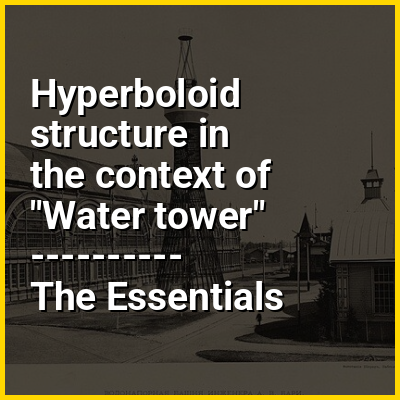
Hyperboloid structures are architectural structures designed using a hyperboloid in one sheet. Often these are tall structures, such as towers, where the hyperboloid geometry's structural strength is used to support an object high above the ground. Hyperboloid geometry is often used for decorative effect as well as structural economy. The first hyperboloid structures were built by Russian engineer Vladimir Shukhov (1853–1939), including the Shukhov Tower in Polibino, Dankovsky District, Lipetsk Oblast, Russia.

↓ Menu

In this Dossier

Hyperboloid structure in the context of Cooling tower

A cooling tower is a device that rejects waste heat to the atmosphere through the cooling of a coolant stream, usually a water stream, to a lower temperature. Cooling towers may either use the evaporation of water to remove heat and cool the working fluid to near the wet-bulb air temperature or, in the case of dry cooling towers, rely solely on air to cool the working fluid to near the dry-bulb air temperature using radiators.

Common applications include cooling the circulating water used in oil refineries, petrochemical and other chemical plants, thermal power stations, nuclear power stations and HVAC systems for cooling buildings. The classification is based on the type of air induction into the tower: the main types of cooling towers are natural draft and induced draft cooling towers.

↑ Return to Menu

Hyperboloid structure in the context of All-Russia Exhibition 1896

The All-Russia industrial and art exhibition 1896 in Nizhny Novgorod was held from May 28 (June 9 N.S.) till October 1 (13 N.S.), 1896. The 1896 exhibition was the largest pre-revolution exhibition in the Russian Empire and was organized with money allotted by Nicholas II, Emperor of Russia. The All-Russia industrial conference was held together with the exhibition.

↑ Return to Menu

Hyperboloid structure in the context of Lattice tower

A lattice tower, or truss tower, is a freestanding vertical framework tower. This construction is widely used in transmission towers carrying high-voltage electric power lines, in radio masts and towers (both self-radiating towers and those that support aerials) and in observation towers. Its advantage is good shear strength at a much lower weight than a tower of solid construction would have as well as lower wind resistance.

In structural engineering, the term lattice tower is used for a freestanding structure, while a lattice mast is a guyed mast supported by guy lines. Lattices of triangular (three-sided) cross-section are most common, particularly in North America. Square (four-sided) lattices are also widely used and are most common in Eurasia. A lattice towers is often designed as either a space frame or a hyperboloid structure.

↑ Return to Menu

Hyperboloid structure in the context of Vladimir Shukhov

Vladimir Grigoryevich Shukhov (Russian: Влади́мир Григо́рьевич Шу́хов; 28 August [O.S. 16 August] 1853 – 2 February 1939) was a Russian and Soviet engineer-polymath, scientist and architect renowned for his pioneering works on new methods of analysis for structural engineering that led to breakthroughs in industrial design of the world's first hyperboloid structures, diagrid shell structures, tensile structures, gridshell structures, oil reservoirs, pipelines, boilers, ships and barges. He is also the inventor of the first cracking method.

Besides the innovations he brought to the oil industry and the construction of numerous bridges and buildings, Shukhov was the inventor of a new family of doubly curved structural forms. These forms, based on non-Euclidean hyperbolic geometry, are known today as hyperboloids of revolution. Shukhov developed not only many varieties of light-weight hyperboloid towers and roof systems, but also the mathematics for their analysis. Shukhov is particularly reputed for his original designs of hyperboloid towers such as the Shukhov Tower.

↑ Return to Menu

Hyperboloid structure in the context of Didcot Power Station

Didcot power station (Didcot B Power Station) is an active natural gas power plant that supplies the National Grid. A combined coal and oil power plant, Didcot A, was the first station on the site, which opened in 1970 and was demolished between 2014 and 2020. The power station is situated in Sutton Courtenay, near Didcot in Oxfordshire, England. Didcot OCGT is a gas-oil power plant, originally part of Didcot A and now independent. It continues to provide emergency backup power for the National Grid.

A large section of the boiler house at Didcot A Power Station collapsed on 23 February 2016 while the building was being prepared for demolition. Four men were killed in the collapse. The combined power stations featured a chimney, demolished in 2020, which was one of the tallest structures in the UK, and could be seen from much of the surrounding landscape. It previously had six hyperboloid cooling towers, with three demolished in 2014 and the remaining three in 2019. RWE Npower applied for a certificate of immunity from English Heritage, to stop the towers being listed, to allow their destruction. In February 2020, the final chimney of Didcot A was demolished.

↑ Return to Menu